Mostrando entradas con la etiqueta History. Mostrar todas las entradas
Mostrando entradas con la etiqueta History. Mostrar todas las entradas
viernes, 21 de septiembre de 2018

jueves, 23 de agosto de 2018
Book Review of Rabid: A Cultural History of the World's Most Diabolical Virus
 Rabid: A Cultural History of the World's Most Diabolical Virus
By: Bill Wasik and Monica Murphy
Why I Got This Book: This book popped up in my recommended book in list in my audible acount and I got it just out of curiosity.
Central Thymes:
• This Book is about is about the history of the interaction of humanity as a species with the Rabbis virus and its particular impact on our culture. But the book also does focus on some other sickness that humans also get from Animals, which the authors mention that 50% of all human sicknesses come from other animals.
• Among the many animals, rabbis can infect some of the most common are dogs, bats, skunks, rats, and raccoons, elevating their levels of aggression leading to more potential attacks which through bites the virus spreads, and it can cross from one species to another easily.
• Approximately 50.000 people per year die of Rabbis, mostly in countries where it is difficult to access the vaccines and modern medicine that help stop the virus from taking hold because once it reaches the brain the sickness has pretty much a 100% death rate. Mass vaccination campaigns for dogs (mass castration also helps) to eradicate the sickness does not get any traction in the developing countries because of a lack of political motivation, authorities mostly only take action when its too late and there is an outbreak like in the old Soviet republics, southeast Asia and Africa, many times there is a total lack of sanitary policy and protocols if there is an outbreak. But richer countries by no means are immune to a large-scale outbreak even New York city had to deal with a hoard of rabid raccoons a couple of years back in 2010.
• Rabbis mostly found its way into human society because of the domestication of Dogs, who are the perfect host for this particular virus and this sickness sparks a special fear in people because its potencially their best friends can become their harbinger of death from one moment to another. Outside of the danger of death Rabbis was perceived as a sickness that brings out the inner evil animal from inside.
• Most visible symptom hydrophobia.
• Louis Pasteur developed the vaccine against rabbis, but the book really makes sure to show the reader how important too since Pasteur was creating the pasteurization proses, a vaccine against anthrax for animals and creating a model for centers of investigation that would reach a global level.
• Book illustrates how rabbis have had a tremendous impact on human culture from all the way back to Egypte, ancient Greece, Babylon and even India, this sickness appears in all kinds of ancient text, found its way into mythology and language influencing the creation of words relative to rage and anger. Even in the more modern time rabbis served for inspiration for some very famous monster like werewolves, vampires and to a degree zombies. The bite is the mode of transmission of rabbis and the way these monster created new ones. And in the case of vampires, there is an aspect of hypersexuality related to these characters that sometimes is a symptom of rabbis, even their aversion to holy water can be linked to hydrophobia. But what the book illustrates is how the fear of rabbis like other pandemics feeds into the concept of the undead, because once someone was infected by rabbis literally they were walking dead.
• All Zoonotic diseases like Rabbis, Smallpox, the Bubonic Plague... like many others thrived with the growth of cities.
What I liked :
• The book itself is a very easy read, very interesting and dynamic at the same time, it got me hooked on a subject that I would not be normally drawn to, and thanks to the fact it straight to the point I finished it in about a week.
• Each chapter covers a specific moment in history and talks about myths and stories from that era that were fueled by rabbis.
• I found fascinating that the new testament and early Christians had a poor view of dogs which had a cultural impact heading into the dark ages.
• I found it very interesting that early myths relative to vampires had no relation t bats, but when vampire bats were discovered in America, rabbis in a way bridges the gap between these monsters and animals, incorporating bats into the vampire mythology, originally vampire would change into dogs.
• Book dive into the evolution of dogs as pets all ready in ancient Greece and in the middle ages the nobility and clergy really appreciated dogs because of the role in the hunt, while peseants had a more negative view of K9s having to deal with semi wild dogs, rabid dogs and during the plague seeing dogs eat corpses that is way bodies are buried 6 feet under. But during the industrial revolution and the slow growth of a middle class having dogs as pets became much more generalized.
• The book goes into great detail how Pasteur created his vaccine against rabbis.
What I didn't like or Debatable Stuff:
• The book at brief moments gets a little gory and explicit.
• The book goes relatively off topic a couple of times focusing on other Zoonitic diseases.
Overall: The book gets a 9 out of 10, it gets you thinking
miércoles, 15 de agosto de 2018
The Internet of Things, the Collaborative Commons, and the Eclipse of Capitalism (2014)
By: Jeremy Rifkin
 Why I Got This Book: It's pretty curious that I was drawn to a book that is essentially a publication about economic issues, something I normally stay away from, but after watching Rifkin in a youtube video on the Big Think channel pushing this book and I was fascinated by the central premise of the book which I'm going to share with you guys the thing I found most interesting and I understood, because economy is feild I understand too much.
Central Thymes:
• The future of Capitalism for Rifkin is a new evolved system a hybrid economy fusing capitalism and collaborative commons. The collaborative commons ( CC) actually predates the representative government and the capitalist market, these social entities formal and informal groups enrich society with its social capital. The CC uses common resource agreed amongst the members to be used collectively, in a democratic fashion. These communes find their genesis in Feudal European society. This system produces a fascinating economic actor the prosumer and redefines private property. Jeremy establishes the Prosumer and collaborative vs Investors and capitalist.
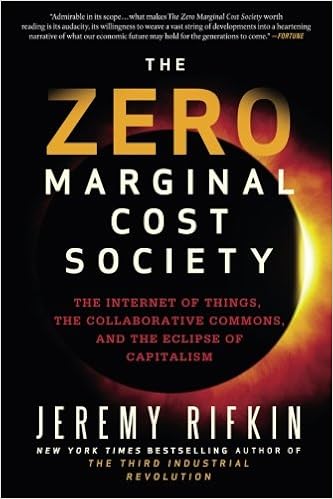 • The Internet of Things (IOT) will usher in the change to the economic paradigm, which is composed of a communications internet, a logistics internet, and an energy internet. This will push capitalist economy which is based on scarcity, will convert and give way to an economy of abundance.
 • The ever growing trend of sharing goods is taking a deep cut into the retail sector.
• Author implicitly implies that technological innovation is the true motor of history, which is a very interesting and provocative way of viewing history.
• Coal leads to steam power and the first industrial revolution, with this new energy matrix brought forth, steam printing making information more accessible and generated the need of a public school system to learn how to read and become professionals that industry needed, steam trains which compressed time and space and one fundamental aspect they were dependable. Also, the creation of a national postal service and trains quickened commercial transaction. Later the advent of the telegraphy accelerated this proses even more.
• In the second industrial revolution was fueled by oil which need high skilled professionals and lots of financial capital, created a new communication matrix with the invention of the internal combustion engine leading to cars and the construction of highway system, which made many people start to move out of cities into suburban lives, especially with electricity becoming more available.
• The end of the age of privacy and transparency across the board will become the norm. Privacy was a product of capitalism by a life behind closed doors, enclosures and privatization left people fenced off against the world.
• 3 D printers are game changers in the world of manufacturing, the first being open sourced, as they evolve the become more efficient versatile in what the can create and produce much less waste compared to traditional manufacturing. But the most interesting aspect of this invention that thanks to prosumers the cost per unit dropped from 30.000 dollars in 2002 to 1.000 in 2017. It one of the few inventions in the world that it is self-sustainable because it can print its own parts. With inventions like the 3 D printer worker can become owners, consumers into prosumer, with less need to commute to work there for less use of vehicles leading to the decompression of highly dense urban core, people of the future will have less need to cluster.
• What we call globalization was basically just a phase where the government decided to deregulate international trade and push for the privatization of public services, wrapped in the promise of global connectivity, but the whole process was at the service of privet enterprise, so the author establishes that the Global Commons is something different to Globalization.
• Cooperatives are major players in the CC, they are none profit are more efficient than the State because they work at a ground level capitalizing on lateral power, and work even better if the State gives it a hand, the book explains how electricity reach every corner of the United State because of the work of Cooperatives. In Europe, Cooperative are pushing the growth of the use of clean energies.
• Self-driven vehicles that will be a reality sooner than later are another game changers revolutionize human transport and the transport of goods, being a fundamental part of the IOT, once integrated the cost of transport will drop and become much more efficient.
What I liked :
• Author dives deep into the evolution of Capitalism from a very interesting and unique perspective.
• Fascinating affirmation that the downfall of Capitalism as we know is a product of its owns downing a natural evolution being push by the progress of cutting edge technology. What I like about the book is an alternative narrative to the end of capitalism, which is pretty much an obsession of the hard left with a revolution against the system and watching it crash and burn. Rifkin illustrates a mutation of traditional capitalism, but I must mention that the transition phase seems to be pretty complicated on a social level, with the growth of unemployment which can lead to social unrest.
• I found it interesting how the author gets into the evolution of privet property, where basically the encloser movement ushered the concept of property pushing the peasants off the land transformed them into free agents, while at the same time the early phases of the industrial revolution and the market economy, lead to legal protection of property and the right of ownership. This spawn the need for more police and courts.
• Rifkin explains that companies that own and ran the train are the first modern cooperation, where the owner does not presuppose management, that need highly trained professional and high level of investment that took time to reap the gains.
• The book gets into the end a privacy as we know it, and this is something we are dealing with now how every aspect of our lives can be scrutinized from the internet, each person leaves a pretty big digital footprint and much of the information we have given away for dumping all kinds of information in social media pages.
• Cars are the ultimate enclosure for the previous generation it was a sign of economic maturity for the economic actor, I was totally surprised of the fact that sharing cars is a thing now, which leads to less carbon emission and fewer cars on the road.
•
What I didn't like or Debatable Stuff:
The book repeats its self to much and drags in certain parts, I stopped reading it twice.
It hard to debate to many things in this books because I'm not an economist, but I must say that the author mentions how all of these inventions will revolutionize manufacturing and impact tremendously in the labor market, but totally glosses over the social unrest the transition phase can potentially have.
Overall: The book gets an 8 out of 10, it gets you thinking.
martes, 12 de junio de 2018
martes, 30 de agosto de 2016
Book Review and Analysis: The Lost Wonders of the World, a Brief History of Cultural Catastrophes of Civilization. (2012) Fernando Baez Work in progress

Author: Fernando Baez
My Personal Expectation with de Book ( Basically why I Picked it up.): I went and bought this book at my local bookstore because
I really enjoyed another book from this author, called the History of Books (Note that I have already reviewed), hoping that this new book would answer some questions
that Baez left unanswered or presupposed in his History of Books, so I can get a
better idea of Baez's historical views.
Central Thymes
and Concepts, that interested me as the reader:
The book is at its best when the author talks about his personal
experiences he really adds a very interesting perspective, it's not your
ordinary history book, you can tell he's a super dedicated investigator, that
cares for his object of study in a good way.
Author establishes that 50% of humanities collective memory has been
lost.
and Baez affirms that the driving force for this book is the fear of forgetting and it's consequences, on a personal level and as a spices.
and Baez affirms that the driving force for this book is the fear of forgetting and it's consequences, on a personal level and as a spices.
Baez defines civilization, as a plural society that
is complex and is interconnected by a series of cultural norms, is tied to a
tradition, language and religion, creating a collective identity.
There is no civilization without culture, this is one of the main
starting points for anthropology, and civilization for archeologist there is no civilization if these four components are not
found: city, writing, religion and division/specialization of tasks/labor.
But a civilization decline over time and some disappear for diverse
reasons, and this book analysis in detail many historic cities, monuments and
wonders that are gone, because they were destroyed by war, built over, lost thanks
to natural disasters, in some cases completely forgotten...
The Neolithic era which mean new rock, was characterized with many
advancements for our species domestication of plants, like cereals, and
animals, and also a urban revolution, sedentary life gave way to accumulation
on information and knowledge and the search for group security, set forth the
evolution for the birth of civilization.
Even though the has been very extensive archeological work in the
region of Mesopotamia the author establishes that it's possible that we have
only uncovered about 50% , and he mentions that they haven't been able to find
yet the city of Dilmun mentioned in the epic poem of Gilgamesh, city that
may have inspired the word paradise that etymologically means inside walls or
walls all around. Now I find it fascinating to think for the first humans to
live in a city to have security gave man peace of mind to be able to developed
and evolve culture.
The author talks about the 6 wonders of the ancient world, establishing that no one truly knows who established this list, that possibly it was a poet by the name Calimaco of Cirene, the original six where the Pyramids of Giza, statue of Zeus, the Colossus, the Mausoleum and the Palace of Artemis
The Seven wonders took form over time, and Baez explains that basically the Greek liked seven more, and they changed over time until we get the one that we have now.
Baez affirm that language is a prosthesis of memory and a fundamental
aspect to any culture, from what I understand from the author's work langue is a extension
of a collective memory and it's a means to access it.
So for the author lost/dead languages are the evidence that a collective memory has been lost. There
are 6800 languages and 3000 are on the verge of being lost, since 1950 humanity
has lost 200 languages, 96% of all the languages of the world are only spoken by 4% of the world's
population.
Better langue skill gave humans the upper hand of the Neanderthal,
be able organize calendars to hunt y collects food. The first writing
appeared 4000 years b.C. In Europe but not much is known about this first
writing system so the author jumps to cuneiform a subject that he works on in
his book the history of books.
The Good stuff about the book itself and some interesting facts that learned from it:
When talking about Egypt the author is pretty blunt by expressing how European countries stole as much as they could put their hands on, even a whole obelisk of Luxor that was taken to France as a trophy.The temple of Luxor was used as a roman military base, many years latter a mosque was built in part of the temple called Abu el Hagad, and Christians stole blocks from the structure to build Churches, and it estimated that only 40% of the original temple is left.
The book gets right to business nice and quick, the introduction
establishes what the author wants to do, defines the principal terms and explains
on a personal level why this subject is important.
The city States Uruk and Ur where the place of origin of many
inventions like the wheel, writing, books, libraries, archives, maps, codes of
law, the chariot, epic tails like the Poem of Gilgamesh, the idea of a
lost paradise, seven day week, the twelve month year, astronomical guides.
Modern day Ur the place where Abraham was born is now called Tell al
Muqayar. Ur was founded 4000 b.C. by the Obeid and one of their lasting
constructions is the Zigurat, now the book has a photo of one of these and
it's a colossal construction I really wonder why I haven't ever seen it in any
documentaries, and I love to see them, these things are just as relevant as the
Egyptian pyramids, culturally they are sort of swept under the rug for some
unknown reason to me.
Baez present the reader with something really sad the fact that in
2003, the US soldiers actually stole clay bricks from Ur monuments and
graffitied some of them. Also Iraq's national museum was looted 25 objects of
importance and 14 thousand less important artifacts were stolen, they
even stole some of the science gear and things needed to preserve archeological
artifacts. The author really opens this can of worms that is fascinating and very
sad ( Note Baez has a book dedicated to the subject), now I always wondered why
would the Bush Administration commit such a colossal blunder in not protecting
such important things to the human patrimony. But I'm just being stupid because
this administration couldn't even prepare the most basic aspects of that war.
When talking about Egypt the author is pretty blunt by expressing how European countries stole as much as they could put their hands on, even a whole obelisk of Luxor that was taken to France as a trophy.The temple of Luxor was used as a roman military base, many years latter a mosque was built in part of the temple called Abu el Hagad, and Christians stole blocks from the structure to build Churches, and it estimated that only 40% of the original temple is left.
When Fernando talks about Biblios he has a particular fondness for the place that he also expresses this in his book "The History of Books". Reading this part of the book is great because it personal for him and he seems to have really enjoyed his trip there and what he had learned there.
Now in Biblios is the place where alphabet was created around 1060 b.C which the Greek copied for their own writing system, but the author mention that about 95% of the original alphabet has been lost over time.
In Petra the author tell another personal story about his travels to that historic site and how he was infuriated when a local guide tried to sell him a priceless archeological object made by the Nabateans the creators of Petra.
The Tower of Babel mentioned in the bible is refrenced by Baez, the author explains that the story might have its origen
in a Sumerian tale of Enmerkar the lord of Aratta, that thanks to Eridu
humanities original langue was divided into many. The bible establishes that
Nimrod was the one that built the Tower of Babel but it
was really made by Nabucodonosor II, that also used Jewish slaves to create the
Zigurate of Etemenanki in 575 b.C. The tower was a watch tower about 90 meters
tall.
Author also references that Noah's ark story also having a Sumerian
origin, establishing that there is cuneiform tablet of Ninive, that mentions a
great flood and was part of the poem of
Gilgamesh, basically it's a story of a man that survives a flood that was sent
against the city of Shuripak, and that had to build a boat in the form of a
cube that had seven floors. In another epic poem Atra-has
in Greek mythology Zeus also flooded the earth in anger and boat built by Deucalion, king of Tesalia to survive the tragedy with his wife.
in Greek mythology Zeus also flooded the earth in anger and boat built by Deucalion, king of Tesalia to survive the tragedy with his wife.
The temple of Salomon orTemple of Jerusalem, also known as Beit Hamikdash, has had three incarnations.First temple was built during the fourth year of the regime of Solomon, this
building goes back to X b.C and had help from the king of Tiro
Hiram, and wood was a big part of the structure, it was the center of the Jewish
physical and spiritual world. The Arc of the
Covenant was kept there with the Ten Commandments. In 586 temple was destroyed by Nabucodonosor who made the Jewish people his
slave and took them to Babylon. The Jewish people had to wait till Ciro of
Persia liberated them in 538. The second temple was built with the help of the Persians, but was left
incomplete because Antioco IV Epifanes attacked and enslaved many Jewish people
and destroyed the temple and imposed the cult to Zeus in 168 b.C. In both cases
the Archeologist have never found
phisical evidence of the original two temples they have been lost in
time.
Now the third temple is the legacy of one of the most
hated men in Jewish history Herodes the great, governor that's severed the
Romans, he built the new temple as a gesture to the Jewish people, and in the
year 70 roman soldiers set fire to the
temple as payback for the Jewish rebellion of the Zealots.
Baez presents some shoking numbers from Second World War, that the Germans devastated 1710 cities, 70000
towns and villages, destroyed 6000000 historical buildings, they explicitly
tried to inflict as much damage on their adversary as possible sending 4
billion euro on the conflict. They also stole 5 million cultural objects. Author also mention that the Nazi deliberately attacked
libraries and archive building, but refers to another one of his books that's about this subject published in
2004.
.
.
The Bad:
Book lacks a little balanced the author dedicates a lot in pages to cities and historical monuments, but very
little to langue and art, it feels almost tacked on, he could have left this a
out and put this info in another book.
Overall: I'll give this book a 9.5out of 10, it's a great and easy read, I ate it up and finished it really fast becasuse of how much I liked it and I can't wait to get my hand on another book by this author.
Suscribirse a:
Entradas (Atom)