Mostrando entradas con la etiqueta Science. Mostrar todas las entradas

jueves, 23 de agosto de 2018

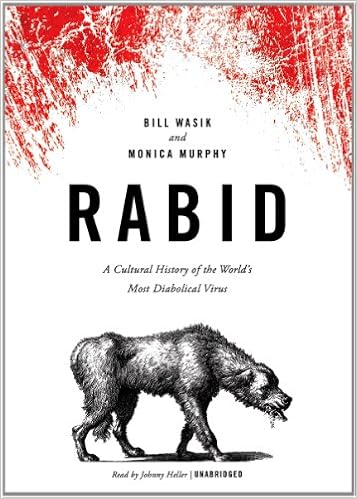
Book Review of Rabid: A Cultural History of the World's Most Diabolical Virus


Resultado de imagen para Rabid: A Cultural History of the World's Most Diabolical VirusRabid: A Cultural History of the World's Most Diabolical Virus

By:  Bill Wasik and Monica Murphy
Why I Got This Book: This book popped up in my recommended book in list in my audible acount and I got it just out of curiosity.

Central Thymes:   
•   This  Book is about is about the history of the interaction of humanity as a species with the Rabbis virus and its particular impact on our culture.  But the book also does focus on some other sickness that humans also get from Animals, which the authors mention that 50% of all human sicknesses come from other animals.
•    Among the many animals, rabbis can infect some of the most common are dogs, bats, skunks, rats, and raccoons, elevating their levels of aggression leading to more potential attacks which through bites the virus spreads, and it can cross from one species to another easily.
•    Approximately 50.000 people per year die of Rabbis, mostly in countries where it is difficult to access the vaccines and modern medicine that help stop the virus from taking hold because once it reaches the brain the sickness has pretty much a 100% death rate. Mass vaccination campaigns for dogs (mass castration also helps)  to eradicate the sickness does not get any traction in the developing countries because of a  lack of political motivation, authorities mostly only take action when its too late and there is an outbreak like in the old Soviet republics, southeast Asia and Africa, many times there is a total lack of sanitary policy and protocols if there is an outbreak. But richer countries by no means are immune to a large-scale outbreak even New York city had to deal with a hoard of rabid raccoons a couple of years back in 2010.
•    Rabbis mostly found its way into human society because of the domestication of Dogs, who are the perfect host for this particular virus and this sickness sparks a special fear in people because its potencially their best friends can become their  harbinger of death from one moment to another.   Outside of the danger of death Rabbis was perceived as a sickness that brings out the inner evil animal from inside.
•    Most visible symptom hydrophobia.
•    Louis Pasteur developed the vaccine against rabbis, but the book really makes sure to show the reader how important too since Pasteur was creating the pasteurization proses, a vaccine against anthrax for animals and creating a model for centers of investigation that would reach a global level.
•    Book illustrates how rabbis have had a tremendous impact on human culture from all the way back to Egypte, ancient Greece, Babylon and even India, this sickness appears in all kinds of ancient text, found its way into mythology and language  influencing the creation of words relative to rage and anger. Even in the more modern time rabbis served for inspiration for some very famous monster like werewolves, vampires and to a degree zombies. The bite is the mode of transmission of rabbis and the way these monster created new ones. And in the case of vampires, there is an aspect of hypersexuality related to these characters that sometimes is a symptom of rabbis, even their aversion to holy water can be linked to hydrophobia. But what the book illustrates is how the fear of rabbis like other pandemics feeds into the concept of the undead, because once someone was infected by rabbis literally they were walking dead.
•    All Zoonotic diseases like Rabbis, Smallpox, the Bubonic Plague... like many others thrived with the growth of cities.
   
What I liked :
•    The book itself is a very easy read, very interesting and dynamic at the same time, it got me hooked on a subject that I would not be normally drawn to, and thanks to the fact it straight to the point I finished it in about a week.
•    Each chapter covers a specific moment in history and talks about myths and stories from that era that were fueled by rabbis.
•    I found fascinating that the new testament and early Christians had a poor view of dogs which had a cultural impact heading into the dark ages.
•    I found it very interesting that early myths relative to vampires had no relation t bats, but when vampire bats were discovered in  America, rabbis in a way bridges the gap between these monsters and animals, incorporating bats into the vampire mythology, originally vampire would change into dogs.
•    Book dive into the evolution of dogs as pets all ready in ancient Greece and in the middle ages the  nobility and clergy really appreciated dogs because of the role in the hunt, while peseants had a more negative view of K9s  having to deal with semi wild dogs, rabid dogs and during the plague seeing dogs eat corpses that is way bodies are buried 6 feet under.  But during the industrial revolution and the slow growth of a middle class having dogs as pets became much more generalized.  
•    The book goes into great detail how Pasteur created his vaccine against rabbis.
What I didn't like or Debatable Stuff:
•    The book at brief moments gets a little gory and explicit.
•    The book goes relatively off topic a couple of times focusing on other Zoonitic diseases.

Overall: The book gets a 9 out of 10, it gets you thinking

martes, 17 de mayo de 2016

Diego Golombek The Neurons of God.


Diego Golombek
The Neurons of God.

So today I Bring you this very intriguing Book from Argentinean Biologist and author Diego Golombek, that has a talent in presenting some pretty complicated scientific stuff in a very light hearted and interesting way, just trapping the reader and in many ways similar to Theoretical Physicist Michio Kaku books.
This books start with an introduction, that for some reason the author calls "This Book (and This Collection), and this part of the book does exactly what's it should, establishing what the author want to do and which direction the book will go, he starts off  briefly explaining his personal experiencing with religion and how he became a man of science, and he uses this exposition to jumps straight to the conflict between Science and Religion, reason vs. Faith. and Diego wastes no time, already  on page 12 he establish a very interesting question: Can there be a Science of Religion? Or Better said a Neurocience of  religion, Is it hard wired in our brains? that why the notion of God or religion never ceases to exist our societies.


Central Thymes and Concepts:


  • In chapter 1 the author makes the point, that in his premise of the science of God, is not to attack the literal interpretations of the Bible or religious figures of many faiths, he establish that beliefs need foundational myths to survive over time and it not the focus of the book trying to study this aspect of faith.
  • In the first part of the book the author  concentrates on  the possibility that religion is universal and is it innate in us, so one of his objective is to analyzes from where  do these beliefs come from,  why have we evolved with this hardwired in our brains. So the author asks a big question ¿is Religion a natural phenomena?,¿ part of our Evolution?, is Universal among humans like langue. ¿Or is it universal but not innate?, eminently cultural, so you would have to learn it.
  • Now Diego explains that religious beliefs may have their genesis in Type 1 errors or false positives, a exaggerated inclination to seeing things that are not there, but during our evolution this may have kept us safe and alive.

    • Then the author bring up the concept of spandrels, which surprised me because I had recently read a book by Francis Fukuyama of State Theory that, brings up the same concept. So what is a  Spandrel? It's actually related to construction and cathedrals, but in the social word it means that some that is made or thought of for one purpose, end up being very practical for something else. Te author establishes that many human social qualities are spandrels from our evolution, now the author ask if religion is a spandrel from some other neurological function that help us survive a species.
    • Golombek then starts to analyze death rituals, as a possible starting point for religions, but human are not alone in this field, Neanderthal also had death rituals like other mammals like dolphins, elephants and chimpanzees, now the author does ask this but it's ¿valid are they religious? , do they have the potential of being so (a investigation for another day). But the author does explain that being conscious that one can die, but this can actually be an issue, fear can paralyze us, so basically  human culture come in to removes this fear by establishing death is not the end just a passage to the other side, at least symbolically, helps us deal with his fear.

    • Author makes  and interesting affirmation that people of faith, have less options when confronted with moral dilemmas, and their belief tend to establish a courses of action, alleviating the burdens of having to chose or to second guess, I actually use this same affirmation for ideology when one has to take a political action, you know Golombek should make a Neuroscience of politics and see if religion and science have any relationship on a neurological level. So having faith actually has a positive impact  on the believer in combating stress and anxiety. 
    • Faith adds cohesion to a group, and I would add identity + social capital, the concept of sacrifice helps root out the opportunist, in a way the benefits  aren't free in being part of a Religious community, there are obligations,  group praying, dietary obligations, only marrying certain people... The author makes the interesting  observation the  more difficult the obligations, stronger is the unity of the group.  And from my point of view this can take things to another level when members of a faith are willing to commit suicide in the name of their faith.
    • So Diego reaches to a preliminary conclusion that religion in a way makes us feel good, this voluntary dance with ignorance gives the believer control over the cosmos, but it also gives the community a strong level of unity.
    • The author establishes that morality is also to a certain entente also hard wired into our brains, and in some cases it secures our survival.
      • Now this is fascinating the author establishes that all immoral behavior can find its origin in revolution and disgust, referring food and in a later stages hygiene specially sexual,  it does make sense because religions tend to have many norms on these to subjects. And its later stage moral disgust when you repute a act of some in the community. Now let's get back to talking about food, eating correct thing that's in good conditions is related to our evolution and our survival, and is related to morality, but I can add from something that I remembered from Fukuyama eating was always a social phenomena, man never ate alone the tribe would always get together and eat and leave nothing, even invite others from other tribes, so I guess many social norms and rituals come from fusing these two concepts.
        • Author affirms being religious can be hereditary, now how it's manifested depends on cultural context in adults. What we inherited is the will to believe, now the author head into the concept of the god gen, or VMAT2 ( vesicular monoamine transporter 2). Dean Hamer was the one responsible for discovering this gen, now he affirms that the concept of transcendence of one self, found in most faiths and belief systems, is hereditary, now VMAT2 controls the activity of the neurotransmitters in our brain, especial the ones related with our mood and personality, Hamer explains optimistic people tend to have more children, they leave more decendence, now this god gen seems to affect our capacity of abstraction and our ability to focus, but the author establishes even thought the studies on VMAT2 are interesting it relationship with religion is in it very early stages of Analysis. Note the concept of transcendence is related with spirituality.
          But the author establishes that one gen can't determine  mood or state of mind, normally it a group of them, VMAT2 depending in its composition can give us minor predisposition, but Hamer  affirms that spirituality is a state of mind, a personal experience, while religion is a institutional manifestation of that state, that is not found in no gen.
        • In another study in the University of  Karolinska found that a particular serotonin receptor called 5-HT1A, possibly had a relationship with levels of spirituality, the more religious the person is less active is his 5-HT1A.
          • In another study a receptor of dopamine D4 show certain variations between people of different level o f faith. But none of these study have been replicated or verified, Hamer publish his finding in a book not in scientific paper.
          • Many ritual that try to reach spiritual ecstasies have many similarities between each other, like being set in a context to recessive god, collective  prayers, repetition, monotone chanting or singing or dancing.
            The religious experience is composed of to factors the will or need to believe and  the right context for the divine to happen. It isn't the same a session of Ayahuasce with music or praying in church with the right acoustics. P 191 believers go to great lengths to create the right moods or atmosphere, so god can show up, everything has to be in the right place.


The Good stuff about the Book:

  • Book is well written and generally pretty accessible.
  • References that are put at the bottom of the page as foot notes, and not at the end of the chapter or the end of the book, I personal like this much more becuase you don't waste time looking for them.
  • Author loves using foot notes. There tons of interesting stuff there, at moments he puts some of personal thoughts in there.
  • Tons of references to pop culture, author  reminds me of Michio Kaku's book, for example he  actually references  M. Night Shyamalan movie Signs, explaining false positives and false negatives.
  • Author affirm that religion is a universal phenomena, while science isn't, science helps us progress as a species religion helps us dream give us a special ego that we are more than what we are so we strive and dream.


Interesting stuff:
  •  The Agriculture, sedentary life, population growth, sickness... Made it necessary the invention of the cemetery, there were social and practical need for them ,  death was very present early man needed to deal with their fragile existence, a poorly disposed corps could bring sickness  to a community if not dealt with correctly, like contaminate water sources.
  • The author citing Richard Dawkins he establishes that " religion isn't the source of morality,  but it is the base and the excuse to justify immoral acts". I'm not on the same page of the affirmation but it a point that many people that are critical of religion have.

  • Then Golombek  makes a reference to Charles Darwin who thought the Religion was Universal and had a hypothesis that faith added internal cohesion and organization to groups, giving them an edge against other groups of humans.
  • Diego establishes that there is a interesting relationship between epilepsy and Holy men/prophets, that the Greek called this condition the sacred sickness,  and the author goes into the main topic  how this disorder in one neurons produced on many occasions illusion that could  be interpreted as a signs of god, like other mental illnesses.
    • Golombek explains something super. Interesting that epilepsy con cause profound religious conversions.
    •  Author tell a interesting story about Moses that  didn't  go up the mountain on his own, but with a group that went up with him including  his brother Aaron , with his sons Nadab y Abihu and 70 others, but God ordered halfway up the should stay and he go the rest of the way but these people were differentiated from the rest becoming a new social cast of priest, a hereditary dynasty called the Cohanim, this name changed over the year into Cohen, Cohan, Cogan, Kahane, Kogan...so genetically they all most have a common ancestor but when they studied their genetic make surprisingly it was discovered they had in part, decendence from Arabs, Golombek reminds the reader that Abraham had children Isaac that would be considered the lineage of the Jewish people and Ismail to considered the founder of the lineage that would become Islam, so in a way there is some truth that these two people have a common decendence.


The Bad:

  • Diego does look over some social origins of religion it much more sophisticated then what he presents especially leaving the political aspect out of it, many early belief systems  revolved around the cult of the ancestor that gave identity to the tribe or clan, that had heavy political implications.
  • Author at moments doesn't differentiate morality from ethics, at moments he uses the concepts indifferently.
    •  Author cites Richard Dawkins too much, I know he's a reference in scientific community but he isn't the only one, maybe some Sam Harris.
      • Author right off the bat establish that among many famous historical figures Joan of Arc, Mohammed and Saint Paul had epilepsy, but without explaining how he reached the conclusions or referencing where did he get this info, in some aspects it makes sense, but it's sloppy on his part.
      • Now  author affirms if religion has a genetic or hereditarily in origin, hid in our brain, in principal it cannot be eradicated. Now I ask the author ¿why should it be eradicated? These types of affirmations that the book is sort of ideologically driven and no as objective that it seems.   
        • There a bit of inbalance between chapter some are to long while other to short, book has no conclusion.
          • Book is kind of let down at the end. The author throws objectivity out the window on the last page establishing that religion is a virus and science is the vaccine, but it's surprising because he s pretty objective during most of  book, even being open minded at moments.
            • Author surprisingly cites very few book in his investigation, about 22, that for a book that touches social issues it pretty short list or this is a red flag that he read only the books that comfirmed his point of view becuase the  becuase titles are mostly anti faith. 
             
Overall I'll give the book a 7 out of ten if you are in to this subject it will get the debate open  your head.

Stayed tuned this is work in progress in the  next weeks I'll update this post, but ¿what are your view on this sudject?