viernes, 21 de septiembre de 2018

jueves, 23 de agosto de 2018
Book Review of Rabid: A Cultural History of the World's Most Diabolical Virus
 Rabid: A Cultural History of the World's Most Diabolical Virus
By: Bill Wasik and Monica Murphy
Why I Got This Book: This book popped up in my recommended book in list in my audible acount and I got it just out of curiosity.
Central Thymes:
• This Book is about is about the history of the interaction of humanity as a species with the Rabbis virus and its particular impact on our culture. But the book also does focus on some other sickness that humans also get from Animals, which the authors mention that 50% of all human sicknesses come from other animals.
• Among the many animals, rabbis can infect some of the most common are dogs, bats, skunks, rats, and raccoons, elevating their levels of aggression leading to more potential attacks which through bites the virus spreads, and it can cross from one species to another easily.
• Approximately 50.000 people per year die of Rabbis, mostly in countries where it is difficult to access the vaccines and modern medicine that help stop the virus from taking hold because once it reaches the brain the sickness has pretty much a 100% death rate. Mass vaccination campaigns for dogs (mass castration also helps) to eradicate the sickness does not get any traction in the developing countries because of a lack of political motivation, authorities mostly only take action when its too late and there is an outbreak like in the old Soviet republics, southeast Asia and Africa, many times there is a total lack of sanitary policy and protocols if there is an outbreak. But richer countries by no means are immune to a large-scale outbreak even New York city had to deal with a hoard of rabid raccoons a couple of years back in 2010.
• Rabbis mostly found its way into human society because of the domestication of Dogs, who are the perfect host for this particular virus and this sickness sparks a special fear in people because its potencially their best friends can become their harbinger of death from one moment to another. Outside of the danger of death Rabbis was perceived as a sickness that brings out the inner evil animal from inside.
• Most visible symptom hydrophobia.
• Louis Pasteur developed the vaccine against rabbis, but the book really makes sure to show the reader how important too since Pasteur was creating the pasteurization proses, a vaccine against anthrax for animals and creating a model for centers of investigation that would reach a global level.
• Book illustrates how rabbis have had a tremendous impact on human culture from all the way back to Egypte, ancient Greece, Babylon and even India, this sickness appears in all kinds of ancient text, found its way into mythology and language influencing the creation of words relative to rage and anger. Even in the more modern time rabbis served for inspiration for some very famous monster like werewolves, vampires and to a degree zombies. The bite is the mode of transmission of rabbis and the way these monster created new ones. And in the case of vampires, there is an aspect of hypersexuality related to these characters that sometimes is a symptom of rabbis, even their aversion to holy water can be linked to hydrophobia. But what the book illustrates is how the fear of rabbis like other pandemics feeds into the concept of the undead, because once someone was infected by rabbis literally they were walking dead.
• All Zoonotic diseases like Rabbis, Smallpox, the Bubonic Plague... like many others thrived with the growth of cities.
What I liked :
• The book itself is a very easy read, very interesting and dynamic at the same time, it got me hooked on a subject that I would not be normally drawn to, and thanks to the fact it straight to the point I finished it in about a week.
• Each chapter covers a specific moment in history and talks about myths and stories from that era that were fueled by rabbis.
• I found fascinating that the new testament and early Christians had a poor view of dogs which had a cultural impact heading into the dark ages.
• I found it very interesting that early myths relative to vampires had no relation t bats, but when vampire bats were discovered in America, rabbis in a way bridges the gap between these monsters and animals, incorporating bats into the vampire mythology, originally vampire would change into dogs.
• Book dive into the evolution of dogs as pets all ready in ancient Greece and in the middle ages the nobility and clergy really appreciated dogs because of the role in the hunt, while peseants had a more negative view of K9s having to deal with semi wild dogs, rabid dogs and during the plague seeing dogs eat corpses that is way bodies are buried 6 feet under. But during the industrial revolution and the slow growth of a middle class having dogs as pets became much more generalized.
• The book goes into great detail how Pasteur created his vaccine against rabbis.
What I didn't like or Debatable Stuff:
• The book at brief moments gets a little gory and explicit.
• The book goes relatively off topic a couple of times focusing on other Zoonitic diseases.
Overall: The book gets a 9 out of 10, it gets you thinking
miércoles, 15 de agosto de 2018
The Internet of Things, the Collaborative Commons, and the Eclipse of Capitalism (2014)
By: Jeremy Rifkin
 Why I Got This Book: It's pretty curious that I was drawn to a book that is essentially a publication about economic issues, something I normally stay away from, but after watching Rifkin in a youtube video on the Big Think channel pushing this book and I was fascinated by the central premise of the book which I'm going to share with you guys the thing I found most interesting and I understood, because economy is feild I understand too much.
Central Thymes:
• The future of Capitalism for Rifkin is a new evolved system a hybrid economy fusing capitalism and collaborative commons. The collaborative commons ( CC) actually predates the representative government and the capitalist market, these social entities formal and informal groups enrich society with its social capital. The CC uses common resource agreed amongst the members to be used collectively, in a democratic fashion. These communes find their genesis in Feudal European society. This system produces a fascinating economic actor the prosumer and redefines private property. Jeremy establishes the Prosumer and collaborative vs Investors and capitalist.
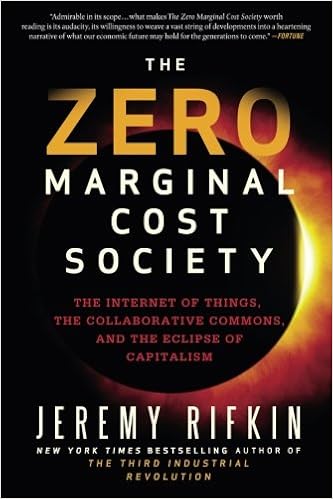 • The Internet of Things (IOT) will usher in the change to the economic paradigm, which is composed of a communications internet, a logistics internet, and an energy internet. This will push capitalist economy which is based on scarcity, will convert and give way to an economy of abundance.
• The ever growing trend of sharing goods is taking a deep cut into the retail sector.
• Author implicitly implies that technological innovation is the true motor of history, which is a very interesting and provocative way of viewing history.
• Coal leads to steam power and the first industrial revolution, with this new energy matrix brought forth, steam printing making information more accessible and generated the need of a public school system to learn how to read and become professionals that industry needed, steam trains which compressed time and space and one fundamental aspect they were dependable. Also, the creation of a national postal service and trains quickened commercial transaction. Later the advent of the telegraphy accelerated this proses even more.
• In the second industrial revolution was fueled by oil which need high skilled professionals and lots of financial capital, created a new communication matrix with the invention of the internal combustion engine leading to cars and the construction of highway system, which made many people start to move out of cities into suburban lives, especially with electricity becoming more available.
• The end of the age of privacy and transparency across the board will become the norm. Privacy was a product of capitalism by a life behind closed doors, enclosures and privatization left people fenced off against the world.
• 3 D printers are game changers in the world of manufacturing, the first being open sourced, as they evolve the become more efficient versatile in what the can create and produce much less waste compared to traditional manufacturing. But the most interesting aspect of this invention that thanks to prosumers the cost per unit dropped from 30.000 dollars in 2002 to 1.000 in 2017. It one of the few inventions in the world that it is self-sustainable because it can print its own parts. With inventions like the 3 D printer worker can become owners, consumers into prosumer, with less need to commute to work there for less use of vehicles leading to the decompression of highly dense urban core, people of the future will have less need to cluster.
• What we call globalization was basically just a phase where the government decided to deregulate international trade and push for the privatization of public services, wrapped in the promise of global connectivity, but the whole process was at the service of privet enterprise, so the author establishes that the Global Commons is something different to Globalization.
• Cooperatives are major players in the CC, they are none profit are more efficient than the State because they work at a ground level capitalizing on lateral power, and work even better if the State gives it a hand, the book explains how electricity reach every corner of the United State because of the work of Cooperatives. In Europe, Cooperative are pushing the growth of the use of clean energies.
• Self-driven vehicles that will be a reality sooner than later are another game changers revolutionize human transport and the transport of goods, being a fundamental part of the IOT, once integrated the cost of transport will drop and become much more efficient.
What I liked :
• Author dives deep into the evolution of Capitalism from a very interesting and unique perspective.
• Fascinating affirmation that the downfall of Capitalism as we know is a product of its owns downing a natural evolution being push by the progress of cutting edge technology. What I like about the book is an alternative narrative to the end of capitalism, which is pretty much an obsession of the hard left with a revolution against the system and watching it crash and burn. Rifkin illustrates a mutation of traditional capitalism, but I must mention that the transition phase seems to be pretty complicated on a social level, with the growth of unemployment which can lead to social unrest.
• I found it interesting how the author gets into the evolution of privet property, where basically the encloser movement ushered the concept of property pushing the peasants off the land transformed them into free agents, while at the same time the early phases of the industrial revolution and the market economy, lead to legal protection of property and the right of ownership. This spawn the need for more police and courts.
• Rifkin explains that companies that own and ran the train are the first modern cooperation, where the owner does not presuppose management, that need highly trained professional and high level of investment that took time to reap the gains.
• The book gets into the end a privacy as we know it, and this is something we are dealing with now how every aspect of our lives can be scrutinized from the internet, each person leaves a pretty big digital footprint and much of the information we have given away for dumping all kinds of information in social media pages.
• Cars are the ultimate enclosure for the previous generation it was a sign of economic maturity for the economic actor, I was totally surprised of the fact that sharing cars is a thing now, which leads to less carbon emission and fewer cars on the road.
•
What I didn't like or Debatable Stuff:
The book repeats its self to much and drags in certain parts, I stopped reading it twice.
It hard to debate to many things in this books because I'm not an economist, but I must say that the author mentions how all of these inventions will revolutionize manufacturing and impact tremendously in the labor market, but totally glosses over the social unrest the transition phase can potentially have.
Overall: The book gets an 8 out of 10, it gets you thinking.
viernes, 27 de julio de 2018
sábado, 30 de junio de 2018
viernes, 29 de junio de 2018
Book Review of Jordan B Peterson's 12 Rules for Life, An Antidote to Chaos (2018)
 12 Rules for Life, An Antidote to Chaos (2018)
By: Jordan B Peterson
Why I Got This Book:
I discovered Jordan Peterson thanks to the Counter Arguments channel on Youtube which had uploaded a fantastic video of Peterson in a interview on the BBC where the female host Cathy Newman just does not stop hammering at him to expose that he issues against woman and that he's part of the alt-right and Jordan with an ability I have seldom seen before outmaneuvers her and actually flips the interview on her and actually makes her prove his point. I was blown away with his debating skills, so I started to look up Peterson on youtube and discovered he was a pretty famous intellectual with some interesting and for some provocative points of view, so I set out to get this book because it came out right around the time I discovered Peterson, so here are my impressions.
Central Thymes:
• Peterson affirms that it is a mistake to think that the main goal in life is the pursuit of happiness.
• Individuals must balance in their interior conflict of order and chaos, their inner Yin and Yang, the author references Taoism as one of the cornerstone in how he views the world and how to fix people lives as a clinical psychologist. The author all leans heavily on Judeo-Christian beliefs too, referencing and analyzing many parts of the bible.
• Jordan describes Order basically culture and its norms which facilitates cooperation among members of society, that is inclined to try to be constants and fixed, the male, while chaos is the unpredictable and the unknown of nature which is in constant change, the female. For Peterson
• Shared cultural systems stabilize human interaction and humans need values to act and perceive the pursuit of their goals which brings progress into their lives.
• Anger is an important tool in life if used correctly can hold tyranny at bay on an individual and on a social level. Because if one does not channel this anger resentment can build creating monsters.
• If there is no adversities, challenges or dangers in life it is not worth living.
• Humans are aware of their defenselessness, finitude, and mortality, with this being the origin of great distress to many people, but this can be used as a double-edged sword that can be exploited.
• Peterson affirms that he believes in equal opportunity but not in equality of outcome, which over time I have come to accept this as the most constructive way to view society.
• Jordan establishes the Ethics is the philosophical study of morality, while Religion covers the domain of the ultimate value, which is not the scientific domain of empirical description. The Peterson explains that religion end is to teach us the proper behavior, stirring us to be a good person. Personally, I feel this is a pretty reductionist view of religion, that serves Peterson's purpose, but the behavior control aspect of religion is one small aspect of faith.
• The way we see the world depends on our religious views, which even for an atheist who live in a culture that in the west, for example, is deeply influenced by Judeo-Christian values cannot escape.
• Bible is the foundational document of Western Society, establishing its values, morality, and concepts of good and evil, personally, I feel this is a little bit an overstatement the Bible is extremely important but it is not the only foundational text that helps shape Western Society.
• School shooters in the US are making an existential protest, it an act of religious fundamentalism even though they did not do it in the name of faith. The conflict in their mind is working on a religious level the world and reality are an insufficient experience and are evil, which must be destroyed.
• Sacrifice a fundamental invention of humanity where human realize the passing of time and delaying gratification, to better one future. On a social level sacrifice and sharing forges ties of trust, collaboration, reciprocity, prestige and reputation in a community.
• Most political debates participants focus on winning but not being right, this leads to leads to reinforcing preconceived notions that are actually are fixed and reestablished, leaving out the possibilities to learn something or being constructive.
• Socialism and social reformers do not care for the poor, they just feel contempt towards the rich, their resentment fuels their auto perception of self-importance, just like SJWs.
• Modern school systems are too hard on male trying to beat out many male traits that are fundamental to men when they adults.
• Postmodern and Neomarxist thinker are obsessed with the concept of the patriarchy, the dominion of the white male, really indulging in victim culture using it as a political tool. They view culture as an oppressive structure, which Peterson establishes that this is ignorant and ungrateful, also shows how they have no understanding in history. Peterson also brings up the topic that P/Ns have gotten to the point of questioning science which they affirm the scientist have vested interest in their finds, and literally, they are no true facts, everything is relative. It has gotten so bad that basic skills and competence are actually put into question.
• Culture for Peterson crushes individuals into acceptable shape, but it offers great gain for people because they inherited the gift of language and technology for example. Culture takes and gives, but when it's healthy it give generously.
• The collective pursuit of a valued goal creates hierarchies and systems the establish who the winners and losers are.
• Nature is the primary oppressor of Women, not men.
What I liked :
• The book is surprisingly honest and personal at moments. In the Audio Book which is narrated by Peterson himself he actually gets choked up talking about a tragic moment in his life. In other moments he surprisingly funny with his dry wit.
• You almost get a Peterson biography in this book because he talks a lot about his own past and personal experiences.
• The book is pretty odd oscillating from a self-help book to a political philosophical manifest.
• Peterson makes a lot of emphasis in how unique individual is and that they are infinitely complex.
• The affirmation the Atheist are also religious people by Jordan is pretty bold which I share with him, they just don't know the god they serve
• Peterson seems to have an admiration for Extreme Sports especially Skateboarding and surprisingly love watching the Simpsons.
• Peterson references the works of Carl Jung, Friedrich Nietzsche, Aleksandr Solzhenitsyn, Sigmund Freude and Fyodor Dostoyevsky.
What I didn't like or Debatable Stuff:
• Some chapters are too long, as a reader, I tuned out at moments and may have messed out a couple of important points. Around chapter 10 the book started to lag a bit but picked up in the last chapter and the conclusion.
• Peterson talks a lot about religion but it is never clear if he actually believes in a true God or in a metaphorical philosophical God. Peterson even though he talks a lot about the positive aspects of religion he seems pretty elusive about his own religious views.
• The author talks a lot about power but never defines it, and it seems he uses it pretty lacksly.
• Tends to consider postmodernist and hardcore Marxist are one and the same, which you sit down to break this down is a mistake, but which is not to say that most SJWs are armchair Postmodernist/ Marxist, which you cannot debate with, even if you have hard empirical evidence on your side, so even though Peterson is academically sloppy he's sort of right.
• Many of Peterson affirmations are used for individual and on a broader social level, and the social world is too complex to have a one size fits all explanation, even though some of his ideas may explain things very well on an individual level but partially on a larger social level.
• Peterson does pander a little to a right-leaning or conservative point of views especially when talking about genders and other social issues. For example, he makes many more references to the old testament than to the new, which conservative Christians love.
• The man hates Elmo, he must be Evil and has a thing for lobsters jajajaja.
• At moments you can tell that Jordan has a pretty big ego.
• When Peterson refers to religion he just focuses how it is used to regulate behavior and it stirs people to be good but does not define good. Neither goes into metaphysical aspect of faith, only focusing on the social norms it generates, this can be problematic if you only view faith in these terms, because his views seem to be pretty sophisticated and seems to omit things to the reader.
• Jordan has a strong position against the idea the Gender is purely a social construct, and establish that this is not up for debate for him this determined by biological factors.
Overall: The book gets an 8 out of 10, it gets you thinking.

Suscribirse a:
Entradas (Atom)