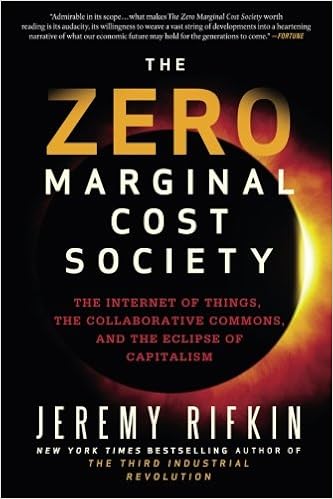
The Internet of Things, the Collaborative Commons, and the Eclipse of Capitalism (2014)
By: Jeremy Rifkin
 Why I Got This Book: It's pretty curious that I was drawn to a book that is essentially a publication about economic issues, something I normally stay away from, but after watching Rifkin in a youtube video on the Big Think channel pushing this book and I was fascinated by the central premise of the book which I'm going to share with you guys the thing I found most interesting and I understood, because economy is feild I understand too much.
Central Thymes:
• The future of Capitalism for Rifkin is a new evolved system a hybrid economy fusing capitalism and collaborative commons. The collaborative commons ( CC) actually predates the representative government and the capitalist market, these social entities formal and informal groups enrich society with its social capital. The CC uses common resource agreed amongst the members to be used collectively, in a democratic fashion. These communes find their genesis in Feudal European society. This system produces a fascinating economic actor the prosumer and redefines private property. Jeremy establishes the Prosumer and collaborative vs Investors and capitalist.
 • The Internet of Things (IOT) will usher in the change to the economic paradigm, which is composed of a communications internet, a logistics internet, and an energy internet. This will push capitalist economy which is based on scarcity, will convert and give way to an economy of abundance.
 • The ever growing trend of sharing goods is taking a deep cut into the retail sector.
• Author implicitly implies that technological innovation is the true motor of history, which is a very interesting and provocative way of viewing history.
• Coal leads to steam power and the first industrial revolution, with this new energy matrix brought forth, steam printing making information more accessible and generated the need of a public school system to learn how to read and become professionals that industry needed, steam trains which compressed time and space and one fundamental aspect they were dependable. Also, the creation of a national postal service and trains quickened commercial transaction. Later the advent of the telegraphy accelerated this proses even more.
• In the second industrial revolution was fueled by oil which need high skilled professionals and lots of financial capital, created a new communication matrix with the invention of the internal combustion engine leading to cars and the construction of highway system, which made many people start to move out of cities into suburban lives, especially with electricity becoming more available.
• The end of the age of privacy and transparency across the board will become the norm. Privacy was a product of capitalism by a life behind closed doors, enclosures and privatization left people fenced off against the world.
• 3 D printers are game changers in the world of manufacturing, the first being open sourced, as they evolve the become more efficient versatile in what the can create and produce much less waste compared to traditional manufacturing. But the most interesting aspect of this invention that thanks to prosumers the cost per unit dropped from 30.000 dollars in 2002 to 1.000 in 2017. It one of the few inventions in the world that it is self-sustainable because it can print its own parts. With inventions like the 3 D printer worker can become owners, consumers into prosumer, with less need to commute to work there for less use of vehicles leading to the decompression of highly dense urban core, people of the future will have less need to cluster.
• What we call globalization was basically just a phase where the government decided to deregulate international trade and push for the privatization of public services, wrapped in the promise of global connectivity, but the whole process was at the service of privet enterprise, so the author establishes that the Global Commons is something different to Globalization.
• Cooperatives are major players in the CC, they are none profit are more efficient than the State because they work at a ground level capitalizing on lateral power, and work even better if the State gives it a hand, the book explains how electricity reach every corner of the United State because of the work of Cooperatives. In Europe, Cooperative are pushing the growth of the use of clean energies.
• Self-driven vehicles that will be a reality sooner than later are another game changers revolutionize human transport and the transport of goods, being a fundamental part of the IOT, once integrated the cost of transport will drop and become much more efficient.
What I liked :
• Author dives deep into the evolution of Capitalism from a very interesting and unique perspective.
• Fascinating affirmation that the downfall of Capitalism as we know is a product of its owns downing a natural evolution being push by the progress of cutting edge technology. What I like about the book is an alternative narrative to the end of capitalism, which is pretty much an obsession of the hard left with a revolution against the system and watching it crash and burn. Rifkin illustrates a mutation of traditional capitalism, but I must mention that the transition phase seems to be pretty complicated on a social level, with the growth of unemployment which can lead to social unrest.
• I found it interesting how the author gets into the evolution of privet property, where basically the encloser movement ushered the concept of property pushing the peasants off the land transformed them into free agents, while at the same time the early phases of the industrial revolution and the market economy, lead to legal protection of property and the right of ownership. This spawn the need for more police and courts.
• Rifkin explains that companies that own and ran the train are the first modern cooperation, where the owner does not presuppose management, that need highly trained professional and high level of investment that took time to reap the gains.
• The book gets into the end a privacy as we know it, and this is something we are dealing with now how every aspect of our lives can be scrutinized from the internet, each person leaves a pretty big digital footprint and much of the information we have given away for dumping all kinds of information in social media pages.
• Cars are the ultimate enclosure for the previous generation it was a sign of economic maturity for the economic actor, I was totally surprised of the fact that sharing cars is a thing now, which leads to less carbon emission and fewer cars on the road.
•
What I didn't like or Debatable Stuff:
The book repeats its self to much and drags in certain parts, I stopped reading it twice.
It hard to debate to many things in this books because I'm not an economist, but I must say that the author mentions how all of these inventions will revolutionize manufacturing and impact tremendously in the labor market, but totally glosses over the social unrest the transition phase can potentially have.
Overall: The book gets an 8 out of 10, it gets you thinking.