Mostrando entradas con la etiqueta Religion. Mostrar todas las entradas
Mostrando entradas con la etiqueta Religion. Mostrar todas las entradas
martes, 12 de junio de 2018

viernes, 6 de abril de 2018
Book Review: Islam and the Future of Tolerance, A Dialogue By Sam Harris and Maajid Nawaz
 Islam and the Future of Tolerance, A Dialogue
By: Sam Harris and Maajid Nawaz
Why I Got This Book: I love to dislike Sam Harris, I'm really not on the same page with him as an intellectual on social issues especially when he talks about religion, he's a pretty hardcore atheist and sometimes his views come off as pretty intolerant especially referring to Islam, but every once and a while he's able to make some very interesting and valid points, especial how political correctness is really affecting social and political analysis. Another thing I respect about the Harris is the fact that he's always willing to sit down and have a constructive debate, expect with Ben Afflict, jajajajaja. And I must say it very important to read intelectuals and academic who you do not agree with because it does make you cuestions things that you sustain and helps you filter put some erroneous ideas one may have and on the other hand it helps muture others.
Now for Maajid Nawaz, I discovered him in a video post recommended to me by youtube, where he talks about the Voldemort effect, where he criticises liberals and the left in general who have no idea how to affront religious extremism. So when I found he going to collaborate on a book with Sam Harris I was fascinated to find what would come this.
 |
| Sam Harris |
• Both authors establish the need that Islam must reform to adjust to the modern world, and it must come from within the faith.
• The book does to great lengths in trying to explain that Sam Harris's views even though very critical of the regressive left, he's by no means is to be mistaken to side with the right. Especially in the extra Q & A the book has Harris explicitly explains that he finds the hard right repulsive and he wants nothing to do with being politically identified with them.
• Harris starts the conversation establishing that Islam is not a religion of peace and if extremist are given a chance they will impose sharia law, and the thing is that views are the most honest interpretation of their faith. But Maajid confronts Harris's position that Islam is not a religion of peace but just a religion, that is interpreted by its followers, with no voice of its own.
• Maajid explains that personal grievances like suffering racism isn't enough to push some into Islamism or extremism. He throws into to the mix Identity crises, charismatic recruiter and Ideological dogma that satisfies the immediate need of that person.
Maajid affirms that many Jihadist are not observant religious people they just need to find a release for their violence. Now the big question I ask to this affirmation is, does Islam as a belief system creates an easy avenue to this situation? Now Nawaz does explain that Jihadist like Islamist do get picky and choosy in the way they interact with their faith, to accommodate their needs, their political agenda. But faith is a big factor, here's where Harris adds his criticism of the regressive left that tries to ignore the faith aspect of this problem and many times acting as Muslim apologist for some hardcore Islamist. He also mentions how political correctness get in the way of any analysis or any honest debates, a true betrayal to liberalism and from my personal point of view they are tremendously reactionary driven more by passion than logic. Sam expresses that silencing these constructive narratives leaves the door open for the hard right like Neo-nazis to being the only voice to address this issues which just make everything worse.
• Nawaz explains that in the west there is an odd anti-west political undercurrent that shames anything the west does just going overboard with the anti-colonialist discourse, having an orientalist fetish, uses reverse racism, tend to side with hardliners that tend to spark internal community conflicts in their search for what is culturally authentic. Minorities do not need to integrat and must auto segragate, in the name of perserving their culture.
 |
| Maajid Nawaz |
Islamist and conservatives are also not the same. Conservative Muslims push back if an Islamist government tries to push a particular interpretation of Islam, this is the same with Jihadist. Maajid explains that initially conservative Muslims are the secret weapon against Islamist and Jihadist because it is possible that they could side with a secular government. But conservatives do take negative position referred questions of human rights, especial towards toward women and LGBTQ people.
Even though many lean on the moderate Muslim for the change in the Muslim world, they are a silent majority that are not politically active in the fight against Islamist and Jihadist, especially in the west, they are citizens that just happen to be Muslim, their religion is secondary to their identity. Therefore they do not engage politically as Muslims.
What I liked :
• Book has an interview format, with Harris asking most of the questions and Maajid answering in the audiobook it voiced by its authors.
• I found Maajid's personal story and his account of his time as a Islamist very interesting. He explains the roots of his extremism in part is due to institutional racism that he suffered growing up in the UK, and his personal grievances were capitalized by local Islamist, which he joined Hizb Ut-Tahrir. This particular group which didn't engage in terrorist activities but did push Islamist revolutionary activities around the world, focusing on military officials to join their ranks. After being imprisoned in Egypte he was reform with the help of Amnesty International that helped to free him.
• It fascinating how the book explains a worrying reality when dealing with Islamist on how they capitalize on failures, be it interventions gone wrong or not interving to help Muslims, it's almost a lose-lose situation.
• Maajid really digs in deep into the issue that some words and concepts like seculer or seculerism do not translate well into arabe and it is a chaleng inits self training to correctly explain these subjects to be able to start a proper political debate in many Muslim countries.
• Harris does press Maajid every once in a while with the poor human rights statistics in many muslim countries.
• Maajid establishes that England is a particularly complicated case refered to be a hotbed for extreamest.
• It is facinating to hear Sam's curiasity about how sinsecer reilgous fanatics are, in a series of question for Maajid and if there can be posers who play the religous card for political gain.
What I didn't like or Debatable Stuff:
• It feels like a wasted opportunity that they do not debate much in this book, you get the impression that both authors go to great lengths to clean up Sam Harris's image.
• Harris feels watered down in this book, he's not his this atheist self.
• Even though I also think Islam needs to be reformed, also think it's tremendously arrogant and over-simplistic, the way it is presented in this book.
• Sam Harris seems to not understand that moderate Muslims do not necessarily interpret that Quran literally, he does understand that moderate religious people tend to relatives their religious beliefs and tend to cherry pick what to abaid from their faith, this tends to be the fact for most people across many faiths.
• Harris establishes that the Quaran need to be edited, while Maajid goes down the path of the need for reinterpretation.
miércoles, 27 de diciembre de 2017
Book Review: God, A Human History By: Reza Aslan.
God, A Human History
By: Reza Aslan.
Why I Got This Book:
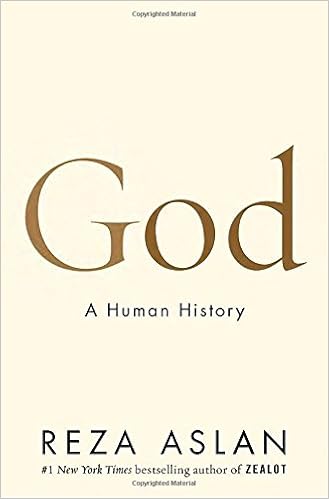 I've pretty much interested in this authors body of work for a while now and this is his latest book.
Central Thymes:
• Aslan explains that it has been a basic constant in the evolution of humanity the concept/idea of God/s from the very early man up until today. Another constant is the humanization of the Devine. Humanities first religions viewed the first deities as superhuman entities endowed with human traits and characteristics, and up until now people describe God with human attributes
• Reza defines religion as a language that tries to express and explain a fundamentally unexplainable experience of trying to commune with God/s. Religion creates a large number of symbols, metaphors and rituals that allow the believer to communicate with the divine.
• The institution of myths and rituals leads to the need of servants and attendees to the need of the God/s, spawn the birth of formal organized religion.
• The belief in the Soul is a Universal Human trait that can be traced to the first humans, and possibly to other humanoid species like the Neanderthals.
• One of the first signes of very early religous expresion was the fact that humans started to bury their dead, and they had seemed to follow certain rituals and many times the grave had a marking so it could be revisited.
• The concept of a soul was already understood by the early man much before any ideas relative towards the divine, but it has been lost in time how and exactly when man discovered the concept of the soul. Now when people passed on their soul went to another realm which could be accessed by the living through dreams, altered states and progressively through rituals.
• Aslan explains for early humans there was an invisible force a universal soul called Mana, it was impersonal, inmaterial and supernatural, a force that takes abode in all animate and inanimate things. The Mana evolved into the idea of a personal soul that once the persona is dead it becomes a spirit. As time progress the souls of the dead were believed to inhabit things, trees, mountains, the moon... for these people they all were pulsing with life, they were animated there for humanized. For the first humans, their soul were no different from those of animals and objects, this is the cornerstone of a ancients forms of animism. As time progressed more some of these spirits became individualized gods each serving a particular function in a final phase these individual deities fused together into one omnipotent and universal God. This is a very very brief summary of Aslan's evolution of God.
• Lord of the Beast or god of the Hunt is one of the first types of deities of great importance in the evolution of God/s, common to many cultures. It a diety that is the ruler and guardian of the forest. Believers must have its favor to have a good hunt, but there was solidarity between hunter and prey, overseen by this deity.
• Morality played no role in early religions, deities were considered beyond morality and at worst amoral.
• Religion is not an evolutionary adaptation, it's a byproduct of two other preexisting evolutionary adaptations. The first of these being Hypersensitivity Agency Detection Device (HADD), which is an adaptation to help human survival, but makes humans attribute agency human cause behind unxplained events. Basically, we as species have a cognitive bias towards agency. The second is called Theory of Mind humans perceive none humans that pose some type of similarity with us we project human traits and characteristics, we anthropomorphize things, animals and events. HADD+ Theory of the Mind+ Concept of the Soul+ Right Circumstances / Context = God and Religion. If I have a soul other people and things must too, there must be a connection.
• Myths are not elaborated story that are basically lies, they are meant to convey a particular perception of the world trying to explain why things are the way they are. Folk Memory is basically a universal myth that crosses most or all cultures, like the great flood or the Garden of Eden.
• The transition from nomad life to agriculture lead man to change their focus on the gods from humanized god sky fathers to earth female deities like Gaia that centered the worship around the fertility of the land tied to the fecundate woman.
• The evolution of early deities was cult to ancestor to deified nature to humanized gods. Now as timed progress the humanized gods became too human, like in the case of the Greeks which lead to some to seek non-anthropomorphic God.
• Akenaton and Zarathustra were the first cases in history to establish Monotheism, but in both cases, they both failed to take hold, people had a hard time in accepting a single deity. Now in the case of Zarathustra's teachings changed and evolved over time to become Zoroastrianism.
• Aslan explains that Monotheism has only existed for around 3000 years, and defines it as the sole worship of on God and negation of all other deities, they are false. He also explains the concept of monolatry is the worship of one god over other, that would be the case of early Judaism, we'll get into this in a bit.
• Evolution Lord of the Beast to Mother Earth to Pantheon of Material Deities to Higharqui of Deities.
• The transition politeism to monolatry to monotheism is part of phenomena called political morphism which is the divinisation of earthly politics, basically, in the societies where this happened, there was a concentration of political power y their faith reflected this situation.
• The destruction of the Temple of Jerusalem at the hands of King Nobuconezer in 586 BCE generate a real crises of faith and identity for the Israelites, which ended up with them redifing their tribal God Yahweh. Aslan explains that tribal societies their Gods actually fought with them when in conflict with other tribes, so if they lost in their God had failed them. In the case of the Israelites, they rationalized this situation was a punishment from Yahweh and it was all part of his divine plan. For Aslan this identity crisis is the true birth of monotheistic Judaism, because previously the Jewish people practiced monolatry. Now their God was singular, personal and eternal.
• Reza explains that the old testament there are actually two distinct Gods El / Elohim and Yahweh and that the early Israelites practiced monolatry, with El being the older deity. In the Old Testament El is referred as God and Yahweh is mentioned as the LORD, and El used to be represented with a Bull, an Oxin or a Caff.
• For Reza, the monotheism of early Christianity was used to validate the position of the Pope, as the absolute head of the Church.
• Reza explains how the society that Mohammed was born into a polytheist society, and that Allah was a sky god much like Zeus for the Arabes and with time became a high god. The Polytheism in Arab society was highly evolved absorbing the gods and prophets of other faiths, including from Judaism and Christianity, feed off many of these religious traditions especially Judaism summarized them, fixed what he considered wrong ( like idol worship) and established that Allah was Yahweh, and there for the one and only God, going up against the Meccan establishment.
• Now Mohammed tried to rid Islam of a humanized God by prohibiting its representation but the Coran is plagued with anthropomorphic characterizations of Allah and it qualities and attributes.
• Islamic scholars shay away from addressing theological issues focusing on legal issues. Aslan explains how Sufism tries to overcome the limitations of early Islam and set out to try to answer: What is God?
• Aslan end the book with Pantheism, which is something ver similar to the Force.
What I liked :
• Why does Man need to humanize the Devine? Why do fashion God/s in our own image? Is the compilation to humanize the divine hardwired in our brains? Do the belief in God and Religion give Humans any evolutionary advantage? Good opening questions for this books Introduction.
• In this book like in others that Aslan has written on religious issues, Reza always gets into personal aspects on how the subject has affected him as a person or was part of his past in his personal spiritual journey. In this case we get his own complete evolution of how his religious views and how he defines God, how they have changed and matured from his perspective ( he doesn't use this word but it is implicit in the book) from being Muslim to a Christian back to being a Muslim, to a Sufi Muslim and finally becoming a Pantheist.
• Even though the book is pretty long it is very focused and organized with the information, it follows a natural progression of ideas using historical evolutions of the idea of God/s.
• Aslan explains that this book does not try to prove if God/s actually exist, it just focuses on how man define the divine and its evolution.
• I liked how Aslan uses the concept of Adam and Eve to explain the early evolution of religion, and how he uses their expulsion from Eden to explain the transition to a sedentary life for humans which meant a big shift in man's faith and beliefs.
• Aslan seems to struggle with the biological origins of faith in God, because it does undermine belief in God in general.
• Myths about talking tree seem to have been a big deal.
• I found fascinating Reza account how man actually suffered becoming sedentary and forming the first small cities, it was almost an act of faith for man to establish them selves they actually lost a lot from there nomad life, for example, their diet was severely reduced and agricultural work was backbreaking. This also ties into what I read on the history of book by Fernando Baez, which explained man wrote the first epic myths because the longed to see the world as nostalgia towards a nomadic life.
• It is interesting how Aslan links the transition of human society from being nomads to establishing themselves in sedentary community dedicating themselves to agriculture, with the stratification of society and the formalization of religion.
• Aslan affirms that hunting made man master over space farming made man a master over time.
• Political Morphism mentioned earlier is one of the most interesting concepts in the book.
• I discovered what the Demigorge was.
• Aslan does a good job explaining how the tinitary conception of God and the true nature of Jesus of the early Christian Church provokes a colossal rift in it first community of believers.
• Aslan explains how Mohammed was very much a product of his times, and humanizes his origins trying to cutting through myths and traditions.
• When Aslan talks about Islam and how to interpret the Coran his Shia upbringing does shine through.
What I didn't like or Debatable Stuff:
• What Aslan presents about Gobecly Tepe and how old it possibly is, does open many debates, around when and why did man created writing and on the impact of this temple structure on pushing the builders to become sedentary. Basically one of the first forms of organized religion made man sedentary not Agriculture, it was a byproduct of this situation or had a convergent evolution.
• Aslan sort of skims over and oversimplifies the worship of ancestors that is characteristic of early human societies, and is still present in some faith. I guess it possible that this would muddy up his linear cut and dry analysis.
• I was let down because Aslan centers his analysis on western faiths mostly, with little mention of Hinduism, Buddhism, Shintoism, Taoism..., it feels like it would have complicated his linear narrative.
• When talking about the trinitary conception of God of the early Christian, Aslan does omit talking about the Holy Spirit. The chapter about Christianity in general is one of the weaker chapters of the book.
By: Reza Aslan.
Why I Got This Book:
I've pretty much interested in this authors body of work for a while now and this is his latest book. Central Thymes:
• Aslan explains that it has been a basic constant in the evolution of humanity the concept/idea of God/s from the very early man up until today. Another constant is the humanization of the Devine. Humanities first religions viewed the first deities as superhuman entities endowed with human traits and characteristics, and up until now people describe God with human attributes
• Reza defines religion as a language that tries to express and explain a fundamentally unexplainable experience of trying to commune with God/s. Religion creates a large number of symbols, metaphors and rituals that allow the believer to communicate with the divine.
• The institution of myths and rituals leads to the need of servants and attendees to the need of the God/s, spawn the birth of formal organized religion.
• The belief in the Soul is a Universal Human trait that can be traced to the first humans, and possibly to other humanoid species like the Neanderthals.
• One of the first signes of very early religous expresion was the fact that humans started to bury their dead, and they had seemed to follow certain rituals and many times the grave had a marking so it could be revisited.
• The concept of a soul was already understood by the early man much before any ideas relative towards the divine, but it has been lost in time how and exactly when man discovered the concept of the soul. Now when people passed on their soul went to another realm which could be accessed by the living through dreams, altered states and progressively through rituals.
• Aslan explains for early humans there was an invisible force a universal soul called Mana, it was impersonal, inmaterial and supernatural, a force that takes abode in all animate and inanimate things. The Mana evolved into the idea of a personal soul that once the persona is dead it becomes a spirit. As time progress the souls of the dead were believed to inhabit things, trees, mountains, the moon... for these people they all were pulsing with life, they were animated there for humanized. For the first humans, their soul were no different from those of animals and objects, this is the cornerstone of a ancients forms of animism. As time progressed more some of these spirits became individualized gods each serving a particular function in a final phase these individual deities fused together into one omnipotent and universal God. This is a very very brief summary of Aslan's evolution of God.
• Lord of the Beast or god of the Hunt is one of the first types of deities of great importance in the evolution of God/s, common to many cultures. It a diety that is the ruler and guardian of the forest. Believers must have its favor to have a good hunt, but there was solidarity between hunter and prey, overseen by this deity.
• Morality played no role in early religions, deities were considered beyond morality and at worst amoral.
• Religion is not an evolutionary adaptation, it's a byproduct of two other preexisting evolutionary adaptations. The first of these being Hypersensitivity Agency Detection Device (HADD), which is an adaptation to help human survival, but makes humans attribute agency human cause behind unxplained events. Basically, we as species have a cognitive bias towards agency. The second is called Theory of Mind humans perceive none humans that pose some type of similarity with us we project human traits and characteristics, we anthropomorphize things, animals and events. HADD+ Theory of the Mind+ Concept of the Soul+ Right Circumstances / Context = God and Religion. If I have a soul other people and things must too, there must be a connection.
• Myths are not elaborated story that are basically lies, they are meant to convey a particular perception of the world trying to explain why things are the way they are. Folk Memory is basically a universal myth that crosses most or all cultures, like the great flood or the Garden of Eden.
• The transition from nomad life to agriculture lead man to change their focus on the gods from humanized god sky fathers to earth female deities like Gaia that centered the worship around the fertility of the land tied to the fecundate woman.
• The evolution of early deities was cult to ancestor to deified nature to humanized gods. Now as timed progress the humanized gods became too human, like in the case of the Greeks which lead to some to seek non-anthropomorphic God.
• Akenaton and Zarathustra were the first cases in history to establish Monotheism, but in both cases, they both failed to take hold, people had a hard time in accepting a single deity. Now in the case of Zarathustra's teachings changed and evolved over time to become Zoroastrianism.
• Aslan explains that Monotheism has only existed for around 3000 years, and defines it as the sole worship of on God and negation of all other deities, they are false. He also explains the concept of monolatry is the worship of one god over other, that would be the case of early Judaism, we'll get into this in a bit.
• Evolution Lord of the Beast to Mother Earth to Pantheon of Material Deities to Higharqui of Deities.
• The transition politeism to monolatry to monotheism is part of phenomena called political morphism which is the divinisation of earthly politics, basically, in the societies where this happened, there was a concentration of political power y their faith reflected this situation.
• The destruction of the Temple of Jerusalem at the hands of King Nobuconezer in 586 BCE generate a real crises of faith and identity for the Israelites, which ended up with them redifing their tribal God Yahweh. Aslan explains that tribal societies their Gods actually fought with them when in conflict with other tribes, so if they lost in their God had failed them. In the case of the Israelites, they rationalized this situation was a punishment from Yahweh and it was all part of his divine plan. For Aslan this identity crisis is the true birth of monotheistic Judaism, because previously the Jewish people practiced monolatry. Now their God was singular, personal and eternal.
• Reza explains that the old testament there are actually two distinct Gods El / Elohim and Yahweh and that the early Israelites practiced monolatry, with El being the older deity. In the Old Testament El is referred as God and Yahweh is mentioned as the LORD, and El used to be represented with a Bull, an Oxin or a Caff.
• For Reza, the monotheism of early Christianity was used to validate the position of the Pope, as the absolute head of the Church.
• Reza explains how the society that Mohammed was born into a polytheist society, and that Allah was a sky god much like Zeus for the Arabes and with time became a high god. The Polytheism in Arab society was highly evolved absorbing the gods and prophets of other faiths, including from Judaism and Christianity, feed off many of these religious traditions especially Judaism summarized them, fixed what he considered wrong ( like idol worship) and established that Allah was Yahweh, and there for the one and only God, going up against the Meccan establishment.
• Now Mohammed tried to rid Islam of a humanized God by prohibiting its representation but the Coran is plagued with anthropomorphic characterizations of Allah and it qualities and attributes.
• Islamic scholars shay away from addressing theological issues focusing on legal issues. Aslan explains how Sufism tries to overcome the limitations of early Islam and set out to try to answer: What is God?
• Aslan end the book with Pantheism, which is something ver similar to the Force.
What I liked :
• Why does Man need to humanize the Devine? Why do fashion God/s in our own image? Is the compilation to humanize the divine hardwired in our brains? Do the belief in God and Religion give Humans any evolutionary advantage? Good opening questions for this books Introduction.
• In this book like in others that Aslan has written on religious issues, Reza always gets into personal aspects on how the subject has affected him as a person or was part of his past in his personal spiritual journey. In this case we get his own complete evolution of how his religious views and how he defines God, how they have changed and matured from his perspective ( he doesn't use this word but it is implicit in the book) from being Muslim to a Christian back to being a Muslim, to a Sufi Muslim and finally becoming a Pantheist.
• Even though the book is pretty long it is very focused and organized with the information, it follows a natural progression of ideas using historical evolutions of the idea of God/s.
• Aslan explains that this book does not try to prove if God/s actually exist, it just focuses on how man define the divine and its evolution.
• I liked how Aslan uses the concept of Adam and Eve to explain the early evolution of religion, and how he uses their expulsion from Eden to explain the transition to a sedentary life for humans which meant a big shift in man's faith and beliefs.
• Aslan seems to struggle with the biological origins of faith in God, because it does undermine belief in God in general.
• Myths about talking tree seem to have been a big deal.
• I found fascinating Reza account how man actually suffered becoming sedentary and forming the first small cities, it was almost an act of faith for man to establish them selves they actually lost a lot from there nomad life, for example, their diet was severely reduced and agricultural work was backbreaking. This also ties into what I read on the history of book by Fernando Baez, which explained man wrote the first epic myths because the longed to see the world as nostalgia towards a nomadic life.
• It is interesting how Aslan links the transition of human society from being nomads to establishing themselves in sedentary community dedicating themselves to agriculture, with the stratification of society and the formalization of religion.
• Aslan affirms that hunting made man master over space farming made man a master over time.
• Political Morphism mentioned earlier is one of the most interesting concepts in the book.
• I discovered what the Demigorge was.
• Aslan does a good job explaining how the tinitary conception of God and the true nature of Jesus of the early Christian Church provokes a colossal rift in it first community of believers.
• Aslan explains how Mohammed was very much a product of his times, and humanizes his origins trying to cutting through myths and traditions.
• When Aslan talks about Islam and how to interpret the Coran his Shia upbringing does shine through.
What I didn't like or Debatable Stuff:
• What Aslan presents about Gobecly Tepe and how old it possibly is, does open many debates, around when and why did man created writing and on the impact of this temple structure on pushing the builders to become sedentary. Basically one of the first forms of organized religion made man sedentary not Agriculture, it was a byproduct of this situation or had a convergent evolution.
• Aslan sort of skims over and oversimplifies the worship of ancestors that is characteristic of early human societies, and is still present in some faith. I guess it possible that this would muddy up his linear cut and dry analysis.
• I was let down because Aslan centers his analysis on western faiths mostly, with little mention of Hinduism, Buddhism, Shintoism, Taoism..., it feels like it would have complicated his linear narrative.
• When talking about the trinitary conception of God of the early Christian, Aslan does omit talking about the Holy Spirit. The chapter about Christianity in general is one of the weaker chapters of the book.
viernes, 18 de agosto de 2017
Book Review and breakdown Slavoj Zizek's Trouble in Paradise. From the End of History to the End of Capitalism (2014) Work in progress
 Trouble in Paradise. From the End of History to the End of Capitalism (2014)
Here a link to a brief video that I made on the subject: link to my incredible video review of the Slavoj's book
By Slavoj Zizek
Why I Bought This Book: I actually caught a couple of dissertation of Zizek online, it was recommended to me by my Youtube feed. And immediately I was fascinated with him because even though I do not share most of his views on politics and international relations, he has a refreshing point of view from the left, being very critical of his own political background. So I went out to get one his books and to my surprise, I found about ten published books in Spanish at my local book store, I had no idea that he was such an established author.
What I liked and Central Thymes:
· Slavoj establishes that conservatives are not really conservatives, they have latched on to an ever changing capitalism system, becoming reckless. Even if it destroys many traditional social institutions, putting social cohesion under immense pressure. This is very true from my point of view, and it's increasingly evident that many time put ideology over the well being and the way of life, backing policies that are detrimental to them.
· The real Conservative is the person that admits that there is antagonism in the capitalist system and it has gotten to certain dead ends. It is the person that calls out against out simple minded capitalist progress, so the radical left finds its self-playing the role of being the new conservatives. He's actually onto something here but later abandons this idea later in the book.
· Rightwing conservatives always defend the freedom of choice but taking away the options.
 |
| Slavoj Zizek |
· Zizek establishes a fascinating concept that in modern capitalism individual people are not seen as parts of the work force, but as entrepreneurs that make use and take advantage of his or hers economic capital. And while their lives progress they most take investments decisions relative to their economic well-being. They make a good and bad investment, like changing jobs, adding or losing their personal capital. After reading this I couldn't help to think about credit cards, and how debt is a possible way of political and financial control. But the book actually goes in this direction after that explain that there is a tradeoff of losing social protection for the debt. So from my point of view but I think Slavoj would be on the same page, be my personal conclusion with this is basically debt ties down social mobility something conservative just love. Slavoj uses the example you do not have the right to a home but must access long term credits.
· People are free to make financial decisions so they are responsible they are their own capitalist responsible for their own future, but conservative just love to forget about how debt and externalities can ruin people's lives.
· State must roll back its control to give the system freedom.
· Slovoj has an obvious soft spot for pop culture and that brings some color to the book.
· Slavoj expresses that the people that we call Islamic fundamentalist, are Pseudo-fundamentalist who are deeply troubled, fascinated and fixated on the lives of the nonbelievers, they obsess about the sinner and infidels. In their battle against sin, they are actual exteriorizing their lack of faith and conviction fuels the violence. They also secretly consider themselves as inferior, so politically correct discourse from the west towards these people just drives these people off the wall. The cultural difference isn't the issue with these fundamentalists, because are pushed to act out of how much they have become similar to us.
What I didn't like:
· It is interesting and frustrating at the same time that this book lacks any kind of focus, while in his dissertations he's much more centered and straight to the point, normally it's the other way around.
· The lack of focus is so bad at moments where you as the reader actually get lost in what the hell he was talking about. The author is all over the place and just bombards you with information, it hard to keep up with what he's trying to explain.
· At the book references Francis Fukuyama's "The End of History" as one of the main concepts that it wants to debunk, but never revisits the idea after the introduction.
· Zizek accuses Christianity of preparing the groundwork for this situation, one owes God infinite debt for one's life. But for me at least being Catholic I that it religious doctrine does not go hand and hand with hardcore capitalist doctrine, or just ask Francis what he thinks about neoliberalism.
· Institution like Wikileaks is a true sign of the progressive democratization of information, the author completely ignores the political aspect of this phenomena. Now he's right in how that information will become more ubiquitous as time progresses, from my point of view it will not be a Hacker thing 20 years down the line.
Reading this book you get the feeling that I'm missing out on things because I'm not familiar with the rest of his body of work, you have to know what makes this guy tick to really appreciate what he's trying to convey in this book, I got to read his older stuff. So I can't grade this book.
martes, 17 de mayo de 2016
Diego Golombek The Neurons of God.

Diego Golombek
The Neurons of God.
So today I Bring you this very intriguing Book from Argentinean Biologist and author Diego Golombek, that has a talent in presenting some pretty complicated scientific stuff in a very light hearted and interesting way, just trapping the reader and in many ways similar to Theoretical Physicist Michio Kaku books.
This books start with an introduction, that for some reason the author calls "This Book (and This Collection), and this part of the book does exactly what's it should, establishing what the author want to do and which direction the book will go, he starts off briefly explaining his personal experiencing with religion and how he became a man of science, and he uses this exposition to jumps straight to the conflict between Science and Religion, reason vs. Faith. and Diego wastes no time, already on page 12 he establish a very interesting question: Can there be a Science of Religion? Or Better said a Neurocience of religion, Is it hard wired in our brains? that why the notion of God or religion never ceases to exist our societies.
Central Thymes and Concepts:
The Good stuff about the Book:
The Bad:
This books start with an introduction, that for some reason the author calls "This Book (and This Collection), and this part of the book does exactly what's it should, establishing what the author want to do and which direction the book will go, he starts off briefly explaining his personal experiencing with religion and how he became a man of science, and he uses this exposition to jumps straight to the conflict between Science and Religion, reason vs. Faith. and Diego wastes no time, already on page 12 he establish a very interesting question: Can there be a Science of Religion? Or Better said a Neurocience of religion, Is it hard wired in our brains? that why the notion of God or religion never ceases to exist our societies.
Central Thymes and Concepts:
- In chapter 1 the author makes the point, that in his premise of the science of God, is not to attack the literal interpretations of the Bible or religious figures of many faiths, he establish that beliefs need foundational myths to survive over time and it not the focus of the book trying to study this aspect of faith.
- In the first part of the book the author concentrates on the possibility that religion is universal and is it innate in us, so one of his objective is to analyzes from where do these beliefs come from, why have we evolved with this hardwired in our brains. So the author asks a big question ¿is Religion a natural phenomena?,¿ part of our Evolution?, is Universal among humans like langue. ¿Or is it universal but not innate?, eminently cultural, so you would have to learn it.
- Now Diego explains that religious beliefs may have their genesis in Type 1 errors or false positives, a exaggerated inclination to seeing things that are not there, but during our evolution this may have kept us safe and alive.
- Then the author bring up the concept of spandrels, which surprised me because I had recently read a book by Francis Fukuyama of State Theory that, brings up the same concept. So what is a Spandrel? It's actually related to construction and cathedrals, but in the social word it means that some that is made or thought of for one purpose, end up being very practical for something else. Te author establishes that many human social qualities are spandrels from our evolution, now the author ask if religion is a spandrel from some other neurological function that help us survive a species.
-
Golombek then starts to analyze death rituals, as a possible starting point for religions, but human are not alone in this field, Neanderthal also had death rituals like other mammals like dolphins, elephants and chimpanzees, now the author does ask this but it's ¿valid are they religious? , do they have the potential of being so (a investigation for another day). But the author does explain that being conscious that one can die, but this can actually be an issue, fear can paralyze us, so basically human culture come in to removes this fear by establishing death is not the end just a passage to the other side, at least symbolically, helps us deal with his fear.
- Author makes and interesting affirmation that people of faith, have less options when confronted with moral dilemmas, and their belief tend to establish a courses of action, alleviating the burdens of having to chose or to second guess, I actually use this same affirmation for ideology when one has to take a political action, you know Golombek should make a Neuroscience of politics and see if religion and science have any relationship on a neurological level. So having faith actually has a positive impact on the believer in combating stress and anxiety.
- Faith adds cohesion to a group, and I would add identity + social capital, the concept of sacrifice helps root out the opportunist, in a way the benefits aren't free in being part of a Religious community, there are obligations, group praying, dietary obligations, only marrying certain people... The author makes the interesting observation the more difficult the obligations, stronger is the unity of the group. And from my point of view this can take things to another level when members of a faith are willing to commit suicide in the name of their faith.
- So Diego reaches to a preliminary conclusion that religion in a way makes us feel good, this voluntary dance with ignorance gives the believer control over the cosmos, but it also gives the community a strong level of unity.
- The author establishes that morality is also to a certain entente also hard wired into our brains, and in some cases it secures our survival.
- Now this is fascinating the author establishes that all immoral behavior can find its origin in revolution and disgust, referring food and in a later stages hygiene specially sexual, it does make sense because religions tend to have many norms on these to subjects. And its later stage moral disgust when you repute a act of some in the community. Now let's get back to talking about food, eating correct thing that's in good conditions is related to our evolution and our survival, and is related to morality, but I can add from something that I remembered from Fukuyama eating was always a social phenomena, man never ate alone the tribe would always get together and eat and leave nothing, even invite others from other tribes, so I guess many social norms and rituals come from fusing these two concepts.
- Author affirms being religious can be hereditary, now how it's manifested depends on cultural context in adults. What we inherited is the will to believe, now the author head into the concept of the god gen, or VMAT2 ( vesicular monoamine transporter 2). Dean Hamer was the one responsible for discovering this gen, now he affirms that the concept of transcendence of one self, found in most faiths and belief systems, is hereditary, now VMAT2 controls the activity of the neurotransmitters in our brain, especial the ones related with our mood and personality, Hamer explains optimistic people tend to have more children, they leave more decendence, now this god gen seems to affect our capacity of abstraction and our ability to focus, but the author establishes even thought the studies on VMAT2 are interesting it relationship with religion is in it very early stages of Analysis. Note the concept of transcendence is related with spirituality.
But the author establishes that one gen can't determine mood or state of mind, normally it a group of them, VMAT2 depending in its composition can give us minor predisposition, but Hamer affirms that spirituality is a state of mind, a personal experience, while religion is a institutional manifestation of that state, that is not found in no gen. - In another study in the University of Karolinska found that a particular serotonin receptor called 5-HT1A, possibly had a relationship with levels of spirituality, the more religious the person is less active is his 5-HT1A.
- In another study a receptor of dopamine D4 show certain variations between people of different level o f faith. But none of these study have been replicated or verified, Hamer publish his finding in a book not in scientific paper.
- Many ritual that try to reach spiritual ecstasies have many similarities between each other, like being set in a context to recessive god, collective prayers, repetition, monotone chanting or singing or dancing.
- Author affirms being religious can be hereditary, now how it's manifested depends on cultural context in adults. What we inherited is the will to believe, now the author head into the concept of the god gen, or VMAT2 ( vesicular monoamine transporter 2). Dean Hamer was the one responsible for discovering this gen, now he affirms that the concept of transcendence of one self, found in most faiths and belief systems, is hereditary, now VMAT2 controls the activity of the neurotransmitters in our brain, especial the ones related with our mood and personality, Hamer explains optimistic people tend to have more children, they leave more decendence, now this god gen seems to affect our capacity of abstraction and our ability to focus, but the author establishes even thought the studies on VMAT2 are interesting it relationship with religion is in it very early stages of Analysis. Note the concept of transcendence is related with spirituality.
The Good stuff about the Book:
- Book is well written and generally pretty accessible.
- References that are put at the bottom of the page as foot notes, and not at the end of the chapter or the end of the book, I personal like this much more becuase you don't waste time looking for them.
- Author loves using foot notes. There tons of interesting stuff there, at moments he puts some of personal thoughts in there.
- Tons of references to pop culture, author reminds me of Michio Kaku's book, for example he actually references M. Night Shyamalan movie Signs, explaining false positives and false negatives.
- Author affirm that religion is a universal phenomena, while science isn't, science helps us progress as a species religion helps us dream give us a special ego that we are more than what we are so we strive and dream.
- The Agriculture, sedentary life, population growth, sickness... Made it necessary the invention of the cemetery, there were social and practical need for them , death was very present early man needed to deal with their fragile existence, a poorly disposed corps could bring sickness to a community if not dealt with correctly, like contaminate water sources.
-
The author citing Richard Dawkins he establishes that " religion isn't the source of morality, but it is the base and the excuse to justify immoral acts". I'm not on the same page of the affirmation but it a point that many people that are critical of religion have.
- Then Golombek makes a reference to Charles Darwin who thought the Religion was Universal and had a hypothesis that faith added internal cohesion and organization to groups, giving them an edge against other groups of humans.
-
Diego establishes that there is a interesting relationship between epilepsy and Holy men/prophets, that the Greek called this condition the sacred sickness, and the author goes into the main topic how this disorder in one neurons produced on many occasions illusion that could be interpreted as a signs of god, like other mental illnesses.
- Golombek explains something super. Interesting that epilepsy con cause profound religious conversions.
- Author tell a interesting story about Moses that didn't go up the mountain on his own, but with a group that went up with him including his brother Aaron , with his sons Nadab y Abihu and 70 others, but God ordered halfway up the should stay and he go the rest of the way but these people were differentiated from the rest becoming a new social cast of priest, a hereditary dynasty called the Cohanim, this name changed over the year into Cohen, Cohan, Cogan, Kahane, Kogan...so genetically they all most have a common ancestor but when they studied their genetic make surprisingly it was discovered they had in part, decendence from Arabs, Golombek reminds the reader that Abraham had children Isaac that would be considered the lineage of the Jewish people and Ismail to considered the founder of the lineage that would become Islam, so in a way there is some truth that these two people have a common decendence.
The Bad:
- Diego does look over some social origins of religion it much more sophisticated then what he presents especially leaving the political aspect out of it, many early belief systems revolved around the cult of the ancestor that gave identity to the tribe or clan, that had heavy political implications.
- Author at moments doesn't differentiate morality from ethics, at moments he uses the concepts indifferently.
- Author cites Richard Dawkins too much, I know he's a reference in scientific community but he isn't the only one, maybe some Sam Harris.
- Author right off the bat establish that among many famous historical figures Joan of Arc, Mohammed and Saint Paul had epilepsy, but without explaining how he reached the conclusions or referencing where did he get this info, in some aspects it makes sense, but it's sloppy on his part.
- Now author affirms if religion has a genetic or hereditarily in origin, hid in our brain, in principal it cannot be eradicated. Now I ask the author ¿why should it be eradicated? These types of affirmations that the book is sort of ideologically driven and no as objective that it seems.
- There a bit of inbalance between chapter some are to long while other to short, book has no conclusion.
- Book is kind of let down at the end. The author throws objectivity out the window on the last page establishing that religion is a virus and science is the vaccine, but it's surprising because he s pretty objective during most of book, even being open minded at moments.
- Author surprisingly cites very few book in his investigation, about 22, that for a book that touches social issues it pretty short list or this is a red flag that he read only the books that comfirmed his point of view becuase the becuase titles are mostly anti faith.
Suscribirse a:
Entradas (Atom)