Mostrando entradas con la etiqueta North Korea. Mostrar todas las entradas

martes, 29 de agosto de 2017

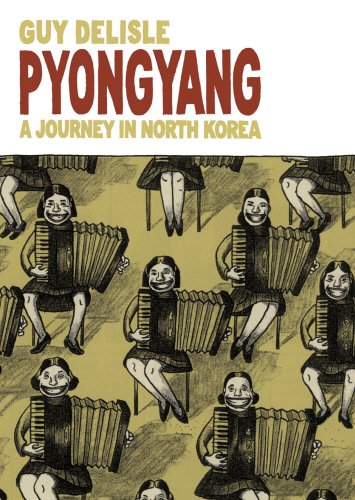
Book / Graphic Novel Review Pyongyang a voyage into North Korea. By Guy Delisle


Resultado de imagen para pyongyang guy delislePyongyang, a Voyage to North Korea  (2003)

By: Guy Delisle

Why I Bought This Book: a while back a coworker of mine started to ask me about North Korea and if the outlandish things that you hear about the country are true. So I asked him why the sudden interest in this hermit country and he explained to me that he had got this graphic novel that explored many of the crazy aspects of the country. So fascinated with the idea of a graphic novel about North Korea so I went to my local book store and got myself a  copy of this fascinating book.

The Story: Well the basic plot of the story is about the experiences of the author/illustrators having to work and live in North Korea, and I don't want to spoil too much talking about some of the absurd situations Guy gets himself into.  

What I liked and  Central Thymes:
•    I loved the simple and cartoonish art of the book, it adds nicely to the story. Each chapter has a full page illustration of important monuments of the country that show off Guy's artistic capabilities.
•    The book is just as insightful as it is funny, a fantastic read. 
•    Guy's culture shock is priceless, and he's pretty honest in showing that at moments he can be a snobbish prick. 
•    It's interesting to see how Guy's views of the country and its people changes as the book progresses.
•    The parallel reality that expats live in,  like the people that work for NGOs, international companies employs and diplomats, is fascinating because they are not allowed to interact with the locals freely, so they only interact amongst each other.
•    Guy seems to be a  music lover  and how he suffers listing to crappy official music that's on all day at his work, is something I can identify with because something similar happened to me working in a small frontier town 2000 km from my home in the middle of nowhere, the terrible music they listened there drove me crazy, jajajaja. 
•    The book is not scientific account and analyses of what's going on in the country, but what is valuable  is that most books and articles about the country tend to have top down perspective centering around the regime and its politics, this book has a bottom up from seeing what it like for a foreigner to actually be there and see for themselves the things that happen in the country.


What I didn't like:
•    The only bad thing about the book is that there isn't an introductory page giving a little bit of context to when the author was in the country and why, or to explain a little more about his job. You get a little bit and pieces, but personally, I want to know more about the author's background but I'm nit picking here.

Overall: 10 out of 10

lunes, 8 de septiembre de 2014

The different types of migration policies; Retention Policies, Example North Korea, Boliva, USSR and Cuba


Today and in  the next series of post, on migratory policy I’m going to work on issues related to the different types of migratory policies that Lelio Marmora describes in his book Las Politicas de Migraciones Internacionales. This author establishes five types of migration policies: for retention, promotion, regulation, recovery and incorporation, and will then be showcased (Marmora; 2004, p. 99). We’ll see each one of these migratory policies, but I’ll use my personal point of view for the analysis.
We’ll start off with Retention policies that are intended to prevent the emigration of  citizens of a particular State, that nation tries to stop the transit of people leaving. So a State can prevent the loss of human capital, the depopulation of a geographical location in particular or in general. This circumstance could be fueled by political/ideological reasons why a regime that does not let its citizens leave its national territory. People leaving a country is a fact that has strong symbolic and political charged message of failure for the regime. An example that we can use to illustrate this kind political defeat, happened to the Soviet regime when Mikhail Baryshnikov ran away from the Bolshoi Ballet tour and settled in the United States. Such a high profile figure defecting to the US at that time must have been a very hard pill to swallow for the soviets. Cuba is another classic example of a country with a retention policies but over the years it getting little more flexible for their people to travel abroad.


North Korea is one of the most well know contemporary cases of a retention policy that I can think of. This country has a very strict control of who can leave its territory, in a intriguing article called North Korea: Understanding Migration to and from a Closed Door Country (2008) written by Hiroyuki Tanaka for the Migration Policy Institute. The author explains that this nation produces two types of emigrants, refugees and temporary contract workers sent by the government.

North Korea implements a very strict migratory control on all entries and exits (in this case we will concentrate on the exits). Individuals caught try to leave the country illegally can be tried for treason and sent to penal-labor colonies. To add to this situation, to be able   transit around the country you need special permits, so getting to the frontier in the first place, is an issue unto itself. In my years reading about migratory issue, this is the first time I have come across this type of severe control in modern State.
This doesn’t mean it’s impossible for North Koreans to get out, they get help from illegal networks  that give them a hand in the logistics to escape, and some level of structural corruption make things a little bit easier, but a lot is on the line if they fail. Now it’s impossible to cross the south boarder, with South Korea because it’s highly militarized. One must not forget that North Korea never singed armistice treaty after the Korean War, so technically they in still in conflict. And in the case of the northern border, North Koreans that illigally cross into China, are not given the possibility to get residency or petition for refugee status. So basically in China theyhave no right to stay there, so they have to find a way to transit to a third country to see if they can considered them as refugees. In China the government tends to look the other way, when it comes to these people and periodically deports them when needed.                         

Another les extreme example of a retention policy can be observed, in the case of Bolivia that historically has tried to curb and control the migration of its natives through different actions. During the 1930s were approved two Supreme Decrees, one in 1937 and another in 1938, which sought to control the phenomenon of emigration. In the first decree citizens needed a passport to be able to leave the country; it was issued by the National Immigration Office. In the second set that everyone who was caught illegally leaving the country, it would be forced, forced works forced public service. (Domenech and Magliano; 2009)

In the case of Argentina, the current policy the law 25,871 almost does not address the question of emigration of Argentine citizens, it only establishes functional measures on how to control their transit, and it mentions how can nationals intending to return can bring back their thing without paying customs. There is no direct retention policy in operation in Argentine. Even though indirectly the ways that one exchanges peso to any other currency has it issues in this country indirectly hampering the intention of its nationals that want to travel aboard.   
You as a reader do you have any examples of retention policies? It would be great to hear from you.


If you like the review give me a hand and support me on Patreon at this Link that will make me, Matias Cavoti very happy to keep writing.