Mostrando entradas con la etiqueta France. Mostrar todas las entradas

martes, 29 de agosto de 2017

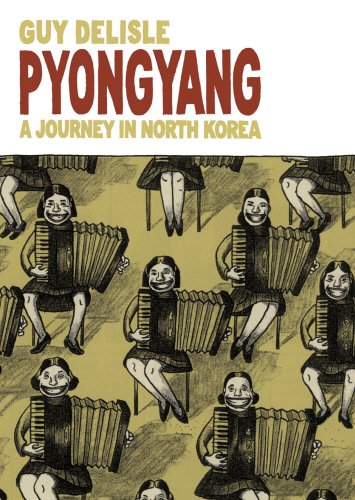
Book / Graphic Novel Review Pyongyang a voyage into North Korea. By Guy Delisle


Resultado de imagen para pyongyang guy delislePyongyang, a Voyage to North Korea  (2003)

By: Guy Delisle

Why I Bought This Book: a while back a coworker of mine started to ask me about North Korea and if the outlandish things that you hear about the country are true. So I asked him why the sudden interest in this hermit country and he explained to me that he had got this graphic novel that explored many of the crazy aspects of the country. So fascinated with the idea of a graphic novel about North Korea so I went to my local book store and got myself a  copy of this fascinating book.

The Story: Well the basic plot of the story is about the experiences of the author/illustrators having to work and live in North Korea, and I don't want to spoil too much talking about some of the absurd situations Guy gets himself into.  

What I liked and  Central Thymes:
•    I loved the simple and cartoonish art of the book, it adds nicely to the story. Each chapter has a full page illustration of important monuments of the country that show off Guy's artistic capabilities.
•    The book is just as insightful as it is funny, a fantastic read. 
•    Guy's culture shock is priceless, and he's pretty honest in showing that at moments he can be a snobbish prick. 
•    It's interesting to see how Guy's views of the country and its people changes as the book progresses.
•    The parallel reality that expats live in,  like the people that work for NGOs, international companies employs and diplomats, is fascinating because they are not allowed to interact with the locals freely, so they only interact amongst each other.
•    Guy seems to be a  music lover  and how he suffers listing to crappy official music that's on all day at his work, is something I can identify with because something similar happened to me working in a small frontier town 2000 km from my home in the middle of nowhere, the terrible music they listened there drove me crazy, jajajaja. 
•    The book is not scientific account and analyses of what's going on in the country, but what is valuable  is that most books and articles about the country tend to have top down perspective centering around the regime and its politics, this book has a bottom up from seeing what it like for a foreigner to actually be there and see for themselves the things that happen in the country.


What I didn't like:
•    The only bad thing about the book is that there isn't an introductory page giving a little bit of context to when the author was in the country and why, or to explain a little more about his job. You get a little bit and pieces, but personally, I want to know more about the author's background but I'm nit picking here.

Overall: 10 out of 10

miércoles, 15 de marzo de 2017

2016 Migratory Report by Matias Cavoti: Part 6 Border Walls and Fences


Conclusion:
Resultado de imagen para border fence europe
18 years ago when I started to study international relations, you couldn't stop reading about globalization, international comers and integration would progressively erode the necessity of borders, people and goods should and must move freely. What a stark contrast with the world we have today that has governments of many State fixated on building fences, walls and barricades, around 70 countries around the world have built some kind of physical barriers to stop the movement of migrants or refugees, be it from their neighbors or for people from third countries. In the past three years, there has been an explosion of announcements and construction of border barriers and the temporary  reintroduction of border controls in the Schengen area which I have summarized in this reference chart.

Country
Barrier/Fence/Wall and Reintroduction of Border Control in Schengen Area.
Reasons
Algeria
Announced the creation of a barrier on its border with Libya and Morocco in 2015.
Immigration, Trafficking and Security.
Austria
Announced the creation of a barrier on its border with Slovenia 2015 and Italy 2016. Temporarily lifted Schengen and reestablished passport border control during 2016 and during early 2017.
Immigration.
Bulgaria
Completed its barrier with Turkey in 2015. And has it military patrolling its Sothern border.  
Immigration.
Demark
Temporarily lifted Schengen and reestablished passport border control during 2016 and during early 2017.
Immigration
Estonia
Announced the creation of a barrier on its border with Russia in 2015.
Security and Territory.
France
Reintroduction temporarily of border control in Schengen area from 13/11/15 to 26/01/17.
Security.
Great Britain
Complete a border fence in Calais and Coquille France in 2015.
Immigration.
Germany
Temporarily lifted Schengen and reestablished passport border control during 2016 and during early 2017.
Immigration
Hungry
Completed a border fence Serbia, begun a barrier with Croatia and announced with Romania all in 2015.  Country plans for a second fence for 2017 to have high-tech aspects like electro shocks, load speakers, cameras and heat sensors.
Immigration.

India
Announced the creation of a barrier on its border with Bhutan 2015.
Security. One must note that this country is already completely fenced off Bangladesh and Pakistan.
Iran
Complete barrier with Iraq in 2015 and previously announced creating a fence on its border with Turkey in 2015.
Immigration and Security.
Israel
Completed a barrier with Egypt in 2013, begun another the same year with Syria and announced another with Jordan in 2015
Immigration and Security.
Kenya
Announced the creation of a barrier on its border with Somalia in 2015
Terrorism and Immigration. One must note that this border is completely militarized.
Latvia
Announced the creation of a barrier on its border with Russia in 2015.
Security and Territory.
Lithuania
Announced the creation of a barrier on its border with Russian exclave Kaliningrad in 2015
Security and Territory.
Malaysia
Announced the creation of a barrier on its border with Brunei, Indonesia and Thailand in 2015.
Trafficking and Smuggling.
Mexico
Announced the creation of a barrier on its border with Guatemala in 2015.
Other.
Morocco
Announced the creation of a new barrier on its border with Algeria in 2015.
Territorial disputes, since 1994 the border between the two countries has been closed.
Myanmar
Has begun building a barrier with Bangladesh in 2015.
Trafficking, Smuggling and Immigration.
Namibia
Announced the creation of a barrier with Angola in 2015.
Other.
Norway
Announced the creation of a border fence on its border with Russia in 2016. Temporarily lifted Schengen and reestablished passport border control with Denmark during 2016 and during early 2017.
Immigration
     Oman
Begun building a barrier with Yemen in 2014
Security.
Saudi Arabia
Completed a barrier on the Syrian border in 2014 and announced another the same year on the border with Qatar.
Immigration, Security and Smuggling.
Slovenia
Started building a barrier on its border with Croatia in 2015. The military controls the border and enforces migratory control.
Immigration.
Sweden
Completed barrier in 2015 and Temporarily lifted Schengen and reestablished passport border control with Denmark during 2016 and during early 2017.
Immigration.
Turkey
Begun a barrier with Syria in 2015.
Immigration and Security.
Ukraine
Announced the creation of a new barrier on its border with Russia.
Territorial.
Tunisia
Has begun building a barrier Libya in 2015.
Immigration and Security.
The United State of America.
Announced in 2016 the establishment of a new and more complete wall.
Security, Smuggling, Illegal migrants, and terrorism.

Building border fences or walls should be the last option on the table, but States are using it as their first choice. Literally the concept of border/separation and us/them logic is back with a vengeance and here to stay, especial in Europe and the United States. The stigmatization of the concept of border barrier that had that taken hold after the fall of the Berlin wall, has writhed away. Ever since 9-11 and the war on terror, finding fertile ground in societies that have lost sensitivity towards needs of migrants or are feeling the burden of over saturation or just will not tolerate migrants, in general, entering their territories.   
But with all of this talk of walls and barriers, people tend to forget, paraphrasing border expert Marcello Di Cintio:  History has already shown us how one of the most heavily fortified borders in history with trigger happy guards, the Berlin Wall, could not stop thousand of East Germans from crossing (Di Cintio/DailyMail 2016). I find that the lack of historical perspective not only in migratory issues troubling, this inclination towards right winged nationalistic policies that push this agenda of securitization of migratory movements and border fences, as quick and magical fixes. But these people are completing ignoring that  border barriers conceived like they have imagined tend to be a burden more than a blessing and have questionable effectively. But these political promises of security and safety from those politicians gain a quick political capital in the short term until public spend becomes an issue.    
The walls and fences tend to divides communities and generates a strong a negative  psychological effect feeding into tensions, distrust and even a slow build animosity. For example working in a border town[1] locals from both sides could cross with minimum control with special IDs because they lived there lives on both sides. Now when it was established that they had to do the same ID controls as everyone else crossing having to wait in line things heated up very quickly, so imagine what a wall can do. Reece Jones, another known authority in border barriers, explains these obstacles always tend to affect the poorest and the most desperate affected, while drug cartels and terrorist group have resources to enter by safer methods, for example, getting their hands on more favorable fake travel documents (Jones/Daily Mail 2016). One must not forget that the Hamburg Cell led by Mohamed Atta that made the attack on the World Trade Center all entered the United State with legal visas, not hopping the border. Another example of how ineffective any kind of physical wall can be against the modern terrorism States face in the present day group like ISIS do not even need to move operatives they can just use the internet to inspire lone wolf attacks in their name, no border need to be cross. Now in my point view drug trafficking can be hindered up to a certain point, but as long as there is demand for those products trafficker will find a way to cross their goods.  
These border barriers affect migratory movement in two ways, funneling migrants to other areas where they can possibly cross or put themselves in danger, like as mention in the chapter about United State and its segmented enforcement the provoking that migrants used services of traffickers to cross the dessert or provoking a build of migrants at the border escalating the tension between State especially when these people are from third State.
In my personal opinion barriers can be very effective but must be defined differently and be only part of a complete migratory policy, not a quick fix and center of a States action because the problem will not go away because of the push and pull factors on the migrants are still at work. If thing are done right, a wall can be used a lesser evil, and instead of funneling people to other areas it should funnel them to places where people can get the proper control. If you have ordinary people, not hardened criminal trying to enter illegally to establish themselves, means that your migratory policy has failed, especially if the barrier the was conceived for dissuasion.
An effective migratory policy and a proper control is a product of exhaustive cooperation on both sides, building ties and sharing information. There is a need to create   clear and unequivocal rules for migrants to obtain legal residencies, no double standards referring to irregular migrants, if you do not want a large amount of undocumented competing unfairly in the domestic labor market generating a possible future social conflict. Border security is fundamental, but addressing the push factors in the countries where migrants come from, sometimes directly investing in these place to generate work is much cheaper than maintaining a small army to watch over a wall, for political this can be a hard sell to their constituency but it is the most cost effective.          


[1] which I can't mention

miércoles, 20 de julio de 2016

Review and Analysis: Rome and Jerusalem; The Vatican's Policy Towards toward the Jewish State by Julian Schvindlerman


Book Title: Rome and Jerusalem; The Vatican's Policy Towards toward the Jewish State

Author: Julian Schvindlerman 

 
My Personal Expectation with this Book ( Basically why I Picked it up.): I actually bought this book at my  local super market and I was drawn to it like a moth to a flam, when I saw on the cover, that who seems to be Benedict XVI  standing at the Western Wall/ Wailing Wall and I read the title and I thought to myself  "oh boy" I'm a Catholic and I know the my Church hasn't been to best of friend's to the Jewish People, so it's another book which will make me question my faith, yupy.  and I must add I always wanted to read in detail the role of the Vatican during the second world war, which played a questionable balancing act.


Central Thymes and Concepts, that interested me as the reader:


Author establishes that the Shoa is the culmination of 16 centuries of Christian intolerance,and after that  Catholic  Church has tried to Christianize the Shoa, presenting the religious institution was also  a victim evading its responsibility.

The Jewish State was born in 1948 but It took the Vatican 45 years to establish diplomatic ties when 1994 the two States established diplomatic relations.
The book comes out swinging establishing that founding fathers of the Church demonized the Jewish people, forgetting that Jesus  and his apostils were Jewish the Torah was the base of their teachings.
But the crucifixion of Christ became the base of the accusation against the Jewish people by the Christians, new testament presents the Jewish people as Jesus s killer.
 

For the author Christianity never tried to replace the Jewish people as the chosen ones in the eyes of God, but established themselves directly and exclusively as the new chosen ones. 
 
The term Zionism was coined in 1885 by Nathan Birnbaum, basically establishing that the Jewish people were a minority in exile, that felt disenchantment  with nationalist movements of the nineteenth century and in  the uncomfortable because they could find their place in Europe. They were a people that had a national and religious identity but were far away from their homeland.  

The Dreyfus case, in France that was a turning point for many Jewish people establishing the new mindset that  they would never stop being outsiders, Alfred Dreyfus was  high ranked military officer who was accused of treason for  spying for the Germans and was stripped of all of his merits and sent to prison, but was really being discriminated because he was Jewish. This case polarized the French people especially it Jewish community that found there place in the country questioned. Over time there was a strong debate all over Europe between the secular and emancipated Jews and nationalist, but the push for a home land grew stronger. Honestly I had never heard of this case till I read about it in this book, then it started to pop up all over the place in  my studies.

The Balfour declaration 1917, is  where the British  establish the  possibility of creating a national homeland for the Jewish people in Palestine, and they had been toying with the idea for a long time back in 1905 they offered to establish a Jewish homeland in the territory of what is now Uganda. Now especial important to know this because it debunks  Anti-Semitic idiots that argue that some group of ultra powerful Jewish people caused the Second World War so they could create the Israel, when the birth of Israel was a very long evolution that started after the first world war.  The book establishes that before and during the second world war, even though the British played a fundamental role in the creation in creating of the Jewish State they valued more there alliance the Arabs, and wanted to create a bi national State with a Arab majority. 

  Now the British  establish the  possibility of creating a national homeland for the Jewish people in Palestine, and they had been toying with the idea for a long time, all the  back in 1905 they offered to establish a Jewish homeland in the territory of what is now Uganda. Now especial important to know this because it debunks  Anti-Semitic idiots that argue that some group of ultra powerful Jewish people caused the Second World War so they could create the State of Israel, when the birth of Israel was a very long evolution that that really started to take shape after the first world war.  But the book establishes that before and during the second world war, even though the British played a fundamental role in the creation in creating of the Jewish State they valued more there alliance the Arabs, and wanted to create a bi national State with a Arab majority.


Author establishes that during the XIX century the Vatican was a enemy of nationalism and Judaism (¿?¿, to my knowledge the Church never explicitly had a  policy agianst the Jewish people and the book can't seem to find one but the book uses the word enemy with out citing where they get it), so the combination of the two in Zionism would inevitably attracted their attention. Now  Church itself was in crisis the French revolution of 1789, gave birth to many political movements the openly clashed with the Church was literally losing territories left and right. The Pope's had a hard time in accepting modernity and liberalism, to the point that the Pope Pio IX declared himself infallible, appealed to dogma to confront basically the world( I must acknowledge this is a real good point) , while Garibaldi finishing his unification of Italy Pio IX auto exiled himself in the Vatican, the next three Popes : Leon XIII, Pio X and Benedict XV, where prisoners of the Vatican till Pio XI made a deal with Mussolini, in the form of the treaty of Letran, which gave birth to the State of the Vatican in 1929.

Nationalism had taken 100% of its territories, but Jewish nationalism presented a singular problem on a theological and political level, the return of the Jewish people to their homeland went against dogma  that they were punished and dispersed for not recognizing Jesus as the son of God, but the book completely omits that this was a shared point of view with  many Christian  denominations not only to the Catholic Church. But the fact that they were going to establish themselves in the. Now for the Vatican Holy land in Jewish hand meant another loss not only territorial but spiritual. 


When Theodor Herzl the founder of World Zionist Organization meets with Pope Pio X, the pontiff establish his position relative to The creation of a Jewish State saying: we cannot help this movement. We cannot stop Jewish people from going to Jerusalem, but we cannot ever approve it. The land of Jerusalem, even if it was not always sacred, it is sanctified by the life of Jesus Christ. As head of the Church I cannot say anything different the Jewish people have not recognized our savior, there for we will not recognize the Jewish People's nation, not even in the form of secular State.


  • Benedict XV had a different vision compared Pio X, he sustained the need of the reconstruction of Judea, implicitly recognizing the link between the Jewish people and the holy land, and saying that they would be good neighbors . 
  •  
    Nazi paganism tried to undermined the Catholics authority, position on who can be baptized, marriage and who is Catholic, was a major menace to the racists beliefs of the Nazi's. When Hitler visited Rome to meet with Mussolini, protocol establishes that he should have requested a audience with the Pope which he didn't, which was a political slap in the face for the Vatican. 


    Pope XII had a strong interest that the German people he didn't want them to be treated like criminals, and felt it was needed to exonerate them so he opposed the United States plans to purge the Nazi influence in  its society, to pave the way for a western style democracy, but this plan had the obligation the each citizen had the obligation to fill a form explaining what they had done politically during the war, that were. Check by the US authorities, to see if they had to be  tried to the tribunals , and what the German Catholic Church did was emitting certificates that validated the innocents of these people. Author also accuses that  Mexico, Cuba and Argentina (No mention of Brazil)  were pressured by the Vatican to hide the War criminals, and the author affirm that Peron actually didn't have problems to receive them painting him as a straight up anti Semitic, historically isn't the case.
      

    During the Second Vatican Concilium, proceeded by John XXIII  produced  the declaration Nostra Aetate that marked a theological change to the Church's dogma towards the Jewish people relieving them the guilt of Christ's death from then and now ( it's sort of  more complicated than that, but it's what you can infer from  the original text).


    The book presents the reader  with  the official teachings of the Church which establishes that Christian sinners are more culpable than the Jewish people that are responsible for Jesus's death. It sort of funny that it not in the debate of this book that the Jewish people were partially responsible Jesus's, the Romans were the just as or even more responsible,  one must not forget that crucifixion was a Roman form of exetution/punishment.


    In 1993 in a dual declaration between Israel and the Vatican, the church promises to actively fight anti-Semitism.
     

    In the year 2000 the Pope  visited  Israel and at the Wailing Wall John Paul II inserted a note asking for forgiveness from the Jewish people.
     

    Pope receives  Kurt Josef Waldhein the president of Austria, who had a shadowy past with the Nazi's and was suspect to have comited crimes during the war, but for the author for the Vatican  it was more of a priority to maintain good relations with the most Catholic nation in Europe ( author exaggerates his point, Poland is the most Catholic Nation of Europe) over being respectful to the victims of the Shoa. A year later  John Paul visited Waldhein in Austria and in 1994 made him a Papal Knight, for his efforts in fomenting peace. Honestly I don't understand what drove the Pope on this issue becuase the man was pretty cuestionable.


    The fact that Benedict XVI lifted the ex-communion of  four Lefebvrits bishops, had been excommunicated by John Paul in 1998  being part of the ultra conservative priest Fraternity of Saint Pio X, that opposed the second Vatican Concilium, caused unrest in the Jewish community, because for example  one of their more prominent  members Richard Williamson was openly  anti-Semitic and didn't believe that the Holocaust took place, defined the Jewish people as the enemies of Christ.


    John Paul II definitively establishes the political and theological acceptance of the Jewish State.


      The Good and Interesting  stuff that I didn't know that blew my mind:

      • Not  much is known about the relationship between the early Church and the people of Jewish faith the book mentions the first direct contact with Pope Sylvester I during the IV century.
      • I found this fascinating that the singe of the cross that Christians habitually do, actually comes from a Jewish practice much the same but it wasn't a crosses but the T for Torah. When Christians adopted this custom rabbinical Judaism abandoned it.

        • Author mentions that in 1939 Hitler receives Khalid Beg al-Qarqani personal representative of the Saudi monarch , where he was informed of the German policy to expel the  Jewish people, and he  replied satisfactorily tell the Adolf that the prophet had done the same. 
          • Interesting to see very the complex  web relations that the Vatican had during the first decades of the XX century.
            • Studding whole  the debate of the creation of Israel, one can really see the exclusive and excluding nature that religions. For example The author cites a church official defending  the position against the creation of a Jewish State arguing that it is more sacred for Christians than for Jews.
         
         
      The Bad:
      • It takes the book 125 page to get into the main topic. 
      • Book bombards you with information with little analysis, it shows you that the writer get lazy at moments and just wants to add pages to the book. 
      • The book makes the accurate observation that the Vatican actually is two distinct entities: one is the State of the Vatican City and the other is the Holy Sea, now that the first is a purely political and administrative entity while the second dedicates itself to the moral and spiritual  activities, and  both are the ruled by the Pope. Now the author at moments get these two entities mixed up at moments when reclaiming certain moral obligations referred to certain international political issues related to Israel.

        • The author does presents the Arabs in a real bad light any time he can, objectivity goes out the window when this subject pops up.   
        • Author comes out swinging establishing that Europe during that time of the Second World War  had a Catholic majority?¿?¿ ( note the author doesn't  give any statistics to prove that affirmation, I would  say it had a Christian majority). The  Nazi's where  born and educated like Catholics, the genocide was planned by Catholic and executed in Catholic lands ( again  to my knowledge even thought Germany had and has an important Catholic population it considered a Protestant country, so Christians planned and executed the Shoa, not exclusively Catholics.


          Pope XII had a strong interest that the German people he didn't want them to be treated like criminals, and felt it was needed to exonerate them so he opposed the United States plans to purge the Nazi influence in  its society, to pave the way for a western style democracy, but this plan had the obligation the each citizen had the obligation to fill a form explaining what they had done politically during the war, that were. Check by the US authorities, to see if they had to be  tried to the tribunals , and what the German Catholic Church did was emitting certificates that validated the innocents of these people. Author also accuses that  Mexico, Cuba and Argentina (No mention of Brazil)  were pressured by the Vatican to hide the War criminals, and the author affirm that Peron actually didn't have problems to receive them painting him as a straight up anti Semitic, historically isn't the case.

          Book has issues differentiating Christians in general and Catholics.

          Book really goes the  extra mile in nitpicking, for example the book's criticisms Benedict XVI when he made a reference towards the Holocaust saying in English which isn't his mother tongue that millions of Jewish people were killed during the Shao, so the author has an issue with the word killed, instead of murdered and that he didn't say 6 million, but in the same statement he said that their suffering  cannot be ever denied or reduced, so from my point of view it's a idiomatic issues not a explicit political omittion. But like that there are many cases where the author interpretation is to inclined to find any error that the book losses objectivity.


      The Debatable:


      In 1929 in the Lateran Treaty  is where Italy recognizes the Vatican as a independent State, so following the sub title of this book officially  the book should start from this point, because you it would cover the Shoa and the evolution and birth of Israel as a State in 1948,  but the book goes way back to the early days of Christianity all the way up to the twentieth  century, I enjoyed all the extra info but it's not contemplated by the title, and the author dwells a lot here.


      The author does presents the Arabs in a real bad light any time he can, with some stinging historical facts like there was a Nazi presence in Palestine, they had their offices in Haifa, and they incited  Arabs to cause trouble, contraband weapons and sabotage British activities. Then book also mentions that in 1939 Hitler receives Khalid Beg al-Qarqani personal representative of the Saudi monarch , where he was informed of the German policy to expel the  Jewish people, and he  replied satisfactorily tell the Adolf that the prophet had done the same.


      The 29 of November of 1947 the UN established the partition of Palestine in to two States, one for the Jewish people and one for the Arabs, the Arabs immediately responded in attacking. 


      Way where Adolf Hitler, Heinrich Himmler, Rudolf Hoess or Joseph Goebbels never excommunicated? So  look up and could find anything on the subject but I can say they were not model Catholics at all,  Hitler even though born Catholic he wasn't a practicing Catholic, Himmler also born Catholic and  while a Nazi he wanted to replace Christianity with pagan beliefs that he shared with Hitler. Goebbels also born Catholic clashed openly with Church officials to reduce the influence of the Catholic church in Germany. Even thought the author is right about their religion they by far not representative of their faith because they openly opposed the Church.


      Me Pio XI personally despised anti-Semitism, and is cited in saying : aren't we all Semitic. But when Kristallnatch came around he didn't condemn it publicly. In 1939 Pio XII became the new  head of the Church, and author mention that he never used the Jewish or Judaism and he didn't sign the Allies  Declaration against the Jewish extermination in 1942.In a radio transmission the 24 of December 1942  in his sermon he did make a brief mention to the Holocaust without explicitly mention the Jewish people. He only referenced the Holocaust publicly two other times. Now the author will establish that during the SWII the Vatican prioritized it material interest over its moral obligations, the Pope acted like a politician than a moral leader. What motivated Pio XII to be mediator of the post war peace, protect the integrity of Vatican city, fear of losing German Catholics and indifference towards the Jewish people in general. From my point of view if the Pope would have protested head on against the Axis, the Vatican would be only a memory  now, and heads of State normally try not to put gigantic bulleyes on their territories, we know that Hitler had no sympathy for the Catholic Church. I think the Pope chose the lesser of two colossal evils, the man was back against the wall, but until the Vatican open it Archives of that time we will note know the whole story off what made him do what he did.
       
      We know and the book also explains the Church took in Jewish people on the run, even the papal residency of Castel Gandolfo and the Vatican itself they, he  even used his own room. But the author sustains it wasn't a established Church policy, he didn't order it there is no written evidence. We history give us are certain individuals in the Church like Angelo Roncalli, Giuseppe Burzio, Andrea Cassulo... that played a very important role in saving Jewish lives, but  it was always as a personal issue.

      Now Pio XII post war image was good, even some Jewish politicians praised his actions during the Shoa, the author of the book establishes that  soft position of some key Jewish political figure is because they didn't want to start a fight with the Catholic Church, and they need to work with them to resolve many of their post war problems, like finding many Jewish or fens that ended up in The care of Catholic families or institutions. So the author establishes that it ok that Jewish political figures can be pragmatic but not the Catholic church this moral double standard will persist during the rest of the book. Note I think it was totally logical what these Jewish leaders did even if they had a bone to pick with the Pope.
       
      ·

      From the author's point of view the Beatification of Pio XII is a way to try to auto absolve the Church itself from it actions during the war, while Beatification of Pio IX from  a Jewish perspective was questionable that wasn't to kind to the Jewish population in Rome. But Beatification of Edith Stein a nun that died in Auschwitz that was born Jewish, this provoked the Israeli ambassador  to formally protest the election. Choosing of a Jewish apostate was considered religiously offensive, while the Church wanted to portray her as a model of conciliation between faiths.


      Author doesn't  like the parallelism the John Paul II does between the Jewish lives lost in Auschwitz and the crucifixion of Christ, presenting the Jewish people as means to clean the sins of man, but from my point of view  the Pope is elevating the Jewish people in religious and historic level for his flock to understand this communities importance, the concpt of never again is very present in the discourse of both sides.

      When the book mentions the historically Christians viewed the fall of the Jewish people and the destruction of the temple as a sign that God had abandon the Jewish people, but this is over simplifying the first Christian viewed themselves as Jewish, they distanced themselves for political reasons to evade the wraith of Rome after the Zealot revolt (Reza Aslan's Zealot he covers  this moment in history very well).


      Overall:


      In 1994  the Vatican and Israel establish diplomatic ties  the book actually should start from this point on or change the title like "Roman Catholic Church and its relationship with the Jewish People" this adjusts itself much better for what we get in the book. Also the  book uses the term Rome and Jerusalem ¿why?, does the Vatican recognize Jerusalem as Israel's capital?

      This book has it's faults and I had to fact check a ton of stuff and there is more to go, I enjoyed it and it has a interesting perspective so I'll give it 6 out of 10