Mostrando entradas con la etiqueta George W Bush. Mostrar todas las entradas

lunes, 1 de octubre de 2018

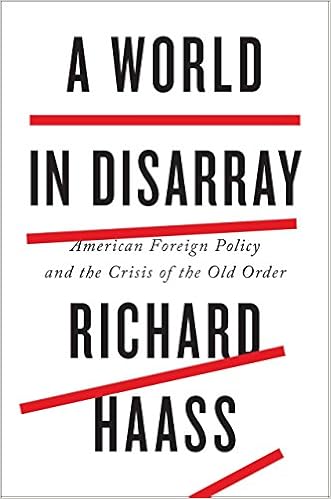
Book Review of Richard Haass's: A World in Disarray: American Foreign Policy and the Crisis of the Old Order (2017) (work in progress)


Resultado de imagen para A World in Disarray: American Foreign Policy and the Crisis of the Old OrderBy:  Richard Haass

Why I got the Book: Richard Haass is a pretty important author in the world of international relations, and I remember reading a couple of books of his back when I was studying, especially   The Reluctant Sheriff: The United State After the Cold War. So basically when I found out he was coming out with a new book in late 2017 I was interested in reading.
What I liked :
•    The book has a very well written introduction, Haass explains exactly what he wants to achieve with the book and basically how.
•    The author takes time to explain the title of the book, so we understand also what is the objective of the book and how he's defining the international system, which is not in a situation of anarchy and it is not a new order either, it is the old order that is in trouble.
•    Haass does a good job defining fundamental terms like World Order at the beginning of the book, I as a reader one appreciates this because you understand exactly what the author is talking about.
•    The book can be divided into three big parts, one focused on the history of the international relation of the twentieth century, the second part centers on the state of international relations during the twenty-first century and finally Haass's recommendations on what the United State should do referring to foreign policy from here on out.
Resultado de imagen para Richard Haass•    Book explains the evolution of the international system during the twentieth century especially analyzing WWII, the post-WWII order, the Cold War and the fall of communism, focusing not only of US foreign policy but also the birth of a constellation of International Organization, NGOs and bilateral and multilateral treaties. 
•    The book has at least two filler chapters and the end where the author gets into his recommendations for future US international policy.
•    Haass is pretty critical of Barack Obama the way he telegraphed his intention with withdrawing troops from Irak and Afganistan or with Iran with the nuclear deal. Also criticizing the comment of the red line with Siria, US involvement in Libya and being very inconsistent with the Arab spring affecting the United States credibility across the world. Richard does mention the succes of killing Osama Bin Ladden is one of the few things that the Obama administration did very well.
•    Haass also complains that the George W Bush and Obama administrations had a very informal way of operating that had a negative impact on making mistakes in foreign policy.
Central Thymes:
•    We are living a grand backlash against globalization, international trade, US involvement around the world and the maintenance of alliances. But this is not only in the United States there is a rise of Populism and Nationalism across the world.
•    The United State is still the most powerful State, but it must share more and more power, because of its ever-changing nature of power, but it is losing influence because of a lack of a proper foreign policy.
•    Power is more distributed, and Richard does not talk about World Order but World Orders. Haass define world order as the nature of the international relations it a measure of the world condition that includes the arrangments the promote peace, prosperity and freedom and those actions that promote the contrary. For there to be order the must be legitimacy, an agreement of the parties of the nature of the relations amongst States (and other actors) the can create a workable situation to operate, we still live in a post westfelian world order. The rules must be defined and no order is safe without physical safeguards. Also for Haass Order depends on the balance of power in the international system and respect for sovereignty.
•    This disorder is a product of structural changes in the international system power  has become more diffuse and there is an ever grown presence of new actors
•    People live longer and better lives, they are more people living in the middle class than any other moment in history.
•    A central aspect of the traditional world order is States and their governments are free to act as they wish within their respective borders.
•    The progressive decolonization during the twentieth century created high levels of disorder in the system on a large scale, the emergence of self-determination that was respected ora least tolerated by many States lead to many countries independence that were not ready for. Also after the end of the cold war and the fall of the USSR 15 new countries appeared on the world stage. Also during this time, we had the emergence of failed States like  Somalia and Haiti, and colossal humanitarian disasters like Ruanda.
•    Post cold war order was incomplete and fragile and international organizations were not up to the task into ushering in a new more solid international order. The Unipolarity the US found itself in a progressively eroding consensus and decreasing legitimacy as time past. The United State being viewed as a superpower is a mistake.
•    The idea of Soverine responsibility becoming more and more important to the modern international system. Issues like Terrorism, Refugees, climate change, cyber crimes/ terrorism, pandemics... all international phenomena that can only be addressed by states working together, unilateral action literal go nowhere and is a waste of time and many find their origin within States and transcend them as they grow, putting in debate the concept of State Sovereignty.  States and their government must understand the ever-growing responsibilities that their internal policies may impact on an international level, Haass explain once State assume this  we will have an evolution of the current international order  
What I didn't like or Debatable Stuff:
Overall: 8 out of 10 good for newbies in international relations.    

jueves, 5 de mayo de 2016

Having fun with Black Panther and International Relations / Black Panther vs ¿George W Bush?


Today I'm going to change things up instead on working on a traditional book about history or international politics, I'm going to have some fun,  I'm going to review and Analyze the first six issues of Black Panther written by Reginald Hudlin (I must note  that to my surprise this writer has very impressive curriculum outside of comics check him out) and is illustrated by the legendary John Romita Jr.

Now I must say before I start, even though comic book movies are exploding establishing record box office sales and finding certain critical respect on  occasions,  I still get this feeling that people still look down on comic books themselves  and very few people are picking them up, and this is a shame because reading comics  really opens up your imagination and helps you think outside of  the box and every once in awhile they make you question stuff, at least this is my personal opinion.
 

 So let get back to Black Panther who has always been a fantastic character, and I want to take advantage of the buzz he'll get in Captain Americas Civil War that has come out this week, and try to get people hooked on this character, becuase his comic are always a great read. 


Now  we are going to work on the   first six issues of Panther's 2005, that  presents the reader with two  very interesting topics: international politics and race relations, and  even though the author bring up some  pretty heavy concepts, the story of the comic never is bogged down or tries to be more than it is, it's a gripping story from front to back. Another thing that I most mention is that the author is no expert in international politics, but it's cool to see him try to get into to these issues.


Core Issues and Ideas in this story arc:
·         We a presented with Wakanda that is a central African country that has incredible resources, has a strong government, that is technological super advanced, depends on no other nation, it  has no alliances with  no other nations, never has been invaded... and there is a big problem the US government  wants to access the untapped petroleum and Vidranium ( a comic book metal that is super valuable) thats in it territory, but T'Challa/Black Panther the country's ruler has no interest in establishing  any type of commercial or economic ties with the United States of America. So the Bush administration (note not mention directly but you can tell it's them) analyzes other options to destabilize the country so they would ask for them for help to save their country, and they know thanks to their intelligence that a villain called the Klaw is out to kill Panther

and they will take advantage of the situation .


·         The Villains that are contracted to take down Panther represent countries that really complicate things for the people of Africa in general  during the colonial era of the continent and after during the post colonial phase:
§  Ulysses Klaw:  Is from Belgium a country that did it's fair share of atrocities on the continent. Now this character is actually Dutch but I guess they changed his nationality because of it historical significance.
§   Rhino: Represents the United State, and we see a character that just running in head first like a freight train, without thinking about his actions.
§  Bartoc the Leaper: This character comes from France another colonial power that  played a major role in Africa.
§  Black Knight: I guess marvel couldn't find any English Villains, (maybe Parnival Plunder) or Catholic Villains, so they made  this odd new Black Knight that is from Great Britain, that is a Catholic zealot/hitman for the Vatican, out to kill pagans. I'm not on the same page of the idea of this character and his characterization of Catholic view but I'll let it slide.
§  Radioactive Man:  Now this character is originally Chinese, but for this story line this is a new Radioactive Man from Russia, and this country played a major role in post colonial Africa.
§  Deathlok's: Zombie killer robots made by the US army, that represent the  Industrial Military complex, always ready to give a helping hand to nations in trouble but indirectly they are occupying it territory.

Add caption
·         Since Wakanda isn't willing to negotiate with the United States on any issue, the Bush administration analyses the possibility to classify the country as a Rogue Nation, but another official  jumps in  and advises not to add this country to the Axis of Evil. Now these two concepts  very interesting political classifications, because they were used by the Clinton administration ( Rogue States)  and latter the Bush administration (Axis of Evil) to establish  enemies of the US.  But the transition from Rogue's to Evil States, shows an evolution of in US policy to validate preemptive strikes, the time of the Reluctant Sheriff had ended policy that characterized US policy during the late 90's early 2000's.
·         The Comic also mentions Regime change which was a political concept that the Bush administration used to justify the war on Iraq, a change of police from the Clinton era, Nation Building that characterized the 90's.
·         Wakandans think that western culture is decadent and backward, in a way the comic doesn't focus on being anti-American, but trying to be less ethnocentric trying to explore the concept of a country that is geographicly in the "Third World" but is superior to any of the world's major powers. There is a part in one of the issues when the leader of another nation tries to make a deal with T'Challa's father appealing  to the fact that he is corruptible like all third world leaders, and he reacts just establishing that his nation need nothing from the rest of the world and that they must be respect his country , because he will not bend to the will of outside interest, and what I've learned from studying international relation for more than 15 years is that autonomy scares the powers that be, because they can become game changers. .

·         The issue explores the racism of the white establishment when administration can't understand how a African black  leader and his country have reached such a level of development, ¿How can they be better than us?, and inclusively panther kicked Captain America's butt once for violating his countries territory, and this make a US general flip out.

So guys I hope you like this brief post if you have any questions post them below that I'll answer them in a jiffy.