Mostrando entradas con la etiqueta International Politics. Mostrar todas las entradas

jueves, 27 de junio de 2019

Book Review of Samuel P. Huntington's Who are We? The Challenges to America's National Identity

Who are We? The Challenges to America's National Identity (2004)


By:  Samuel P. Huntington

Why I got the Book: Basically I enjoyed his classic book Clash of Civilizations even though that book does have some major  issues and certain parts have not aged well, So I came across this very interesting book by Huntington a couple of years ago on US migratory policy that I just had to get, because it is in a field I specialize in immigration.
What I liked :
•    Huntington explores how American constructs  its identity and how it has evolved from its early colonial days up until the early 2000s.
•    The author dives deep into the fact that Americans historically are traditionally religious, something that most none American find surprising.
•    The book takes great effort in trying to explain how the idea that the United States is a country that was and is a  country of immigrants at it had its doors open to them, is a relatively modern concept.
Central Thymes:
•    Is the influx of Spanish speaking migrants, subvert or modify United States national identity and will it become a bilingual and bicultural country?
•    Identity is the feeling of self of an individual within a Grupo. A product of the self-conscious of itself and poses qualities that differentiates itself from others.
•    One Individual may have more than one identity depending on how many group or ciphers they are a part of,  these can adscriptive ( age, sex, ethnic, race...), territorial, economic, cultural, political, social and national. But the identity itself is an imaginary personality, of what we think we are and what we want to be. Identity is also defined by the interaction with other.
•    Individuals need the other, but do they need an enemy? The creation of the enemy actually helps and consoles individuals, it brings cohesion to the group and comparison of what one is not is gratifying, help create differentiation. With groups, the enemy reinforces all of its qualities. The need for self-esteem leads to groups feeling that they are better than the rest, and the group's ego pushes the notion that they are better than the rest.
•    The book gets into the idea that the United States is a nation of immigrants is a pretty modern concept.  The Country was not founded by immigrants but by colonist leaving their land of origin to create something new collectively. There is a strong sense of community and there is an explicit or implicit pact among its members. Immigrants do not create a new society, they move from one to another.
•    In the case of the original colonist of the United States, they were not representative of their population of their country of origin, they were from parts that had been marginalized.
•    66 million migrants arrived to the United States from 1820 to 2000, but the principle make up the US population was descendants of the colonist, immigrants, slaves, native Americans and other conquered groups like Puerto Ricans, Hawaiians and descendants of Mexicans from Texas.
•    The American creed is a principal part of their civic identity and the idea of the exceptionality of their country, American think that their core values are universal.  Another aspect of its identity like it anglo, protestant and racial nature, comes a goes if taken into account for identity, but  territory has never played as a major factor.
•     Race used to be a bigger factor in US identity, in 1790 for citizenship was only for free white people, even though 20% population of Black. With this logic, the United State did not make Philipines or Puerto Rico into States. In 1875 prohibited the immigration of prostitutes and delinquents. In 1882 the prohibition of Chinese immigrants became law, Irish and Polish immigration were looked down on. The idea of a multiracial and Ethnic America is a modern concept born during and after the second world war. 
•    For a large portion of US history Catholics were considered the other,   this a big part of their British heritage that had a strong anti-catholic policy.  In the colonies, Catholics were viewed as possible traitors when Britain had gone to war against Spain and France. The colonial British authority allowed Jewish people to become citizens but not Catholics, execute in Maryland and later in Quebec. Around 1815 with a large influx of migrants from Irland and Germany that were Catholic attitude towards them slowly started to change but also got worse in certain sectors provoking a political backlash they were considered a danger to democracy, because they considered their church autocratic and authoritarian, therefore their followers are the same.
•    The US has a civil religion a profound love for institutions and for patriotism, Americans think they are a chosen people that are exceptional, the new Israel. Many public ceremonies have religious influences and iconography, even certain none religious holidays have a strong religious undertone like memorial day or Thanks Giving.
•    Subnational identities can be based on race, ethnicity, culture, gender, religion...
•    Multiculturalism went up against the concept of the melting pot and assimilation, diversity is more important than the unity of the community, this produced the deconstruction of the American identity.
•    The author cites George Stewart that instead of using the term melting pot the concept of transmutation pot.
•    The lack of an other /enemy up until 2001, the growth in the number of democracies up until that moment across the world, the denationalization of elites y the growth of migrant diasporas of lead to blurring the frontier between national identities and transnational identities.
•    The practical disappearance of ethnicity as a basis for national identity, slow dilution of racial differences and lesser importance of racial identities, the growth of Hispanic culture and the amount of bilingual and bicultural people and less importance of national identity for the countries elites.

What I didn't like or Debatable Stuff:    
•    The greatest threat to modern countries social cohesion is immigration, and basically States have three options: first try to reduce it to zero or near zero, have immigration without assimilation or have immigration with assimilation, at least for me this is a terrible oversimplification of the phenomena of immigration.
•    The author establishes that true assimilation for migrant happens in the second and third generation, but this varies a lot from one immigrant group to another and sometimes second and third generation migrants push back from this assimilation.
•    Book has a lot of filler.
Overall:

lunes, 1 de octubre de 2018

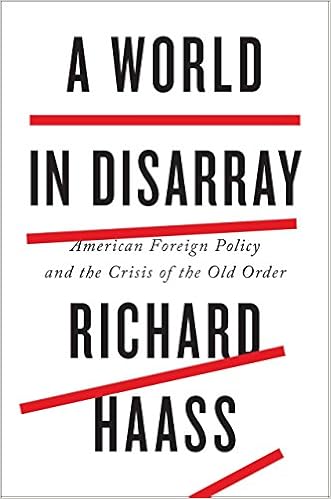
Book Review of Richard Haass's: A World in Disarray: American Foreign Policy and the Crisis of the Old Order (2017) (work in progress)


Resultado de imagen para A World in Disarray: American Foreign Policy and the Crisis of the Old OrderBy:  Richard Haass

Why I got the Book: Richard Haass is a pretty important author in the world of international relations, and I remember reading a couple of books of his back when I was studying, especially   The Reluctant Sheriff: The United State After the Cold War. So basically when I found out he was coming out with a new book in late 2017 I was interested in reading.
What I liked :
•    The book has a very well written introduction, Haass explains exactly what he wants to achieve with the book and basically how.
•    The author takes time to explain the title of the book, so we understand also what is the objective of the book and how he's defining the international system, which is not in a situation of anarchy and it is not a new order either, it is the old order that is in trouble.
•    Haass does a good job defining fundamental terms like World Order at the beginning of the book, I as a reader one appreciates this because you understand exactly what the author is talking about.
•    The book can be divided into three big parts, one focused on the history of the international relation of the twentieth century, the second part centers on the state of international relations during the twenty-first century and finally Haass's recommendations on what the United State should do referring to foreign policy from here on out.
Resultado de imagen para Richard Haass•    Book explains the evolution of the international system during the twentieth century especially analyzing WWII, the post-WWII order, the Cold War and the fall of communism, focusing not only of US foreign policy but also the birth of a constellation of International Organization, NGOs and bilateral and multilateral treaties. 
•    The book has at least two filler chapters and the end where the author gets into his recommendations for future US international policy.
•    Haass is pretty critical of Barack Obama the way he telegraphed his intention with withdrawing troops from Irak and Afganistan or with Iran with the nuclear deal. Also criticizing the comment of the red line with Siria, US involvement in Libya and being very inconsistent with the Arab spring affecting the United States credibility across the world. Richard does mention the succes of killing Osama Bin Ladden is one of the few things that the Obama administration did very well.
•    Haass also complains that the George W Bush and Obama administrations had a very informal way of operating that had a negative impact on making mistakes in foreign policy.
Central Thymes:
•    We are living a grand backlash against globalization, international trade, US involvement around the world and the maintenance of alliances. But this is not only in the United States there is a rise of Populism and Nationalism across the world.
•    The United State is still the most powerful State, but it must share more and more power, because of its ever-changing nature of power, but it is losing influence because of a lack of a proper foreign policy.
•    Power is more distributed, and Richard does not talk about World Order but World Orders. Haass define world order as the nature of the international relations it a measure of the world condition that includes the arrangments the promote peace, prosperity and freedom and those actions that promote the contrary. For there to be order the must be legitimacy, an agreement of the parties of the nature of the relations amongst States (and other actors) the can create a workable situation to operate, we still live in a post westfelian world order. The rules must be defined and no order is safe without physical safeguards. Also for Haass Order depends on the balance of power in the international system and respect for sovereignty.
•    This disorder is a product of structural changes in the international system power  has become more diffuse and there is an ever grown presence of new actors
•    People live longer and better lives, they are more people living in the middle class than any other moment in history.
•    A central aspect of the traditional world order is States and their governments are free to act as they wish within their respective borders.
•    The progressive decolonization during the twentieth century created high levels of disorder in the system on a large scale, the emergence of self-determination that was respected ora least tolerated by many States lead to many countries independence that were not ready for. Also after the end of the cold war and the fall of the USSR 15 new countries appeared on the world stage. Also during this time, we had the emergence of failed States like  Somalia and Haiti, and colossal humanitarian disasters like Ruanda.
•    Post cold war order was incomplete and fragile and international organizations were not up to the task into ushering in a new more solid international order. The Unipolarity the US found itself in a progressively eroding consensus and decreasing legitimacy as time past. The United State being viewed as a superpower is a mistake.
•    The idea of Soverine responsibility becoming more and more important to the modern international system. Issues like Terrorism, Refugees, climate change, cyber crimes/ terrorism, pandemics... all international phenomena that can only be addressed by states working together, unilateral action literal go nowhere and is a waste of time and many find their origin within States and transcend them as they grow, putting in debate the concept of State Sovereignty.  States and their government must understand the ever-growing responsibilities that their internal policies may impact on an international level, Haass explain once State assume this  we will have an evolution of the current international order  
What I didn't like or Debatable Stuff:
Overall: 8 out of 10 good for newbies in international relations.    

lunes, 6 de febrero de 2017

2016 Migratory Report by Matias Cavoti Part 1 Introduction Definition of Migrant


IntroductionResultado de imagen para migrant

Ever since the Lampedusa shipwreck back in October of 2013, that put migrants and their plight on a 24/7 news cycle,  viewers got to see in real time the slow evolution of a Migratory and Refugee crisis that climaxed in late 2015. This coverage from global news networks sparked a strong social/political debate over migrant  control, immigration flows and migratory policy or lack there of, and this debate been going on the last three years topping many States political agendas, there has been a large number of reports by international organizations like from the International Organization form Migrations that use the Lampedusa event as a starting point but explain that migrants fatalities have slowly have been on the rise for the last 15 years,  because of lack of legal access to destination countries like the United States or the member countries of the EU, through legal/political means, for example, establishing travel visas or not permitting access  legal residencies in host countries and even physical barriers like building walls  with tight border control, just to name a few, have hindered the opportunities of many migrants pushing them to take risk in trying to reach and enter the country they want to immigrate to, many time putting their life in danger. And  what has become increasing evident observing major destination countries and even transit States, the last five years, is that their migratory policies are outdated or even broken,  the tools that they use to manage migratory  flows are buckling under pressure  because of the increasing amount of people arriving, and for example  as this report will explain many destinations States like the United States of America and even transit countries like Mexico, do not take the proper statics on migrants border deaths or missing, so it's pretty hard to establish the proper actions to curve illegal transits, because the places where border deaths occur are the same places where migrants and smugglers try to crosses illegally so State cannot take the appropriate actions because they are basically operating in the dark in many cases.
This brief report will concentrate on the migratory flows themselves, the dangers that migrants face in their migration, analyze the politics behind this transnational phenomena and explain some central migratory concepts. For example, Push and Pull factors will be only mentioned only when needed. The time frame for this study will be from the Lampedusa shipwreck in October 2013 to September of 2016 when Frontex becomes the official Border control and Coast Guard of the European Union which seem to be a real game changer. And this Report will mainly focus on the migratory flows that cross Central America crossing Mexico to the United State,  Easter and Western African flows heading north and the eastern European flows, these four  major areas are major migratory hotspots which International Organization for Migration (IOM) has made a series of reports during last three years, the United State Department of State Trafficking In Persons of 2016, Frontex Quarterly Reports and news articles from various  sources. 
Now this study  will center on  migrants and will leave refugees mostly out of analysis because both these two international phenomena are distinctly different but are actually growing into each other, the line between them is getting harder to define so it's fundamental to establish some basic concepts like migrant before moving on with this report to understand exactly what is being referenced to eliminate any misconceptions or errors of interpretations, first and foremost Migrant must be defined, and one must note that IOM has modified their definition of migrant in 2016 so we'll work  with the new definition and the old one, to see the evolution of the concept that was needed to better understand the phenomena: 
"IOM defines a migrant as any person who is moving or has moved across an international border or within a State away from his/her habitual place of residence, regardless of (1) the person’s legal status; (2) whether the movement is voluntary or involuntary; (3) what the causes of the movement are; or (4) what the length of the stay is (IOM 2016)[1]". But this definition adds new elements that were not present in the previous one which defined migrants as "people or group of individuals that move from one geographic unit to another crossing administrative or political frontiers with the intention establishing themselves temporarily or permanently in a place different from their place of birth (IOM 2011)".  
The newer definition explicitly covers more theoretical terrain while the older one does cover the same issues, but implicitly and with some level of interpretation.  The first difference is the reference to the legal status that is made explicit the fact that migrants can be legal, temporary, permanent, illegal, irregular, undocumented, refugees, stateless and displaced by humanitarian or environmental disasters. Now  even though Refugees can be considered migrants, this particular concept has been separated and treated distinctly differently for  traditional migrations, but as referenced previously in the report  as of late the theoretical line drawn between these two concepts have become increasingly blurred with the ever growing mix migratory flows that have been observed the last   20 years. So it's  impossible to leave refugees totally out of the analysis because the flows in  many cases are mixed having a symbiotic relationship in some cases migrants capitalizing off refugees and vice versa, this will be illustrated later in the report when it will be explained how migrants took advantage of the Syrian refugee crisis to enter the Europe.
Now back the factors that differentiated these two concepts is that migrants travel and reestablish themselves voluntarily while refugees are pushed out of their country involuntarily, now with this new definition establishes that in both cases they are considered migrants be it voluntary or not and puts both under the same theoretical umbrella.
One must note that in  July of  2016 of the International Organization for Migrants (IOM) official became a related organization to the United Nations, this will give the UN mandate for the first time on migratory issues and when this happened both institutions made joint declaration referred to Refugees and Migrants, the UN and IOM, established and reaffirmed some key principals that I would like to highlights:
·         Even though migrants and refugees each have unique legal definitions, people that are migrants or refugee have the same universal human rights, and even though migration must be an option, not an obligation. But   It's getting harder to separate the flow of refugees and migrants, mixed flow are growing more common.
·  
· 
·    
Now having established what is a migrant, it is fundamental to understand what is a Migratory  Policy (MP), it can established that it is an  important political tool and has become hot topic in many countries during the last  10 years and for example it took center stage during the 2016 US election with diametrically opposed positions held by the candidates Hillary Clinton and Donald Trump, in how to manage the migratory flows in direction towards their country and what to do with the illegal migrants that are already in its national territory. Now for nations that are the destination for large masses of immigrants, they are in great need for tools to act and control migratory flows that are directed in their direction and through a proper MP, for example, can help recipient  States to capitalize on the human capital migrants represent.  So basically the objective for a migratory policy is to find a way to manage the flow of people entering (or exiting) a country temporarily or permanently and how can it serve best the needs/interests of the host country. Migratory policies can have the objective of retaining, promoting, regulating, incorporating, recovering and even blocking or redirecting migrants (Marmora 2002)[2].  
Also, we must define the what is trafficking of persons or human trafficking, concepts that will be recurring issues in this report, they are umbrella terms for the act of recruiting, harboring, transport, providing or obtaining a person compelled labor or commercial sex acts through the use of force, fraud or coercion. (TIP 2016). The TIP report establishes that movement isn't obligatory, a person can be subjected to human trafficking in their own hometown, but for the sake of this report, we will only highlight most important international cases where people are forced or tricked to cross international borders.


[1] http://www.iom.int/who-is-a-migrant
[2] The last two policies are not referenced by Marmora in his book The Policies of International Migrations, in his book he tends to omit that blocking or redirecting migrants is an option for the State, but these options a very real and are applied often.

viernes, 8 de agosto de 2014

Political Theory-Migratory Policy: States Social Identity and how they Establish their Political Interests.


As we have seen on previus post Corporate identity is the engine that provides the initiative to the actor/States for their actions, but these are conditioned by the social relations of the actor, therefore the corporate identity depends on the relations of the subject with others (Wendt 1994; 356). Here is where we introduce the concept of social identity where the actor attributes meaning to itself and by doing this it takes perspective of the others actors, it is impossible to think an actor as a person who is completely alone in the world, likes it or not it must interact with others, to a greater or lesser extent this depends on each State. The two identities have a strong interrelation and feedback in to each other, to strengthen over time. But there is something one must keep in mind, that an actor has one corporate identity, but may have multiple social identities, but it is always limited and determined by the historical and cultural background of the actor. When one assumes an identity the actor also gives identity to others and in this context the vision of the State is born. Social identity can be simplified   in these terms, it the way the actor sees itself, how he sees others and how it’s seen. The vision of the actor in the world is born of this social identity. In the case of migratory policy we’ll see how the definition of a social identity condition de decisions of an actor, in this case Argentina.

Identity determines interest and therefore a change in any aspect of the Sates identity, will drag in a new group of interests. We are using the example of Argentina Migratory Policy in my post, to explain this point.  Initially you can see that the previous Immigration law caused dissociation between the actions [6] of the actor, social reality in its borders and its identity. Argentina’s view on migrants had a serious distortion of what was happening on a domestic level and on a international level, the old law that established its migratory policy did not serve the countries best interests, you can si a similar situation in the US  that has a high dissociation between its migration policy, social reality and their national identity, which has sparked a strong debate on what the government should do, this point will be developed in detail later in other posts. What we can say preliminarily is that currently that the Argentine identity revolves around the fact that sees itself and is seen by other States ( especially in the region), as a democratic country that respects human rights and that it had a historic role of reception of migrants.
Within the process of identity formation Wendt says that the actor uses imitation and social learning (Kowert; 2001), this is a borrowed concept from other constructivist author from another area of investigation, that is Jean Peaget, an expert in the psychology of education. We must establish whether Argentina immigration policy is the result of imitation or is a product of social learning. The actor learns to change their knowledge and perceptions of the world, and this is a dynamic process that is maturing over time, the perceived world is not a static place but is always changing.
Also can be exposed ahead of time that there is no doubt that the Argentina learned from their past mistakes committed during law 22.439 and capitalizes on that to create an immigration policy that is much more efficient, functional and that fits the needs of the country. One must ask what could have changed in the Government/State or within the population or what modification on the basis of their social relations, would lead to a change Argentina’s view, that made it change its migratory policy? Because something triggered an adjustment in policy and created a whole new theoretical body of knowledge, to be able to operate a new international and domestic reality. But this knowledge is not a copy of reality, here comes the factor of perception, one tends to see what best suits ones interests best, may be relatively selective according to the subject and this in turn is determined by the experience, needs and how the actor encodes and decodes the information that it receives from the world. The perceived world is a subjective world that can be shared by other actors or not.


If you like the review give me a hand and support me on Patreon at this Link that will make me, Matias Cavoti very happy to keep writing.