Mostrando entradas con la etiqueta Samuel Huntington. Mostrar todas las entradas

jueves, 27 de junio de 2019

Book Review of Samuel P. Huntington's Who are We? The Challenges to America's National Identity

Who are We? The Challenges to America's National Identity (2004)


By:  Samuel P. Huntington

Why I got the Book: Basically I enjoyed his classic book Clash of Civilizations even though that book does have some major  issues and certain parts have not aged well, So I came across this very interesting book by Huntington a couple of years ago on US migratory policy that I just had to get, because it is in a field I specialize in immigration.
What I liked :
•    Huntington explores how American constructs  its identity and how it has evolved from its early colonial days up until the early 2000s.
•    The author dives deep into the fact that Americans historically are traditionally religious, something that most none American find surprising.
•    The book takes great effort in trying to explain how the idea that the United States is a country that was and is a  country of immigrants at it had its doors open to them, is a relatively modern concept.
Central Thymes:
•    Is the influx of Spanish speaking migrants, subvert or modify United States national identity and will it become a bilingual and bicultural country?
•    Identity is the feeling of self of an individual within a Grupo. A product of the self-conscious of itself and poses qualities that differentiates itself from others.
•    One Individual may have more than one identity depending on how many group or ciphers they are a part of,  these can adscriptive ( age, sex, ethnic, race...), territorial, economic, cultural, political, social and national. But the identity itself is an imaginary personality, of what we think we are and what we want to be. Identity is also defined by the interaction with other.
•    Individuals need the other, but do they need an enemy? The creation of the enemy actually helps and consoles individuals, it brings cohesion to the group and comparison of what one is not is gratifying, help create differentiation. With groups, the enemy reinforces all of its qualities. The need for self-esteem leads to groups feeling that they are better than the rest, and the group's ego pushes the notion that they are better than the rest.
•    The book gets into the idea that the United States is a nation of immigrants is a pretty modern concept.  The Country was not founded by immigrants but by colonist leaving their land of origin to create something new collectively. There is a strong sense of community and there is an explicit or implicit pact among its members. Immigrants do not create a new society, they move from one to another.
•    In the case of the original colonist of the United States, they were not representative of their population of their country of origin, they were from parts that had been marginalized.
•    66 million migrants arrived to the United States from 1820 to 2000, but the principle make up the US population was descendants of the colonist, immigrants, slaves, native Americans and other conquered groups like Puerto Ricans, Hawaiians and descendants of Mexicans from Texas.
•    The American creed is a principal part of their civic identity and the idea of the exceptionality of their country, American think that their core values are universal.  Another aspect of its identity like it anglo, protestant and racial nature, comes a goes if taken into account for identity, but  territory has never played as a major factor.
•     Race used to be a bigger factor in US identity, in 1790 for citizenship was only for free white people, even though 20% population of Black. With this logic, the United State did not make Philipines or Puerto Rico into States. In 1875 prohibited the immigration of prostitutes and delinquents. In 1882 the prohibition of Chinese immigrants became law, Irish and Polish immigration were looked down on. The idea of a multiracial and Ethnic America is a modern concept born during and after the second world war. 
•    For a large portion of US history Catholics were considered the other,   this a big part of their British heritage that had a strong anti-catholic policy.  In the colonies, Catholics were viewed as possible traitors when Britain had gone to war against Spain and France. The colonial British authority allowed Jewish people to become citizens but not Catholics, execute in Maryland and later in Quebec. Around 1815 with a large influx of migrants from Irland and Germany that were Catholic attitude towards them slowly started to change but also got worse in certain sectors provoking a political backlash they were considered a danger to democracy, because they considered their church autocratic and authoritarian, therefore their followers are the same.
•    The US has a civil religion a profound love for institutions and for patriotism, Americans think they are a chosen people that are exceptional, the new Israel. Many public ceremonies have religious influences and iconography, even certain none religious holidays have a strong religious undertone like memorial day or Thanks Giving.
•    Subnational identities can be based on race, ethnicity, culture, gender, religion...
•    Multiculturalism went up against the concept of the melting pot and assimilation, diversity is more important than the unity of the community, this produced the deconstruction of the American identity.
•    The author cites George Stewart that instead of using the term melting pot the concept of transmutation pot.
•    The lack of an other /enemy up until 2001, the growth in the number of democracies up until that moment across the world, the denationalization of elites y the growth of migrant diasporas of lead to blurring the frontier between national identities and transnational identities.
•    The practical disappearance of ethnicity as a basis for national identity, slow dilution of racial differences and lesser importance of racial identities, the growth of Hispanic culture and the amount of bilingual and bicultural people and less importance of national identity for the countries elites.

What I didn't like or Debatable Stuff:    
•    The greatest threat to modern countries social cohesion is immigration, and basically States have three options: first try to reduce it to zero or near zero, have immigration without assimilation or have immigration with assimilation, at least for me this is a terrible oversimplification of the phenomena of immigration.
•    The author establishes that true assimilation for migrant happens in the second and third generation, but this varies a lot from one immigrant group to another and sometimes second and third generation migrants push back from this assimilation.
•    Book has a lot of filler.
Overall:

martes, 18 de junio de 2019

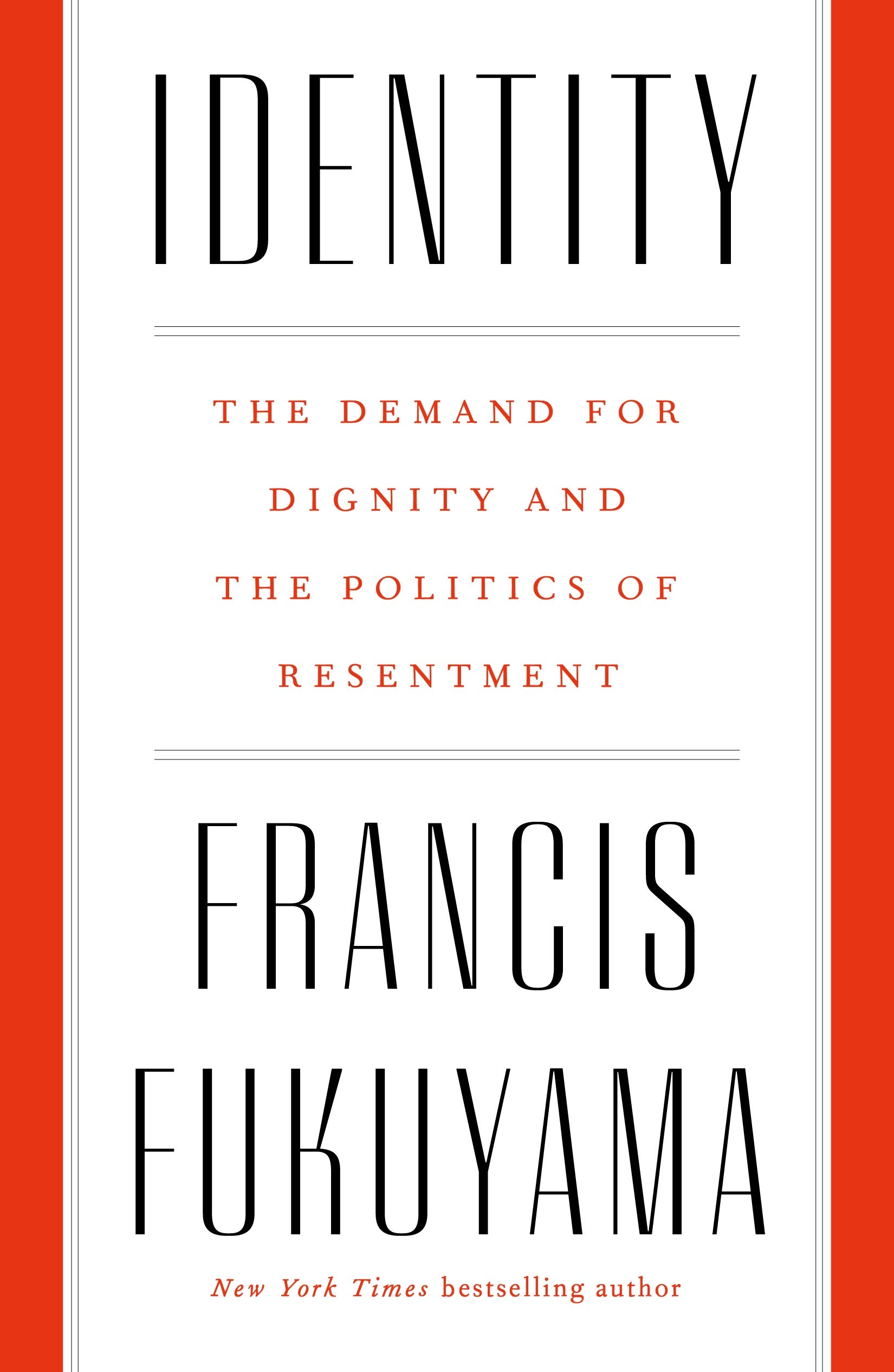
Book Review of Francis Fukuyama's: Identity, The Demand for Dignity and the Politics of Resentment

Resultado de imagen para Identity, The Demand for Dignity and the Politics of Resentment.Identity, The Demand for Dignity and the Politics of Resentment. (2018)

By:  Francis Fukuyama

Why I got the Book: I  love Fukuyama's work, so I'm always ready to pick up and read one of his books.

What I liked :
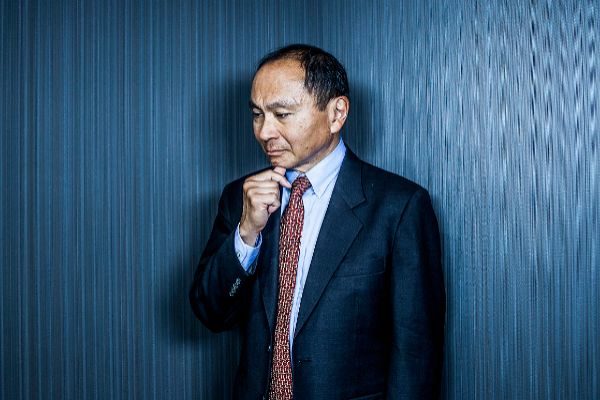
Imagen relacionada•    I found it funny that Fukuyama explains that he was completely surprised by Trump's victory in the United States elections and of Brexit. Fukuyama's initial hunch of what lead to these two major historical events was the rise of populism and authoritarian governments across many democracies, being fed by the decay of classic democratic institutions, like in Hungry, Turkey, Thailand, Poland...  while the Arab spring showed how weak democratic revolutions can be.
•    If you're a newbie to the world of political philosophy and theory of the State, one can learn a lot in this book.
•    The book explores the world of identity politics and Francis takes great effort to define identity itself and how this concept has evolved over the years.
•    Fukuyama revindicates Samuel Huntington in this book citing him and defending his work.
Identity politics for Fukuyama by no means are consider as a bad thing, for him it does seek change culture and behavior, to try to respond and amend an injustice affecting that group.    


Central Thymes:
•    Modern nationalist populist are described by Fukuyama initially by rising to power legitimately through democratic means, they claim a connection to the people through narrow ethnic/cultural terms, do not like basic democratic institutions always putting them in question and seek to undermind the check and balances that are fundamental to the health of democracy.
•    Two core concepts the book revolves around is Isothumia the demand to be respected on an equal basis with other people or groups and Megalothumia the desire to be recognized as superior. Fukuyama explains that Isothumia and Megalothumia can and do feed into each other.
•    Francis make a fascinating affirmation that liberal capitalist democracies have created a world order that has lead to a great inequality amongst  the populations of many nations but overall humanity, in general, is better off in general with many social and economic indicators better than ever but there is a great concentration of power  in  elites across the globe, the rise of new oligarchs in many State across the globe. Elites that are viewed are the ones responsible for the Economic crash in the US in 2008 and the crisis in Greece, there has been the perception of the hollowing out of the middle class. 
•    The author explains the evolution of the Left and Right of the political spectrum and how they change, with the left shifting focus from  equality of workers, trade unions, social protection, and economic redistribution now fixated on groups that view themselves as marginalized, diving head first into identity politics. While the right that centered their views of freedom, reducing the size of government and the promotion of the private sector, but  also now indulging in identity politics in the search of the true patriots who will protect national identity defined by race, ethnicity and/ or religion.
•    Transnational elites vs. patriotic national elite that fighting their proper respect and recognition.
•    The book establishes that Identity is how one defines ones inner self but also how the social world with its rules and norms shapes one's identity giving it or not recognition and importance, basically your worth and dignity. Now in modern times, the inner self is intrinsically valuable and the outer society is systematically wrong. One must not conform to the rules that society imposes, it must change one must find and receive recognition, self-esteem has become paramount.
•    Fukuyama explains that traditionally it is established the individual are rational utility maximizers, who seek to benefit their own self interest and if they cooperate with others it is to reach this goal. But the rational choice paradigm and behavior economics cannot explain preferences and identity politics, where status, dignity, and honor are fundamental and become political rights. And in these modern times, the desire for equal recognition has changed for the validation of the group's superiority. There an obsession with the idea of validation and authenticity, while feeling varying degrees of resentment and humiliation, the author uses the example of the Arabe Spring.
•    Francis writes that when a minimal common culture is perpetually put into question a shared moral horizon starts to disappear competing with a cacophony of competing values systems, many people do not enjoy this situation of this new found freedom, many people feel an intense insecurity and alienation. While we have the rise therapeutic liberalism, product of the rise and incorporation of psychology within many disciplines within the social sciences and in public policy since the mid '80s has lead to the politicization of the recognition of self-esteem and lived experiences, that does not worry about a just or unjust society, but focus on rules that retrain and recognition. The problem this creates a great divergence amongst groups which have different shared experiences, causing that it impossible to see eye to eye on any key issues and social media feeds into this tremendously. 
•    Nationalism and politicized religion create a collective identity and are really good at diagnosing problems and each have their way of solving these problems, they are willing to play the democratic game to reach their illiberal objectives. They feel disrespected and they feel a great nostalgia for an imagined past, author uses the example of second and third generation Muslims in Europe, that turn to jihadist who are mostly disenfranchised and marginalized young adults many time petty criminals and or parts of gangs, the motivation of their conversion is more personal and sociological than religious, fueled by the problem of identity the rejection of their parents identities and their host societies. 
•     The Middle class is a theme that the author revolves around a lot in this book, which seeks respect and are politically motivated, they feel threatened and have really pushed the rise of nationalism across many countries, feeling the poor or unworthy  (migrants for example)   are eating away at their well being and unfairly favored, while feeling invisible or ignored by the ruling elites.  People of the middle class feel like the work hard than the rest and play by the rules, and feel it's unjust that they are unseen they perceive their status is being trampled on. The nationalist discourse they are holding you down find an echo in these people.  
•    The book gets into the evolution of the left during the past 50 years which started to fixate on culture, especially on institutions that opressed minorities at home and on developing nations. Multiculturalism became the predominant form of public policy, but this lead to many immigrant communities not wanting to integrate themselves in their host societies, in the case of Europe Salafist community leaders pushed for this, and the left recognized these political figures for being the more authentic representatives of their community than the westernized Muslims.
•    In the social/political discourse opinions become privileged over reason, and everything is driven by identity, also a short form dissertation reign in the world of social media feeds into this. Identity politics can start producing feedback in a way that makes political correctness more and more important, And this happens on both sides of the political spectrum eventhough it started on the fringes of the left.
•    Identity becomes none negotiable in the way they are conceived today, have paved the way to the death of political debate.
•    Society needs to protect the excluded and marginalized but also establish common goals, national identity creates the shared belief in the countries political system whether it be democratic or not. This identity can be embodied informal laws and institutions, for example, the recognition of an official national language .A official history within school curriculums plays a fundamental role in the construction of a common identity among many other things the state can do for its construction. The promoter of culture like poets, filmmakers, artist, musicians... tend to have a special place in culture. If people constantly question  there national identity seeking refuge in the more personal definition of identity, basically over time you'll have a  community not willing to seek common goals with other groups to achieve common national goals, this also eats away a the trust among communities killing social capital.
•    Fukuyama does not like the concept of dual nationality, ius solis should define nationality, assimilation is fundamental, common school desegregate communities, civics classes are extremely fundamental, the border must be controlled but a proper migratory policy needs
      
  
What I didn't like or Debatable Stuff:
•    The author revisits certain aspects of the theory of States and political philosophy that he has already touched in other books, it seems to be his go-to place for filler for Fukuyama.    
Overall:

domingo, 3 de julio de 2016

Book Review and Analysis: Making War in the Name of God by Christopher Catherwood (Work in Progress)


Book Title: Making War in the Name of God

Author: Christopher Catherwood (History Professor in the University of Cambridge and the University of Richmond. Member of the  Royal Historical Society).

My Personal Expectation with de Book ( Basically why I Picked it up): The topic presented in the title of this publication, is something that always has interested me, religious conflicts, and the subject  has dominated my studies since I have gotten my hands of Samuel Huntingtun's Clash of Civilizations more than 15 years ago . Now the title establishes Wars in the name of God so I'm gearing up for a book that will present me, the reader, with a wide range of conflicts between many religions,  or at least the ones that symbols are on the cover Judaism, Christianity and Islam. The title and cover doesn't give us a time frame so I guess the book goes back to the dawn of organized religion. So sit tight my review and analysis of the book will probably come around in two weeks maybe. less.   


So a finished my review and Analysis of this interesting history book, that basically is about the conflict between Christianity and Islam so here is my breakdown, of the stuff I liked.


Central Thymes and Concepts, that interested me as the reader:

  • The author explains that there is two classes of Jihad, the first being minor or military and major or religious, which is the internal struggle for sanctity, and the author affirms that most Muslims that live in the west view the second as the right path. But in the west most none Muslims do not know this distinction and only think of Jihad as those violent acts that one sees on the TV or reads in scores of book on the subject. Now Christopher doesn't it leave it there he recommends reading David Cooks, Understanding the Jihad, and that author establishes that even though most Muslims today view Jihad as an internal struggle, historically the military concept of Jihad has prevailed. that this division is more of a modern novelty, and that the internal struggle is more of a perpetration for the military struggle.
  •  Catherwood  affirms that people in the West and in the Islamic world must stop repeating  that the West as a civilization is responsible for perpetual aggression against the Islamic World, that they are victims of Imperial Christianity, these is a bold affirmations that the author  defends pretty effectively, establishing that since the death of the Prophet Mohammed, from  632 till 1683, Islam had been on a expansionist aggressive with the leader of the State was also the leader of the faith, with Christianity on the defensive. Christianity in its early phases was a persecuted and was clandestine faith, while Islam from the beginning has been militaristic and political, where the leader of the faith was the head of State. but this example of  Catherwood is not to show how evil Islam is, but to give people  some historical perspective and the author directly establish that Islamic world acted as an imperial power in expansion, just like the West has been acting since colonialism as individual Nation States not in the name of a faith.
  • The author presents a unique perspective referring to how the crusades started citing Bernard Lewis that explains that the true conflict that had arose in Palestine  sparking the crusades wasn't a conflict between Christian and Muslims ( in the first phase), but really  between Sunni and Shia Muslims to end the dominion of the Fatimid's, there was a Sunni need of ending this heresy in the heart of the Muslim world, and the famous Saladin was the man to do it.


    • The book on page 115 establish one of the sad aspects of religious conflict that  I hadn't noticed explicitly, when these conflicts explode people kill people that they know, civilians kill civilians, even women and children, this is a shocking but true conclusion.  For some reason in religious  conflicts convert the other in something infrahuman that does not have the right to live and sadly there are many examples that makes validate this point.
      There is a need humiliate the other, denigrate him/her, dehumanize then p116, doing this make the act of killing easier for people that normally would not attack and kill someone like a soldier, the enemy is a virus a plague that can destroy your life and everything around you and also your god your reason of existence. People like Osama bin Laden take a normal human conflict and take it out of Its context to a cosmic level to get divine sanction, there is no sin or wrong doing God thinks It's ok. Once the Other is dehumanized and terrible act against the Other is valid because It's the Will of god, they are not personal enemies they are gods enemies.


      • Chris presents the reader  how Orthodox Christian's  religious animosity towards Muslims evolved, and to a certain extent it a byproduct of the fall of the Ottoman Empire, that was  left on standby during the time the existence of the  State of Yugoslavia. Author establishes that the Balkan War was a religious War First and foremost. In the Ottoman empire each religious group was classified in the Millet System, so Orthodox Christian were in the Orthodox Millet. The Ottoman Empire really cracked down  on the Balkan region and there were mass conversations in Bosnia and in Albania. Serbs considered the Slavs that converted traitors of their blood line. And one must add that Serbs had their own Orthodox Church that governed itself, symbol of the lost Serbian Empire. For Serbs to be Serb is to be Orthodox and vice versa, and all this tied to the land. Author establishes it wrong to use the term ethnic cleansing during the Balkan Wars, because the groups involved are all of the same ethnicity: Serbs, Croats and Bosnians, it was a religious-cleansing.


The Good stuff about the Book:
  • Book concentrate on the conflict between Islam and Christianity, but it  also dives into internal conflict in each faith.

    • Author actually does something pretty interesting  establishing that it's possible that he'll not be objective, establishing that he's a religious person, a Anglican to be exact and that  his maternal family come from Wales. while his paternal family comes from North Ireland, and he explains that this has a great impact on his religious views. This is valuable the an author that  actually addresses this issue because many authors act like their  totally impartial or do their best, but almost always their religious or political views  seep in, so knowing this right of the bat you know how to filter the information, but the funny thing is that  in this case this author is one of the most objective ones that I've ever come across in a long time.
      • Chris points out there is a problem with authors that work on Islam and conflicts related to this faith; I must add with any faith , or they establish that  it's a totally aggressive religion prone to violence (like another book I'm reading ...) or a totally not responsible for any violent acts, and just some individuals are the ones causing  some trouble but don't represent the faith, so the author establishes both of these points of view are wrong, and I'm on the same page that one has to find some middle ground. From my point of view one cannot say Islam is a religion of Peace or Christianity is a Peace, this is wrong they are just religions and nothing else, now in this case they both have holy books that promote peace but also violent acts, what I've learned over the years people take what they want from their faith a tend to discard the rest, in other words religious people are picky, so the people make faiths violent or peaceful.
      • The chapter about the war in the Balkan and why it happened, has one of the best explanations that I've have ever come across about this conflict, the author really nails it in this part of the book.
        • Book set me on the search of a author that Chris cites called Vmik Volkan that seem pretty interesting.
        • The book is well written in the aspect that the author goes straight to the point, he doesn't go overboard with information and it a easy read I finished it pretty fast because it's enjoyable, because the author writes from his perspective it isn't a copy and paste of another history  book, authors do that sometimes when you get with these types of books.


The Bad:
  • Book on the cover references the conflicts with Judaism but only refers to them marginally, but a Jewish star is on the cover one would think there would be more about their conflict with other faiths, it mentioned how the suffered at the hands of the crusaders, but there is no mention of the Arab Israeli conflict.  
  • The Author sustains that the  Balkan Wars where the principle motors in the birth of modern Fundamentalist, pretty much forgetting Chechnya and Afghanistan.
    • Book only concentrates on the conflicts between Christianity and Islam, and at moments in goes in to the internal struggles of each faith, but vary rarely mentions other faiths, so the title of the book is just to brood and a little misleading because you get the idea that possibly the book covers  all religious conflicts.


Overall: I'm going to give this book a 7 out of 10, becuase you can tell the author takes the book to his confort spot the Balkan Wars omiting tons of stuff, maybe changing the title you acutally fix this.