Mostrando entradas con la etiqueta Francis Fukuyama. Mostrar todas las entradas

martes, 18 de junio de 2019

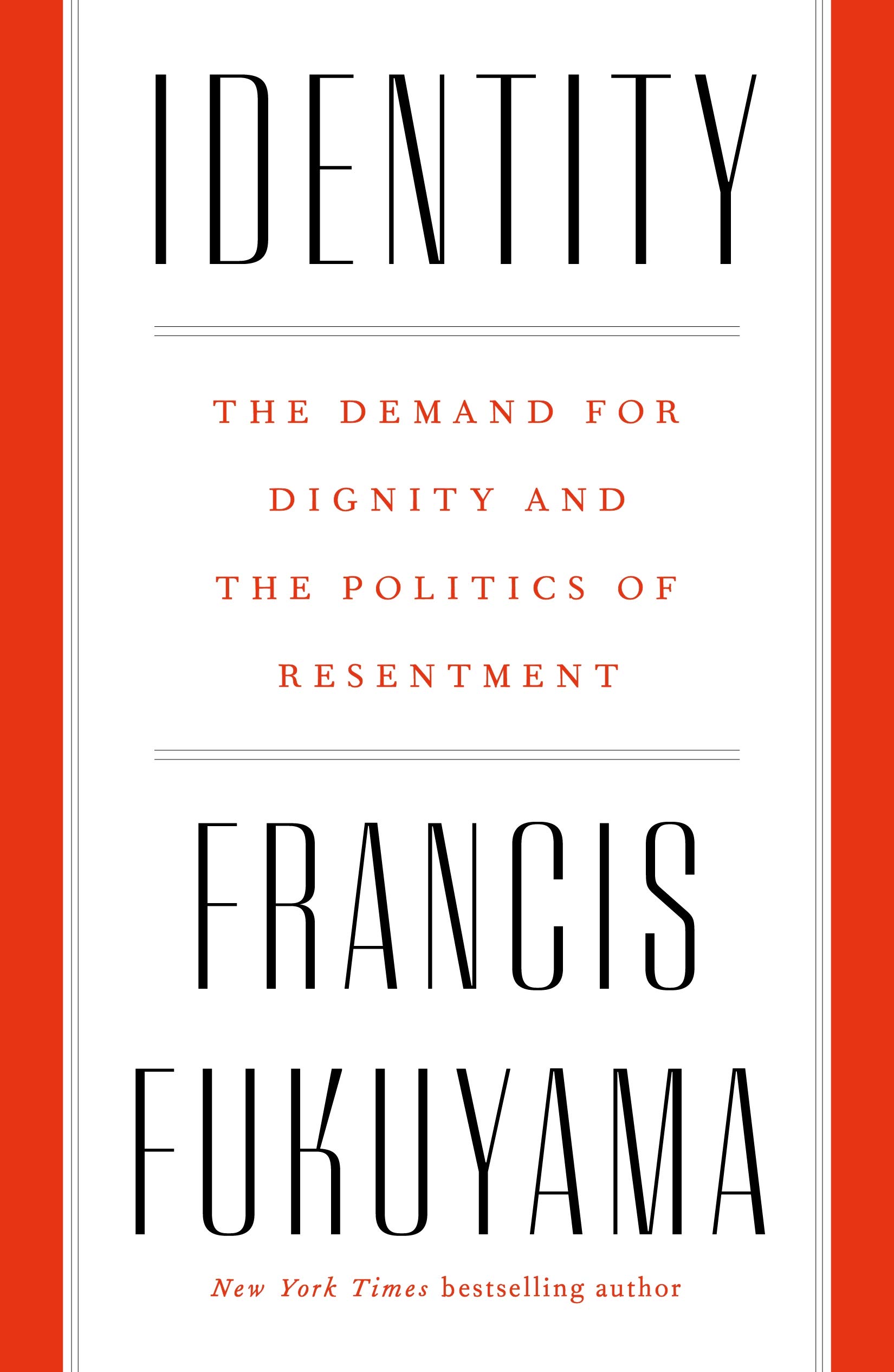
Book Review of Francis Fukuyama's: Identity, The Demand for Dignity and the Politics of Resentment

Resultado de imagen para Identity, The Demand for Dignity and the Politics of Resentment.Identity, The Demand for Dignity and the Politics of Resentment. (2018)

By:  Francis Fukuyama

Why I got the Book: I  love Fukuyama's work, so I'm always ready to pick up and read one of his books.

What I liked :
Imagen relacionada•    I found it funny that Fukuyama explains that he was completely surprised by Trump's victory in the United States elections and of Brexit. Fukuyama's initial hunch of what lead to these two major historical events was the rise of populism and authoritarian governments across many democracies, being fed by the decay of classic democratic institutions, like in Hungry, Turkey, Thailand, Poland...  while the Arab spring showed how weak democratic revolutions can be.
•    If you're a newbie to the world of political philosophy and theory of the State, one can learn a lot in this book.
•    The book explores the world of identity politics and Francis takes great effort to define identity itself and how this concept has evolved over the years.
•    Fukuyama revindicates Samuel Huntington in this book citing him and defending his work.
Identity politics for Fukuyama by no means are consider as a bad thing, for him it does seek change culture and behavior, to try to respond and amend an injustice affecting that group.    


Central Thymes:
•    Modern nationalist populist are described by Fukuyama initially by rising to power legitimately through democratic means, they claim a connection to the people through narrow ethnic/cultural terms, do not like basic democratic institutions always putting them in question and seek to undermind the check and balances that are fundamental to the health of democracy.
•    Two core concepts the book revolves around is Isothumia the demand to be respected on an equal basis with other people or groups and Megalothumia the desire to be recognized as superior. Fukuyama explains that Isothumia and Megalothumia can and do feed into each other.
•    Francis make a fascinating affirmation that liberal capitalist democracies have created a world order that has lead to a great inequality amongst  the populations of many nations but overall humanity, in general, is better off in general with many social and economic indicators better than ever but there is a great concentration of power  in  elites across the globe, the rise of new oligarchs in many State across the globe. Elites that are viewed are the ones responsible for the Economic crash in the US in 2008 and the crisis in Greece, there has been the perception of the hollowing out of the middle class. 
•    The author explains the evolution of the Left and Right of the political spectrum and how they change, with the left shifting focus from  equality of workers, trade unions, social protection, and economic redistribution now fixated on groups that view themselves as marginalized, diving head first into identity politics. While the right that centered their views of freedom, reducing the size of government and the promotion of the private sector, but  also now indulging in identity politics in the search of the true patriots who will protect national identity defined by race, ethnicity and/ or religion.
•    Transnational elites vs. patriotic national elite that fighting their proper respect and recognition.
•    The book establishes that Identity is how one defines ones inner self but also how the social world with its rules and norms shapes one's identity giving it or not recognition and importance, basically your worth and dignity. Now in modern times, the inner self is intrinsically valuable and the outer society is systematically wrong. One must not conform to the rules that society imposes, it must change one must find and receive recognition, self-esteem has become paramount.
•    Fukuyama explains that traditionally it is established the individual are rational utility maximizers, who seek to benefit their own self interest and if they cooperate with others it is to reach this goal. But the rational choice paradigm and behavior economics cannot explain preferences and identity politics, where status, dignity, and honor are fundamental and become political rights. And in these modern times, the desire for equal recognition has changed for the validation of the group's superiority. There an obsession with the idea of validation and authenticity, while feeling varying degrees of resentment and humiliation, the author uses the example of the Arabe Spring.
•    Francis writes that when a minimal common culture is perpetually put into question a shared moral horizon starts to disappear competing with a cacophony of competing values systems, many people do not enjoy this situation of this new found freedom, many people feel an intense insecurity and alienation. While we have the rise therapeutic liberalism, product of the rise and incorporation of psychology within many disciplines within the social sciences and in public policy since the mid '80s has lead to the politicization of the recognition of self-esteem and lived experiences, that does not worry about a just or unjust society, but focus on rules that retrain and recognition. The problem this creates a great divergence amongst groups which have different shared experiences, causing that it impossible to see eye to eye on any key issues and social media feeds into this tremendously. 
•    Nationalism and politicized religion create a collective identity and are really good at diagnosing problems and each have their way of solving these problems, they are willing to play the democratic game to reach their illiberal objectives. They feel disrespected and they feel a great nostalgia for an imagined past, author uses the example of second and third generation Muslims in Europe, that turn to jihadist who are mostly disenfranchised and marginalized young adults many time petty criminals and or parts of gangs, the motivation of their conversion is more personal and sociological than religious, fueled by the problem of identity the rejection of their parents identities and their host societies. 
•     The Middle class is a theme that the author revolves around a lot in this book, which seeks respect and are politically motivated, they feel threatened and have really pushed the rise of nationalism across many countries, feeling the poor or unworthy  (migrants for example)   are eating away at their well being and unfairly favored, while feeling invisible or ignored by the ruling elites.  People of the middle class feel like the work hard than the rest and play by the rules, and feel it's unjust that they are unseen they perceive their status is being trampled on. The nationalist discourse they are holding you down find an echo in these people.  
•    The book gets into the evolution of the left during the past 50 years which started to fixate on culture, especially on institutions that opressed minorities at home and on developing nations. Multiculturalism became the predominant form of public policy, but this lead to many immigrant communities not wanting to integrate themselves in their host societies, in the case of Europe Salafist community leaders pushed for this, and the left recognized these political figures for being the more authentic representatives of their community than the westernized Muslims.
•    In the social/political discourse opinions become privileged over reason, and everything is driven by identity, also a short form dissertation reign in the world of social media feeds into this. Identity politics can start producing feedback in a way that makes political correctness more and more important, And this happens on both sides of the political spectrum eventhough it started on the fringes of the left.
•    Identity becomes none negotiable in the way they are conceived today, have paved the way to the death of political debate.
•    Society needs to protect the excluded and marginalized but also establish common goals, national identity creates the shared belief in the countries political system whether it be democratic or not. This identity can be embodied informal laws and institutions, for example, the recognition of an official national language .A official history within school curriculums plays a fundamental role in the construction of a common identity among many other things the state can do for its construction. The promoter of culture like poets, filmmakers, artist, musicians... tend to have a special place in culture. If people constantly question  there national identity seeking refuge in the more personal definition of identity, basically over time you'll have a  community not willing to seek common goals with other groups to achieve common national goals, this also eats away a the trust among communities killing social capital.
•    Fukuyama does not like the concept of dual nationality, ius solis should define nationality, assimilation is fundamental, common school desegregate communities, civics classes are extremely fundamental, the border must be controlled but a proper migratory policy needs
      
  
What I didn't like or Debatable Stuff:
•    The author revisits certain aspects of the theory of States and political philosophy that he has already touched in other books, it seems to be his go-to place for filler for Fukuyama.    
Overall:

sábado, 1 de noviembre de 2014

Building the Concept of Religion from the Ground up, (Huston Smith, Francis Fukuyama, Jean-Pierre Denis, Reza Aslan, Michio Kaku And Odon Vallet)


Ok in this post I’m finally going to start to working on a subject that isn’t migratory policy, I’m going to begin writing my views on different belief systems and  we’ll dive into some of the hot topics on a international level where religion is in the spot light. Religious issues have followed me during most of my academics instruction, in my second year of university the World Trade Center where brought down in a terrible act of malice, justified by a very distorted view of Islam. There’s when Islamic terrorism really took center stage in my studies and it fascinated me on how these belief systems created such an obtuse construction of the world to vindicate their actions. Really all religions have this ability, to build realities and condition and Justify its believer’s views and actions (we’ll see that in future posts), but in this case it takes everything to the extreme. 


The argentine author and scientist Diego Golombek  in his book "The Neurons of God" establish that about 84% (p 32), of the world's population professes some kind of faith, and 92% (p. 33) in the United States of America.  63% of all Americans think the Bible is the literal word of God. And so curiously religion has an incredible impact  on  domestic and international politics. The author Jean-Pierre Denis in a article for Le Mond’s, Atlas of  Religions,  explains that there is a strong relationship between history, geography and religion, converting belief systems in geo-political challenges, that most be decoded with urgency (Denis; 2009).  There are an ever increasing amount of international actors and movements that are that heavily influenced by their religious beliefs or use religion to their advantage for political gains, in both cases we find traditional Nations States in a complicated situation, not knowing how to manage and affront these new challenges.  We must understand what religion is in the first place before we are able to act for or against it.  

So to start off we are going to try to define religion because only when you do this adequately is when you can take the proper disiotions related to the subject at hand. The author Odon Vallet, Doctor in Law and Religious Sciences, who is a professor in the University of Paris, explains that from his point of view that there is no universally accepted definition of Religion and it particular (Odon, 2009). So if there is no universal definition,  it’s going to be pretty hard to establish any certain characteristic that is valid across the board. Every time I find a great example that is common to all faiths I end up finding the exception sooner or later. 


Now to start off  with something that seems obvious but it's very important to take into account when studying religion is to understand we humans are conscious beings, we know that we exist and we understand that one day we are going to die, and I found a explanation that illustrate my point in how  important this is in a surprising place in a science book by Michio Kaku  talking about artificial intelligence, no he  tries to define conciseness to establishes if AI can reach the level of development of a human being, so he establishes three important components of conciseness:

·         capacity to feel and recognize its surroundings.

·         awareness of one self and existence.

·         Capacity to plan for the future establishing objectives and  plans, meaning the ability to establish simulation of future events be able to establish strategies.
Now point two is fundamental for religion because all faiths implicitly or explicitly understand that one exists, and even establish myths of how existence has been created and  end, and even go into the debates if certain things are created or uncreated. The we have point three that is also important to belief systems because we know that we will perish some day and establish a afterlife and establish means and objective to reach as a believer to reach a good afterlife.  To further ilustrait this point
lets focus a second on Diego Golombek's "Neurons of God",  trying to find origins of religion explains that death rituals, are a  possible starting point for religion in general, but human are not alone in this field, Neanderthal also had death rituals like other mammals like dolphins, elephants and chimpanzees, now the author does ask this but it's ¿valid are they religious? , do they have the potential of being so (a investigation for another day). But the author does explain that being conscious that one can die, can actually be an issue, fear can paralyze us, so basically  human culture comes in to remove this fear by establishing death is not the end just a passage to the other side, at least symbolically, helps us deal with his fear. 


Fear that became more present with the birth of agriculture, sedentary life, population growth, sickness... made it necessary the invention of the cemetery, there were social and practical need for them ,  death was very present early man needed to deal with their fragile existence, a poorly disposed corps could bring sickness  to a community if not dealt with correctly, like contaminate water sources.

Now to move along with my construction of the concept of religion, to my luck, I stumble on the author Huston Smith that saved me a lot of grief and establishes a list of basic characteristics that are common to all faiths. In Smith's  book Religions of the World establishes 6 basic characteristics that are born by the intrinsic needs of the believers. The First one these characteristics on Smith’s list is the need of authority (p. 107, Smith), but on a human level, be it a person or group of people that are specialized in the matter at hand, and due to certain dynamics in the social world, sooner or later the need of some sort of organic structuring because of administrative needs of authority. 


Now  let's dig deeper into to this need of authority,  Golembek  brings up the concept of spandrels, which surprised me because I had recently read a book by Francis Fukuyama of State Theory that, brings up the same concept. So what is a  Spandrel? It's actually related to construction and cathedrals, but in the social word it means that some that is made or thought of for one purpose, end up being very practical for something else. The author establishes that many human social qualities are spandrels from our evolution, now the author asks if religion is a spandrel from some other neurological function that help us survive a species, now I affirm from my point of view that the need for authority and structure in religion that creates a spandrel with in a spandrel, because of this aspect religion lends itself easily into a primitive form a State and inevitably bleeds into politics.

The Second, fundamental aspect to religion is the ritual (P. 107, Smith); this characteristic has a strong social significance, it tends to physically bring the believers together, it’s a fundamental aspect to religion and it’s theologically relevant too because it’s also an effective tool used to bring order to a chaotic world. Now this comes from the fact that most religious beliefs and all superstition may have their genesis in Type 1 errors or false positives, a exaggerated inclination to seeing things that are not there, but during our evolution this may have kept us safe and alive. So Golembek explains that humans have a tendency to believe there is a cause and effect in many phenomena, so we naturally find patterns and intentions in everything, bring order to chaos.

 The Third aspect is the need of theological backbone to the belief system: Where do we come from? Why are we here? What happens after death? The answers provided by religion in these particular matters are only sustain by speculation (P. 108, Smith) and irrational thought, as a reader you mustn’t take this pejoratively, it just means it’s not based on scientific fact, this doesn’t mean its irrelevant.
The fourth constant in religion is the tradition (P. 108,Smith), it gets passed from generation to generation, and I must add that over time the official religion tends differ from form popular version of the same belief, it tends to take a life of its own. 
The fifth aspect is the belief that practicing that particular faith one will be favored and put under Gods grace (P. 108 Smith). And the last Characteristic is the mystery (P. 108 Smith); we finite beings and we cannot grasp or completely understand something infinite, like God. There are things religion can’t explain even though it’s in its jurisdiction, here mystery comes into play.


Here is a characteristic that’s not listed by Huston Smith, the French journalist Jean-Pierre Denis explains that religions alters the physical world dividing space between sacred places and profanes locations. From my point of view it not only locations but also objects and even certain people. But the thing is, be it a person or a place, it establishes a mental north for the believer, a location to go, a place where person can find enlightenment, heaven on earth or to transcend. We can also infer from this is that for many Faiths the physical world is relevant, the believer needs something palpable. 

In Reza Aslan's book Not god but God, present a interesting aspect of Religion that is pretty important and we sort of touched in the second Smith point, and it's to understand that religions are institutions that shape their sacred history and are transformed into authoritive models of orthodoxy (the correct interpretation of Myth) and on the other hand you have orthopraxy (correct interpretation of Ritual). Aslan use the example of Christianity as a orthodox religion ( for mi especially Roman Catholics) and Judaism a more of a orthopraxic faith, leaving Islam in more of a middle ground. I would put Sunni closer to the orthopraxic and the Shi’ah closer to the orthodoxy.

Another characteristics that is common to all faiths  is the fact that Religions generates social capital. So what is this Social Capital?  The political author Francis Fukuyama, in his book The Great Disruption: Human Nature and the Reconstitution of Social Order. (Free Press 1999), he states that “social virtues like honesty; reciprocity and fulfilling with ones promises, not only have a social and ethical merit, but also have an economic and tangible value to themselves” (p 34, Fukuyama 1999) these values and other like them foment cooperation and trust in members of a society. Even though he doesn’t make a direct reference to religion, most faiths generate values and moral conduct among its believers and how their relationship with non believers should be. These social norms generated by religion can create positive social capital and certain situations it can create negative social capital, a good example for this religious extremism, politics tends to have major hand in this.  
    
Social capital has benefits that transcend the economic sphere, and is an indicator of the health of a civil society (P 38, Fukuyama 1999), in the case of religion it authorities have to roads to teach tolerance to those that do not practice the faith or intolerance to those who profess other beliefs or don’t have them in the first place, here is where Religion becomes a constructive member of the society or a major problem. This is major debate that is play out in many place of the world.
I most add that there is a third road which would be on varying levels of indifference toward the world of the non believer.


Faith adds cohesion to a group, and I would add identity + social capital, the concept of sacrifice helps root out the opportunist, in a way the benefits  aren't free in being part of a Religious community, there are obligations,  group praying, dietary obligations, only marrying certain people... the  more difficult the obligations, stronger is the unity of the group.  And from my point of view this can take things to another level when members of a faith are willing to commit suicide in the name of their faith.


Now in the Neuron of God the author presents us with something  fascinating he establishes that all immoral behavior can find its origin in revolution and disgust, referring food and in a later stages hygiene specially sexual,  it does make sense because religions tend to have many norms on these to subjects. And its later stage moral disgust when you repute a act of some in the community. Now let's get back to talking about food, eating correct thing that's in good conditions is related to our evolution and our survival, and is related to morality, but I can add from something that I remembered from Fukuyama eating was always a social phenomena, man never ate alone the tribe would always get together and eat and leave nothing, even invite others from other tribes, so I guess many social norms and rituals come from fusing these two concepts, maybe  one of the  first forms of a more evolved and sophisticated social capital.
   

Golombek makes  and interesting affirmation that people of faith, have less options when confronted with moral dilemmas, and their belief tend to establish a courses of action, alleviating the burdens of having to chose or to second guess, I actually use this same affirmation for ideology when one has to take a political action, you know Golombek should make a Neuroscience of politics and see if religion and science have any relationship on a neurological level. So having faith actually has a positive impact  on the believer in combating stress and anxiety.
 
   
                                                 Work in progress


Feedback is always great; I’d love to hear your opinions good and bad.