jueves, 27 de junio de 2019

Book Review of Samuel P. Huntington's Who are We? The Challenges to America's National Identity

Who are We? The Challenges to America's National Identity (2004)


By:  Samuel P. Huntington

Why I got the Book: Basically I enjoyed his classic book Clash of Civilizations even though that book does have some major  issues and certain parts have not aged well, So I came across this very interesting book by Huntington a couple of years ago on US migratory policy that I just had to get, because it is in a field I specialize in immigration.
What I liked :
•    Huntington explores how American constructs  its identity and how it has evolved from its early colonial days up until the early 2000s.
•    The author dives deep into the fact that Americans historically are traditionally religious, something that most none American find surprising.
•    The book takes great effort in trying to explain how the idea that the United States is a country that was and is a  country of immigrants at it had its doors open to them, is a relatively modern concept.
Central Thymes:
•    Is the influx of Spanish speaking migrants, subvert or modify United States national identity and will it become a bilingual and bicultural country?
•    Identity is the feeling of self of an individual within a Grupo. A product of the self-conscious of itself and poses qualities that differentiates itself from others.
•    One Individual may have more than one identity depending on how many group or ciphers they are a part of,  these can adscriptive ( age, sex, ethnic, race...), territorial, economic, cultural, political, social and national. But the identity itself is an imaginary personality, of what we think we are and what we want to be. Identity is also defined by the interaction with other.
•    Individuals need the other, but do they need an enemy? The creation of the enemy actually helps and consoles individuals, it brings cohesion to the group and comparison of what one is not is gratifying, help create differentiation. With groups, the enemy reinforces all of its qualities. The need for self-esteem leads to groups feeling that they are better than the rest, and the group's ego pushes the notion that they are better than the rest.
•    The book gets into the idea that the United States is a nation of immigrants is a pretty modern concept.  The Country was not founded by immigrants but by colonist leaving their land of origin to create something new collectively. There is a strong sense of community and there is an explicit or implicit pact among its members. Immigrants do not create a new society, they move from one to another.
•    In the case of the original colonist of the United States, they were not representative of their population of their country of origin, they were from parts that had been marginalized.
•    66 million migrants arrived to the United States from 1820 to 2000, but the principle make up the US population was descendants of the colonist, immigrants, slaves, native Americans and other conquered groups like Puerto Ricans, Hawaiians and descendants of Mexicans from Texas.
•    The American creed is a principal part of their civic identity and the idea of the exceptionality of their country, American think that their core values are universal.  Another aspect of its identity like it anglo, protestant and racial nature, comes a goes if taken into account for identity, but  territory has never played as a major factor.
•     Race used to be a bigger factor in US identity, in 1790 for citizenship was only for free white people, even though 20% population of Black. With this logic, the United State did not make Philipines or Puerto Rico into States. In 1875 prohibited the immigration of prostitutes and delinquents. In 1882 the prohibition of Chinese immigrants became law, Irish and Polish immigration were looked down on. The idea of a multiracial and Ethnic America is a modern concept born during and after the second world war. 
•    For a large portion of US history Catholics were considered the other,   this a big part of their British heritage that had a strong anti-catholic policy.  In the colonies, Catholics were viewed as possible traitors when Britain had gone to war against Spain and France. The colonial British authority allowed Jewish people to become citizens but not Catholics, execute in Maryland and later in Quebec. Around 1815 with a large influx of migrants from Irland and Germany that were Catholic attitude towards them slowly started to change but also got worse in certain sectors provoking a political backlash they were considered a danger to democracy, because they considered their church autocratic and authoritarian, therefore their followers are the same.
•    The US has a civil religion a profound love for institutions and for patriotism, Americans think they are a chosen people that are exceptional, the new Israel. Many public ceremonies have religious influences and iconography, even certain none religious holidays have a strong religious undertone like memorial day or Thanks Giving.
•    Subnational identities can be based on race, ethnicity, culture, gender, religion...
•    Multiculturalism went up against the concept of the melting pot and assimilation, diversity is more important than the unity of the community, this produced the deconstruction of the American identity.
•    The author cites George Stewart that instead of using the term melting pot the concept of transmutation pot.
•    The lack of an other /enemy up until 2001, the growth in the number of democracies up until that moment across the world, the denationalization of elites y the growth of migrant diasporas of lead to blurring the frontier between national identities and transnational identities.
•    The practical disappearance of ethnicity as a basis for national identity, slow dilution of racial differences and lesser importance of racial identities, the growth of Hispanic culture and the amount of bilingual and bicultural people and less importance of national identity for the countries elites.

What I didn't like or Debatable Stuff:    
•    The greatest threat to modern countries social cohesion is immigration, and basically States have three options: first try to reduce it to zero or near zero, have immigration without assimilation or have immigration with assimilation, at least for me this is a terrible oversimplification of the phenomena of immigration.
•    The author establishes that true assimilation for migrant happens in the second and third generation, but this varies a lot from one immigrant group to another and sometimes second and third generation migrants push back from this assimilation.
•    Book has a lot of filler.
Overall:

martes, 18 de junio de 2019

Book Review of Francis Fukuyama's: Identity, The Demand for Dignity and the Politics of Resentment

Resultado de imagen para Identity, The Demand for Dignity and the Politics of Resentment.Identity, The Demand for Dignity and the Politics of Resentment. (2018)

By:  Francis Fukuyama

Why I got the Book: I  love Fukuyama's work, so I'm always ready to pick up and read one of his books.

What I liked :
Imagen relacionada•    I found it funny that Fukuyama explains that he was completely surprised by Trump's victory in the United States elections and of Brexit. Fukuyama's initial hunch of what lead to these two major historical events was the rise of populism and authoritarian governments across many democracies, being fed by the decay of classic democratic institutions, like in Hungry, Turkey, Thailand, Poland...  while the Arab spring showed how weak democratic revolutions can be.
•    If you're a newbie to the world of political philosophy and theory of the State, one can learn a lot in this book.
•    The book explores the world of identity politics and Francis takes great effort to define identity itself and how this concept has evolved over the years.
•    Fukuyama revindicates Samuel Huntington in this book citing him and defending his work.
Identity politics for Fukuyama by no means are consider as a bad thing, for him it does seek change culture and behavior, to try to respond and amend an injustice affecting that group.    


Central Thymes:
•    Modern nationalist populist are described by Fukuyama initially by rising to power legitimately through democratic means, they claim a connection to the people through narrow ethnic/cultural terms, do not like basic democratic institutions always putting them in question and seek to undermind the check and balances that are fundamental to the health of democracy.
•    Two core concepts the book revolves around is Isothumia the demand to be respected on an equal basis with other people or groups and Megalothumia the desire to be recognized as superior. Fukuyama explains that Isothumia and Megalothumia can and do feed into each other.
•    Francis make a fascinating affirmation that liberal capitalist democracies have created a world order that has lead to a great inequality amongst  the populations of many nations but overall humanity, in general, is better off in general with many social and economic indicators better than ever but there is a great concentration of power  in  elites across the globe, the rise of new oligarchs in many State across the globe. Elites that are viewed are the ones responsible for the Economic crash in the US in 2008 and the crisis in Greece, there has been the perception of the hollowing out of the middle class. 
•    The author explains the evolution of the Left and Right of the political spectrum and how they change, with the left shifting focus from  equality of workers, trade unions, social protection, and economic redistribution now fixated on groups that view themselves as marginalized, diving head first into identity politics. While the right that centered their views of freedom, reducing the size of government and the promotion of the private sector, but  also now indulging in identity politics in the search of the true patriots who will protect national identity defined by race, ethnicity and/ or religion.
•    Transnational elites vs. patriotic national elite that fighting their proper respect and recognition.
•    The book establishes that Identity is how one defines ones inner self but also how the social world with its rules and norms shapes one's identity giving it or not recognition and importance, basically your worth and dignity. Now in modern times, the inner self is intrinsically valuable and the outer society is systematically wrong. One must not conform to the rules that society imposes, it must change one must find and receive recognition, self-esteem has become paramount.
•    Fukuyama explains that traditionally it is established the individual are rational utility maximizers, who seek to benefit their own self interest and if they cooperate with others it is to reach this goal. But the rational choice paradigm and behavior economics cannot explain preferences and identity politics, where status, dignity, and honor are fundamental and become political rights. And in these modern times, the desire for equal recognition has changed for the validation of the group's superiority. There an obsession with the idea of validation and authenticity, while feeling varying degrees of resentment and humiliation, the author uses the example of the Arabe Spring.
•    Francis writes that when a minimal common culture is perpetually put into question a shared moral horizon starts to disappear competing with a cacophony of competing values systems, many people do not enjoy this situation of this new found freedom, many people feel an intense insecurity and alienation. While we have the rise therapeutic liberalism, product of the rise and incorporation of psychology within many disciplines within the social sciences and in public policy since the mid '80s has lead to the politicization of the recognition of self-esteem and lived experiences, that does not worry about a just or unjust society, but focus on rules that retrain and recognition. The problem this creates a great divergence amongst groups which have different shared experiences, causing that it impossible to see eye to eye on any key issues and social media feeds into this tremendously. 
•    Nationalism and politicized religion create a collective identity and are really good at diagnosing problems and each have their way of solving these problems, they are willing to play the democratic game to reach their illiberal objectives. They feel disrespected and they feel a great nostalgia for an imagined past, author uses the example of second and third generation Muslims in Europe, that turn to jihadist who are mostly disenfranchised and marginalized young adults many time petty criminals and or parts of gangs, the motivation of their conversion is more personal and sociological than religious, fueled by the problem of identity the rejection of their parents identities and their host societies. 
•     The Middle class is a theme that the author revolves around a lot in this book, which seeks respect and are politically motivated, they feel threatened and have really pushed the rise of nationalism across many countries, feeling the poor or unworthy  (migrants for example)   are eating away at their well being and unfairly favored, while feeling invisible or ignored by the ruling elites.  People of the middle class feel like the work hard than the rest and play by the rules, and feel it's unjust that they are unseen they perceive their status is being trampled on. The nationalist discourse they are holding you down find an echo in these people.  
•    The book gets into the evolution of the left during the past 50 years which started to fixate on culture, especially on institutions that opressed minorities at home and on developing nations. Multiculturalism became the predominant form of public policy, but this lead to many immigrant communities not wanting to integrate themselves in their host societies, in the case of Europe Salafist community leaders pushed for this, and the left recognized these political figures for being the more authentic representatives of their community than the westernized Muslims.
•    In the social/political discourse opinions become privileged over reason, and everything is driven by identity, also a short form dissertation reign in the world of social media feeds into this. Identity politics can start producing feedback in a way that makes political correctness more and more important, And this happens on both sides of the political spectrum eventhough it started on the fringes of the left.
•    Identity becomes none negotiable in the way they are conceived today, have paved the way to the death of political debate.
•    Society needs to protect the excluded and marginalized but also establish common goals, national identity creates the shared belief in the countries political system whether it be democratic or not. This identity can be embodied informal laws and institutions, for example, the recognition of an official national language .A official history within school curriculums plays a fundamental role in the construction of a common identity among many other things the state can do for its construction. The promoter of culture like poets, filmmakers, artist, musicians... tend to have a special place in culture. If people constantly question  there national identity seeking refuge in the more personal definition of identity, basically over time you'll have a  community not willing to seek common goals with other groups to achieve common national goals, this also eats away a the trust among communities killing social capital.
•    Fukuyama does not like the concept of dual nationality, ius solis should define nationality, assimilation is fundamental, common school desegregate communities, civics classes are extremely fundamental, the border must be controlled but a proper migratory policy needs
      
  
What I didn't like or Debatable Stuff:
•    The author revisits certain aspects of the theory of States and political philosophy that he has already touched in other books, it seems to be his go-to place for filler for Fukuyama.    
Overall:

lunes, 1 de octubre de 2018

Book Review of Richard Haass's: A World in Disarray: American Foreign Policy and the Crisis of the Old Order (2017) (work in progress)


Resultado de imagen para A World in Disarray: American Foreign Policy and the Crisis of the Old OrderBy:  Richard Haass

Why I got the Book: Richard Haass is a pretty important author in the world of international relations, and I remember reading a couple of books of his back when I was studying, especially   The Reluctant Sheriff: The United State After the Cold War. So basically when I found out he was coming out with a new book in late 2017 I was interested in reading.
What I liked :
•    The book has a very well written introduction, Haass explains exactly what he wants to achieve with the book and basically how.
•    The author takes time to explain the title of the book, so we understand also what is the objective of the book and how he's defining the international system, which is not in a situation of anarchy and it is not a new order either, it is the old order that is in trouble.
•    Haass does a good job defining fundamental terms like World Order at the beginning of the book, I as a reader one appreciates this because you understand exactly what the author is talking about.
•    The book can be divided into three big parts, one focused on the history of the international relation of the twentieth century, the second part centers on the state of international relations during the twenty-first century and finally Haass's recommendations on what the United State should do referring to foreign policy from here on out.
Resultado de imagen para Richard Haass•    Book explains the evolution of the international system during the twentieth century especially analyzing WWII, the post-WWII order, the Cold War and the fall of communism, focusing not only of US foreign policy but also the birth of a constellation of International Organization, NGOs and bilateral and multilateral treaties. 
•    The book has at least two filler chapters and the end where the author gets into his recommendations for future US international policy.
•    Haass is pretty critical of Barack Obama the way he telegraphed his intention with withdrawing troops from Irak and Afganistan or with Iran with the nuclear deal. Also criticizing the comment of the red line with Siria, US involvement in Libya and being very inconsistent with the Arab spring affecting the United States credibility across the world. Richard does mention the succes of killing Osama Bin Ladden is one of the few things that the Obama administration did very well.
•    Haass also complains that the George W Bush and Obama administrations had a very informal way of operating that had a negative impact on making mistakes in foreign policy.
Central Thymes:
•    We are living a grand backlash against globalization, international trade, US involvement around the world and the maintenance of alliances. But this is not only in the United States there is a rise of Populism and Nationalism across the world.
•    The United State is still the most powerful State, but it must share more and more power, because of its ever-changing nature of power, but it is losing influence because of a lack of a proper foreign policy.
•    Power is more distributed, and Richard does not talk about World Order but World Orders. Haass define world order as the nature of the international relations it a measure of the world condition that includes the arrangments the promote peace, prosperity and freedom and those actions that promote the contrary. For there to be order the must be legitimacy, an agreement of the parties of the nature of the relations amongst States (and other actors) the can create a workable situation to operate, we still live in a post westfelian world order. The rules must be defined and no order is safe without physical safeguards. Also for Haass Order depends on the balance of power in the international system and respect for sovereignty.
•    This disorder is a product of structural changes in the international system power  has become more diffuse and there is an ever grown presence of new actors
•    People live longer and better lives, they are more people living in the middle class than any other moment in history.
•    A central aspect of the traditional world order is States and their governments are free to act as they wish within their respective borders.
•    The progressive decolonization during the twentieth century created high levels of disorder in the system on a large scale, the emergence of self-determination that was respected ora least tolerated by many States lead to many countries independence that were not ready for. Also after the end of the cold war and the fall of the USSR 15 new countries appeared on the world stage. Also during this time, we had the emergence of failed States like  Somalia and Haiti, and colossal humanitarian disasters like Ruanda.
•    Post cold war order was incomplete and fragile and international organizations were not up to the task into ushering in a new more solid international order. The Unipolarity the US found itself in a progressively eroding consensus and decreasing legitimacy as time past. The United State being viewed as a superpower is a mistake.
•    The idea of Soverine responsibility becoming more and more important to the modern international system. Issues like Terrorism, Refugees, climate change, cyber crimes/ terrorism, pandemics... all international phenomena that can only be addressed by states working together, unilateral action literal go nowhere and is a waste of time and many find their origin within States and transcend them as they grow, putting in debate the concept of State Sovereignty.  States and their government must understand the ever-growing responsibilities that their internal policies may impact on an international level, Haass explain once State assume this  we will have an evolution of the current international order  
What I didn't like or Debatable Stuff:
Overall: 8 out of 10 good for newbies in international relations.    

jueves, 23 de agosto de 2018

Book Review of Rabid: A Cultural History of the World's Most Diabolical Virus


Resultado de imagen para Rabid: A Cultural History of the World's Most Diabolical VirusRabid: A Cultural History of the World's Most Diabolical Virus

By:  Bill Wasik and Monica Murphy
Why I Got This Book: This book popped up in my recommended book in list in my audible acount and I got it just out of curiosity.

Central Thymes:   
•   This  Book is about is about the history of the interaction of humanity as a species with the Rabbis virus and its particular impact on our culture.  But the book also does focus on some other sickness that humans also get from Animals, which the authors mention that 50% of all human sicknesses come from other animals.
•    Among the many animals, rabbis can infect some of the most common are dogs, bats, skunks, rats, and raccoons, elevating their levels of aggression leading to more potential attacks which through bites the virus spreads, and it can cross from one species to another easily.
•    Approximately 50.000 people per year die of Rabbis, mostly in countries where it is difficult to access the vaccines and modern medicine that help stop the virus from taking hold because once it reaches the brain the sickness has pretty much a 100% death rate. Mass vaccination campaigns for dogs (mass castration also helps)  to eradicate the sickness does not get any traction in the developing countries because of a  lack of political motivation, authorities mostly only take action when its too late and there is an outbreak like in the old Soviet republics, southeast Asia and Africa, many times there is a total lack of sanitary policy and protocols if there is an outbreak. But richer countries by no means are immune to a large-scale outbreak even New York city had to deal with a hoard of rabid raccoons a couple of years back in 2010.
•    Rabbis mostly found its way into human society because of the domestication of Dogs, who are the perfect host for this particular virus and this sickness sparks a special fear in people because its potencially their best friends can become their  harbinger of death from one moment to another.   Outside of the danger of death Rabbis was perceived as a sickness that brings out the inner evil animal from inside.
•    Most visible symptom hydrophobia.
•    Louis Pasteur developed the vaccine against rabbis, but the book really makes sure to show the reader how important too since Pasteur was creating the pasteurization proses, a vaccine against anthrax for animals and creating a model for centers of investigation that would reach a global level.
•    Book illustrates how rabbis have had a tremendous impact on human culture from all the way back to Egypte, ancient Greece, Babylon and even India, this sickness appears in all kinds of ancient text, found its way into mythology and language  influencing the creation of words relative to rage and anger. Even in the more modern time rabbis served for inspiration for some very famous monster like werewolves, vampires and to a degree zombies. The bite is the mode of transmission of rabbis and the way these monster created new ones. And in the case of vampires, there is an aspect of hypersexuality related to these characters that sometimes is a symptom of rabbis, even their aversion to holy water can be linked to hydrophobia. But what the book illustrates is how the fear of rabbis like other pandemics feeds into the concept of the undead, because once someone was infected by rabbis literally they were walking dead.
•    All Zoonotic diseases like Rabbis, Smallpox, the Bubonic Plague... like many others thrived with the growth of cities.
   
What I liked :
•    The book itself is a very easy read, very interesting and dynamic at the same time, it got me hooked on a subject that I would not be normally drawn to, and thanks to the fact it straight to the point I finished it in about a week.
•    Each chapter covers a specific moment in history and talks about myths and stories from that era that were fueled by rabbis.
•    I found fascinating that the new testament and early Christians had a poor view of dogs which had a cultural impact heading into the dark ages.
•    I found it very interesting that early myths relative to vampires had no relation t bats, but when vampire bats were discovered in  America, rabbis in a way bridges the gap between these monsters and animals, incorporating bats into the vampire mythology, originally vampire would change into dogs.
•    Book dive into the evolution of dogs as pets all ready in ancient Greece and in the middle ages the  nobility and clergy really appreciated dogs because of the role in the hunt, while peseants had a more negative view of K9s  having to deal with semi wild dogs, rabid dogs and during the plague seeing dogs eat corpses that is way bodies are buried 6 feet under.  But during the industrial revolution and the slow growth of a middle class having dogs as pets became much more generalized.  
•    The book goes into great detail how Pasteur created his vaccine against rabbis.
What I didn't like or Debatable Stuff:
•    The book at brief moments gets a little gory and explicit.
•    The book goes relatively off topic a couple of times focusing on other Zoonitic diseases.

Overall: The book gets a 9 out of 10, it gets you thinking

miércoles, 15 de agosto de 2018


The Internet of Things, the Collaborative Commons, and the Eclipse of Capitalism  (2014)

By:  Jeremy Rifkin

Resultado de imagen para Jeremy RifkinWhy I Got This Book: It's pretty curious  that I was drawn to a book that is essentially a publication about economic issues, something I normally stay away from, but after watching Rifkin in a youtube video on the Big Think channel pushing this book and I was fascinated by the central premise of the book which I'm going to share with you guys the thing I found most interesting and I understood, because economy is feild I understand too much.

Central Thymes:
•    The future of Capitalism for Rifkin is a new evolved system a hybrid economy fusing capitalism and collaborative commons. The collaborative commons ( CC) actually predates the representative government and the capitalist market, these social entities formal and informal groups enrich society with its social capital. The CC uses common resource agreed amongst the members to be used collectively, in a democratic fashion. These communes find their genesis in Feudal European society.  This system produces a fascinating economic actor the prosumer and redefines private property. Jeremy establishes the Prosumer and collaborative vs Investors and capitalist.
Resultado de imagen para zero marginal cost society•    The Internet of Things (IOT) will usher in the change to the economic paradigm, which is composed of a communications internet, a logistics internet, and an energy internet. This will push capitalist economy which is based on scarcity,  will convert and give way to an economy of abundance. 
•    The ever growing trend of sharing goods is taking a deep cut into the retail sector.
•    Author implicitly implies that technological innovation is the true motor of history, which is a very interesting and provocative way of viewing history.
•    Coal leads to steam power and the first industrial revolution, with this new energy matrix brought forth, steam printing making information more accessible and generated the need of a public school system to learn how to read and become professionals that industry  needed, steam trains which compressed time and space and one fundamental aspect they were dependable.     Also, the creation of a national postal service and trains quickened commercial transaction. Later the advent of the telegraphy accelerated this proses even more.
•    In the second industrial revolution was fueled by oil which need high skilled professionals and lots of financial capital, created a new communication matrix with the invention of the internal combustion engine leading to cars and the construction of highway system, which made many people start to move out of cities into suburban lives, especially with electricity becoming more available.
•    The end of the age of privacy and transparency across the board will become the norm. Privacy was a product of capitalism by a life behind closed doors, enclosures and privatization left people fenced off against the world.
•    3 D printers are game changers in the world of manufacturing, the first being open sourced, as they evolve the become more efficient versatile in what the can create and produce much less waste compared to traditional manufacturing. But the most interesting aspect of this invention that thanks to prosumers the cost per unit dropped from 30.000 dollars in 2002 to 1.000 in 2017. It one of the few inventions in the world that it is self-sustainable because it can print its own parts. With inventions like the 3 D printer worker can become owners, consumers into prosumer, with less need to commute to work there for less use of vehicles leading to the decompression of highly dense urban core, people of the future will have less need to cluster.
•    What we call globalization was basically just a phase where the government decided to deregulate international trade and push for the privatization of public services, wrapped in the promise of global connectivity, but the whole process was at the service of privet enterprise, so the author establishes that the Global Commons is something different to Globalization.
•    Cooperatives are major players in the CC, they are none profit are more efficient than the State because they work at a ground level capitalizing on lateral power, and work even better if the State gives it a hand, the book explains how electricity reach every corner of the United State because of the work of Cooperatives. In Europe, Cooperative are pushing the growth of the use of clean energies.
•    Self-driven vehicles that will be a reality sooner than later are another game changers revolutionize human transport and the transport of goods, being a fundamental part of the IOT, once integrated the cost of transport will drop and become much more efficient.

What I liked :
•    Author dives deep into the evolution of Capitalism from a very interesting and unique perspective.
•    Fascinating affirmation that the downfall of Capitalism as we know is a product of its owns downing a natural evolution being push by the progress of cutting edge technology. What I like about the book is an alternative narrative to the end of capitalism, which is pretty much an obsession of the hard left with a revolution against the system and watching it crash and burn. Rifkin illustrates a mutation of traditional capitalism, but I must mention that the transition phase seems to be pretty complicated on a social level, with the growth of unemployment which can lead to social unrest.
•    I found it interesting how the author  gets into  the evolution of privet property, where basically the encloser movement ushered the concept of property  pushing the peasants off the land transformed them into free agents, while at the same time the early phases of the industrial revolution and the market economy, lead to legal protection of property and the right of ownership. This spawn the need for more police and courts.
•    Rifkin explains that companies that own and ran the train are the first modern cooperation, where the owner does not presuppose management, that need highly trained professional and high level of investment that took time to reap the gains.
•    The book  gets into the end a privacy as we know it, and this is something we are dealing with now how every aspect of our lives can be scrutinized from the internet, each person leaves a pretty big digital footprint and much of the information we have given away for dumping all kinds of information in social media pages. 
•    Cars are the ultimate enclosure for the previous generation it was a sign of economic maturity for the economic actor, I was totally surprised of the fact that sharing cars is a thing now, which leads to less carbon emission and fewer cars on the road.
•   
What I didn't like or Debatable Stuff:
The book repeats its self to much and drags in certain parts, I stopped reading it twice.

It hard to debate to many things in this books because I'm not an economist, but I must say that the author mentions how all of these inventions will revolutionize manufacturing and impact tremendously in the labor market, but totally glosses over the social unrest the transition phase can potentially have.

Overall: The book gets an 8 out of 10, it gets you thinking.

viernes, 29 de junio de 2018

Book Review of Jordan B Peterson's 12 Rules for Life, An Antidote to Chaos (2018)


12 Rules for Life, An Antidote to Chaos (2018)

By:  Jordan B Peterson

Why I Got This Book:

I discovered Jordan Peterson thanks to the  Counter Arguments channel on Youtube which had uploaded a fantastic video of Peterson in a interview on the BBC where the female host Cathy Newman just does not stop hammering at him  to expose that he issues against woman and that he's part of the alt-right and Jordan with an ability I have seldom seen before outmaneuvers her and actually flips the interview on her  and actually makes her prove his point. I was blown away with his debating skills, so I started to look up Peterson on youtube and discovered he was a pretty famous intellectual with some interesting and for some provocative points of view, so I set out to get this book because it came out right around the time I discovered Peterson, so here are my impressions.
Central Thymes:
•    Peterson affirms that it is a mistake to think that the main goal in life is the pursuit of happiness.
•    Individuals must balance in their interior conflict of order and chaos, their inner Yin and Yang, the author references Taoism as one of the cornerstone in how he views the world and how to fix people lives as a clinical psychologist. The author all leans heavily on Judeo-Christian beliefs too, referencing and analyzing many parts of the bible.
•    Jordan describes Order basically culture and its norms which facilitates cooperation among members of society, that is inclined to try to be constants and fixed, the male, while chaos is the unpredictable and the unknown of nature which is in constant change, the female.  For Peterson
•    Shared cultural systems stabilize human interaction and humans need values to act and perceive the pursuit of their goals which brings progress into their lives.
•    Anger is an important tool in life if used correctly can hold tyranny at bay on an individual and on a social level. Because if one does not channel this anger resentment can build creating monsters.
•    If there is no adversities, challenges or dangers in life it is not worth living.
•    Humans are aware of their defenselessness, finitude, and mortality, with this being the origin of great distress to many people, but this can be used as a double-edged sword that can be exploited.
•    Peterson affirms that he believes in equal opportunity but not in equality of outcome, which over time I have come to accept this as the most constructive way to view society.
•    Jordan establishes the Ethics is the philosophical study of morality, while Religion covers the domain of the ultimate value, which is not the scientific domain of empirical description. The Peterson explains that religion end is to teach us the proper behavior, stirring us to be a good person. Personally, I feel this is a pretty reductionist view of religion, that serves Peterson's purpose, but the behavior control aspect of religion is one small aspect of faith.
•    The way we see the world depends on our religious views, which even for an atheist who live in a culture that in the west, for example, is deeply influenced by Judeo-Christian values cannot escape.
•    Bible is the foundational document of Western Society, establishing its values, morality, and concepts of good and evil, personally, I feel this is a little bit an overstatement the Bible is extremely important but it is not the only foundational text that helps shape Western Society.
•    School shooters in the US are making an existential protest, it an act of religious fundamentalism even though they did not do it in the name of faith.  The conflict in their mind is working on a religious level the world and reality are an insufficient experience and are evil, which must be destroyed. 
•    Sacrifice a fundamental invention of humanity where human realize the passing of time and delaying gratification, to better one future. On a social level sacrifice and sharing forges ties of trust, collaboration, reciprocity, prestige and reputation in a community.
•    Most political debates participants focus on winning but not being right, this leads to leads to reinforcing preconceived notions that are actually are fixed and reestablished, leaving out the possibilities to learn something or being constructive.
•    Socialism and social reformers do not care for the poor, they just feel contempt towards the rich, their resentment fuels their auto perception of self-importance, just like SJWs.
•    Modern school systems are too hard on male trying to beat out many male traits that are fundamental to men when they adults.
•    Postmodern and Neomarxist thinker are obsessed with the concept of the patriarchy, the dominion of the white male, really indulging in victim culture using it as a political tool. They view culture as an oppressive structure, which Peterson establishes that this is ignorant and ungrateful, also shows how they have no understanding in history.  Peterson also brings up the topic that P/Ns have gotten to the point of questioning science which they affirm the scientist have vested interest in their finds, and literally, they are no true facts, everything is relative. It has gotten so bad that basic skills and competence are actually put into question.
•    Culture for  Peterson crushes individuals into acceptable shape, but it offers great gain for people because they inherited the gift of language and technology for example. Culture takes and gives, but when it's healthy it give generously.
•    The collective pursuit of a valued goal creates hierarchies and systems the establish who the winners and losers are.  
•    Nature is the primary oppressor of Women, not men.

What I liked :
•    The book is surprisingly honest and personal at moments. In the Audio Book which is narrated by Peterson himself he actually gets choked up talking about a tragic moment in his life. In other moments he surprisingly funny with his dry wit.
•    You almost get a Peterson biography in this book because he talks a lot about his own past and personal experiences.
•    The book is pretty odd oscillating from a self-help book to a political philosophical manifest. 
•    Peterson makes a lot of emphasis in how unique individual is and that they are infinitely complex.
•    The affirmation the Atheist are also religious people by Jordan is pretty bold which I share with him, they just don't know the god they serve
•    Peterson seems to have an admiration for Extreme Sports especially Skateboarding and surprisingly love watching the Simpsons.
•    Peterson references the works of  Carl Jung, Friedrich Nietzsche, Aleksandr Solzhenitsyn, Sigmund Freude and Fyodor Dostoyevsky.

What I didn't like or Debatable Stuff:
•    Some chapters are too long, as a reader, I tuned out at moments and may have messed out a couple of important points. Around chapter 10 the book started to lag a bit but picked up in the last chapter and the conclusion. 
•    Peterson talks a lot about religion but it is never clear if he actually believes in a true God or in a metaphorical philosophical  God. Peterson even though he talks a lot about the positive aspects of religion he seems pretty elusive about his own religious views.
•    The author talks a lot about power but never defines it, and it seems he uses it pretty lacksly.
•    Tends to consider postmodernist and hardcore Marxist are one and the same, which you sit down to break this down is a mistake, but which is not to say that most SJWs are armchair Postmodernist/ Marxist, which you cannot debate with, even if you have hard empirical evidence on your side, so even though Peterson is academically sloppy he's sort of right.
•    Many of Peterson affirmations are used for individual and on a broader social level, and the social world is too complex to have a one size fits all explanation, even though some of his ideas may explain things very well on an individual level but partially on a larger social level.  
•    Peterson does pander a little to a right-leaning or conservative point of views especially when talking about genders and other social issues.  For example, he makes many more references to the old testament than to the new, which conservative Christians love.
•    The man hates Elmo, he must be Evil and has a thing for lobsters jajajaja.
•    At moments you can tell that Jordan has a pretty big ego.
•    When Peterson refers to religion he just focuses how it is used to regulate behavior and it stirs people to be good but does not define good. Neither goes into metaphysical aspect of faith, only focusing on the social norms it generates, this can be problematic if you only view faith in these terms, because his views seem to be pretty sophisticated and seems to omit things to the reader.
•    Jordan has a strong position against the idea the Gender is purely a social construct, and establish that this is not up for debate for him this determined by biological factors.
Overall: The book gets an 8 out of 10, it gets you thinking.

and Taoist, one must balance the inner Order and Chaos, and people that prevail are able to want on the frontier between constants and change.  Peterson actually uses an interesting example that good music has a proper balance between predictable and unpredictable, which makes it artistically interesting.

martes, 19 de junio de 2018

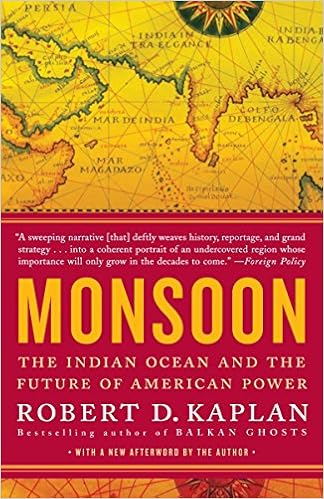
Review and Analysis Monsoon: The Indian Ocean and the Future of American Power


Monsoon: The Indian Ocean and the Future of American Power

By:  Robert D Kaplan

Published in 2010

Resultado de imagen para monsoon the future of the indian
Why I Got This Book:
I actually got this book by mistake, I really wanted to acquire another one of Kaplan's books called the Asian Caldron, which I saw a review for in one of the Caspian's Reports youtube channel. The question is that I also enjoyed this publication a lot because it is also about geopolitics but instead of focusing on the south china sea, it centers on the Indian Ocean.

Central Thymes:
•    One of the main themes of the book proposed by the author it how the Indian Ocean has been historically interconnected thanks to the predictability of the Monsoon winds.
•    Many of the Muslim country to the East of the Indian Ocean are more moderate or more tolerant to other faith because Islam here mostly expanded to this region because of trade a not by the sword and conquest.
•    The Indian Ocean is the center of the new Asian Century, it has 37 countries and 1/3 of the world's population.
•    Sea routes are more important the land routes the Indian Ocean has become the new silk road, 1/2 of all container traffic cross the Indian Ocean every year, one must add that even though this is mostly true China is heavily investing not only seaport and maritime infrastructure they are also creating a new land route silk road to Europe.  China is really preparing the terrain in becoming the new worlds super power. And even though the book does not discuss the One Belt One Road initiative, you can see its genesis in this book. China investing heavily in ports and infrastructure all over the region for example in Pakistan and Srilanka.
•    The author explains how Oman  a true melting pot culture, Kaplan explains that the country has a true transpolinization of people, language and customs, thanks to historic trade across de Indian Ocean, it is literally a sea born nation that looks to the sea to interact and has a very little developed hinterland with tribal conflicts. The country has strong ties with Iran, but it has been a stable and pro-western State. Oman is an important geopolitical player because of its control of the Gulf of Hormuz.
•    India as a country has no interest in exporting democracy and has no issues working with questionable regimes.
•    Kaplan criticizes the United State foreign policy always fixating on the projection of Western Democracy as the center of its worldview and requirement for working together with other countries, this leads to the US not being able to engage correctly in the Indian ocean and loses an important geopolitical position to other important actors like China and India. The author affirms some societies organize themselves differently or have their own take on democracy and the United State must learn how to respect this to be able to interact with these countries. But  Kaplan seems to forget US's relations ship with Pakistan which as a country is far from being a beacon of democracy in this part of the world. Also, the book is critical on how the US  takes little effort in trying to understand the reality of each country in the region especially Bangladesh or Srilanka.
•    Gujarat is a State in India that has a real potential for religious violence between Hindus and Muslims, even though interaction between both communities in everyday life is an necessity, but as of late relations have become strand and both sides have started to segregate themselves.  With Muslims being alienated more and more, possibly pushing people into fundamentalist hands, Kaplan affirms that India has more to lose dealing with Islamic Terrorism than any other State in the region.
•    Narendra Modi is the face of Hindu nationalism which is a growing force in India, which is polarizing communities and fueling the ever-growing segregation. The RSS is the principal political party behind this resurgence. Modern  Hindu nationalism is characterized for taking hold in the professional class, with a deliberate  revision of history sweeping any positive aspect of Islam in India's history under the rug, trying to build a new Indian  identity. Modi's political views are anti-democratic, grassroots, more complex than a standard fascist movement but is fuelled by the commonality of being and anti-movement. It defines itself by the thing  it stands against. He has an obsession with virility, with action over reason, love for the collective group, hatred for the individual. 
•    Gujarat is the Indian  Mecca for international investment, and this part of India has a strong tradition of projecting itself to the Indian Ocean. Gujaratis are one of the most important migrant group from India with a large footprint not only in the Indian ocean but also around the world especially in the United States.
•    India and China are at the same time bitter rivals and allies in the region, each political move that Resultado de imagen para Robert D Kaplanthe other does.
•    Climate change affecting the Monson  which is hitting pretty hard Bangladesh, and the rising ocean levels have the potential of producing a total ecological and humanitarian disaster. The already invading seas water is destroying many  crops that the country depends on. Leading people losing their livelihoods which pushes them to migrate to the cities where they cannot find a decent job, making these people easy picking for Wahabist recruiters that are growing in this relatively moderate Muslim country. NGOs fill the void for the lack of State presence in Bangladesh , politics in the country is communal and bottom up, the people organize them solve to fix the overwhelming problems.
•    China has a special interest for Srilanka, investing heavily in infrastructure and logistics. Also China is interested in projecting soft power while the US is taking away financial assistance to the nation over human right issues, and has basically ignored the island for more than 10 years and China was happy to fill the void. China has block any resolution against Srilanka in the UN security council, it has trained it military officers. This is a persistent theme in the book the void that the US has left in the region is being quickly filled by China and India. China's help to the countries in the Indian Ocean with no lectures about human rights, focusing on their projection in the region and a new status quo that favors there interest as a country. The Bambo curtain has fallen over this region and with Obama's government tried to correct this with weak results. The United State obsession with the war on terror, hunting down al-Qaida lead to the US not having a proper plan to work with the countries of the Indian Ocean.
•    The Tsunami in Indonesia had deep religious and political effects on this nation, Islam made a big push in the country in the aftermath of the disaster, with a strong Anti-Western sentiment. But it is not have a conservative Muslim population, they are more liberal in general much is left to personal interpretation, Islam coexist with Hinduism and Buddhism in relative peace. 
•    Kaplan establishes an interesting position explaining that religion interacts with nature, in the case of fundamentalist capitalize on environmental contingencies and demographic stresses.  Now fundamentalist Islam raises many political question  which it offers no answers only faith and the prophet, this form of political Islam  is fueled by rage and anarchy.
•    Muslims in the middle east are obsessed with their glorious past, producing certain disconnect and alienation with the rest of the Islamic world.
•    Empires most of the time are no born on purpose, States become strong and development needs and counter-intuitively new insecurities  which lead to them having to expand, but in the case of China in their growth has leaned on soft power for a long time with an invasion of Chinese migrants spilling all over the Indian Oceans, boom of trade and comers and major investment in infrastructure. And China's rise is benefiting Arab economies.
•    Portugal was the first European power to operate in the Indian Ocean , so for many of the countries of the region they were their   first contact with  European society, which left a sour taste in the mouths because the Portuguese hacked, slash and pillaged  every time they could. Kaplan explains that the Portuguese at this time had a crusader type of mentality the more Muslims they killed the better they were hardcore fanatic Catholics.

What I liked :
•    Each chapter is structured, ecovering a country, region or city, diving into its history and explaining its geopolitical importance in modern times.
•    Learned a lot about important historical events that I was not familiar with, especial some particular aspects of colonialism in the Indian Ocean, the book digs deep into this subject.
•    In some chapters, Kaplan focuses on certain historical figures or on contemporary political figures
•    Kaplan makes a very interesting point about Arabs, in how the west defines them as desert people that lived by the sword but must not forget that that spread around the area of the Indian Ocean expanding very quick thanks to their seafaring skills and trade.
•    The author defines Pakistan as an artificial State that has nuclear capabilities, something like a Nuclear Yugoslavia. I never thought of this country in this way and it actually sent chills up my spine, Pakistan as a State can never fail, but politically the State has never been able to bring it people together with a common identity. later Kaplan explains that Indian fear Pakistan but it dreads it collapse even more.
•    I had no ideas or didn't remember the riots on Gujarat from 2002 which ended  with 1044 people dead and 223 people missing, but blew me away is that book implied in the book the that  Narendra Modi that was the chief of Gujarat  actual Prime Minister of India actually set up the whole situation that would end up in the Riots and the police where complicit during the whole, the justice system did not push for justice. The two things that I found fascinating is still the level of tension up until this day between the Muslim and Hindu communities, but the most interesting is to see how Modi who seemingly has blood on his had from this incident was able to become the Prime Minister and when he took office and  I remember it was a big deal he actually had a big event in Madison Square Garden the first time he visited the United States as head of State. Kaplan mentions that Modi never apologized or expressed regret becoming a hero for the Hindu nationalist.
•    Since Islamic terrorism did not affect Burma the United States during the 2000's never showed interest in this country or in the struggle of the Rohinja refugees.
•    I learned more about the colonial past of the Indian Ocean especially the role of the English, Dutch, and Portuguese. Now the book presents the Portuguese as a highly destructive force in the region but the Dutch were the worst.
•    Kaplan makes a very interesting affirmation that Pirates are a singe of prosperity, parasites that thrives when trade is flourishing like it is in the Indian Ocean, especial those who are established in Puntland Somalia.
   
What I didn't like or Debatable Stuff:
•    The author establishes that individuals can play a fundamental role in history and on some chapter he focuses on a major political actor of each region. From what I know from history this is a very hot topic if individuals are fundamental actors or not.
•    Some chapters of this book are too long.


Verdict: 8/10 if history and Geopolitics are your thing this book is great.